Quick Puzzle Activities For Classroom Engagement
Enhance classroom learning with quick puzzle activities that boost focus, creativity, and problem-solving skills for students of all ages.
Mar 27, 20251.6K Shares62.7K Views

Incorporating puzzle activities into classroom routines offers numerous benefits for students. Puzzles are not just fun; they play a vital role in enhancing learning experiences. By engaging students in solving problems, puzzles help develop critical thinking and boost problem-solving skills. Additionally, they capture students' attention, making learning more interactive and enjoyable.
Teachers should consider adding quick puzzle activities to their daily plans. These activities are easy to implement and require minimal preparation. They can be used as warm-up exercises, transition activities, or quick breaks during lessons. Integrating such puzzles can lead to improved focus and better retention of information among students.
Benefits of Quick Puzzle Activities
- Enhance Learning:Puzzles encourage active participation, helping students grasp concepts more effectively.
- Develop Problem-Solving Skills:Working through puzzles challenges students to think critically and find solutions.
- Increase Student Engagement:Interactive puzzles make lessons more engaging, keeping students interested and attentive.
4 Benefits Of Using Puzzles In Classroom Activities
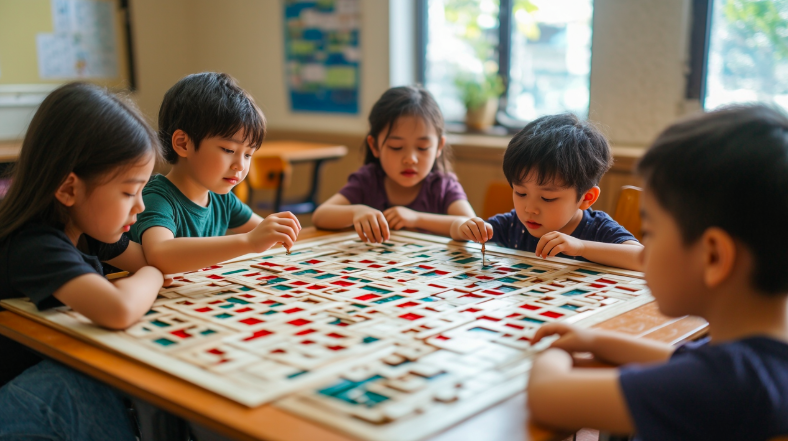
1. Stimulating Cognitive Skills
Puzzles are excellent tools for improving students' cognitive abilities. They require critical thinking, problem-solving, and logical reasoning. When students work on puzzles, they are forced to think in different ways to piece together the solution. This enhances their attention to detail and helps them improve their memory and focus. The process of figuring out the puzzle sharpens their analytical thinking and decision-making skills, which are important in both academic and real-life situations.
2. Enhancing Creativity
Using puzzles in classroom activities promotes creativity. When students approach a puzzle, they often have to think outside the box to come up with new solutions. This helps foster an environment where students feel comfortable experimenting with different ideas and strategies. Puzzles encourage students to explore multiple possibilities and develop innovative solutions, which can be useful in other subjects and in daily life.
3. Providing a Fun Learning Experience
Puzzles turn learning into an enjoyable experience. Instead of the usual routine of reading and memorizing, students engage in a more interactive and exciting way to learn. This makes the learning process less stressful and more engaging. By integrating puzzles into lessons, students remain interested and motivated, which leads to better retention of the material. The fun aspect of puzzles also encourages students to participate more actively in class.
4. Encouraging Teamwork and Collaboration
Puzzles can be an excellent way to promote teamwork and collaboration among students. When working on a puzzle, students need to communicate and share ideas with their peers. This builds collaboration skills and helps them learn how to listen, negotiate, and work towards a common goal. As students work together, they learn the importance of collective problem-solving, which is a key skill in both academic and professional settings.
7 Types Of Quick Puzzles For Classroom
Puzzles are excellent tools for enhancing learning in the classroom. They engage students, improve problem-solving skills, and make learning enjoyable. Here are some types of puzzles that can be used effectively in educational settings:
1. Word Searches
Purpose:Word searches help students improve their vocabulary and spelling skills. They also enhance pattern recognition abilities.
Suitable For:Word searches are versatile and can be used across various age groups and subjects. For younger students, simple word searches with basic words are appropriate. For older students, more complex word searches with subject-specific terms can be used.
2. Crossword Puzzles
Purpose:Crossword puzzles challenge students' knowledge and encourage critical thinking. They are excellent for reinforcing subject-specific terminology and concepts.
Suitable For:Suitable for middle and high school students, crossword puzzles can be tailored to different subjects like science, history, or literature, making them versatile for various educational levels.
3. Logic Puzzles
Purpose:Logic puzzles develop analytical thinking and problem-solving skills. They require students to apply reasoning and logic to find solutions.
Suitable For:These puzzles are ideal for middle and high school students. They can be used in subjects like mathematics and science to enhance logical reasoning abilities.
Purpose:Jigsaw puzzles improve spatial awareness, attention to detail, and teamwork skills when done in groups. They also help in understanding how individual parts form a whole.
Suitable For:Suitable for all age groups, jigsaw puzzles can be used in subjects like geography (puzzle maps) or history (historical event timelines) to make learning interactive and engaging.
Purpose:Sudoku puzzles enhance logical reasoning and concentration. They require students to fill a grid with numbers without repeating in rows, columns, or regions.
Suitable For:Ideal for middle and high school students, Sudoku puzzles are excellent for developing mathematical and logical skills.
6. Riddles
Purpose:Riddles stimulate creative thinking and problem-solving abilities. They encourage students to think outside the box.
Suitable For:Suitable for all age groups, riddles can be used as warm-up activities or as a fun way to introduce new topics.
7. Brain Teasers
Purpose:Brain teasers challenge students' thinking and improve cognitive abilities. They often involve puzzles that require lateral thinking.
Suitable For:Appropriate for high school students, brain teasers can be used to develop advanced problem-solving skills and critical thinking.
How To Integrate Quick Puzzles Into Daily Classroom Activities
1. Plan Puzzles for Warm-Ups
Starting the class with a quick puzzle can energize students and help them focus. Simple brainteasers or riddles work well as warm-ups. Teachers can present these puzzles at the beginning of the lesson for 5-10 minutes. These activities set a positive tone for the rest of the class.
Example: A math teacher could use a number puzzle where students figure out the answer to a problem before the lesson begins. This engages students’ minds and prepares them for more complex tasks ahead.
2. Use Puzzles for Quick Reviews
Puzzles can be an effective way to review previous lessons without taking much time. Teachers can use them at the end of a lesson to recap key points. By incorporating puzzles, students can recall important concepts in a fun and engaging way.
Example: After a history lesson, a teacher might use a crossword puzzle with key historical dates or terms that were covered in the class. This helps students recall what they've learned while staying engaged.
3. Integrate Puzzles as Group Tasks
Using puzzles in small groups promotes teamwork and communication. Group tasks allow students to collaborate, discuss, and share their thoughts, helping them build problem-solving skills.
Example: A science teacher can give a group of students a puzzle related to a recent experiment. They can work together to solve it, which reinforces what they've learned in class and encourages group interaction.
4. Create Time-Efficient Activities
Quick puzzles, such as matching games, word searches, or logic puzzles, can be completed in 5-10 minutes, making them a good fit for busy classrooms. These activities do not take away from lesson time but still engage students and reinforce learning.
Example: A teacher could set up a 5-minute word search related to the subject of the day. It’s short, engaging, and serves as a simple review activity that won't disrupt the lesson flow.
5. Build Puzzles into Transitions
Teachers can use puzzles during transitions between different activities or subjects. These short, easy puzzles help students stay engaged while they wait for the next activity to begin.
Example: If students are waiting for their next set of instructions or for materials to be handed out, a teacher can give them a simple puzzle to solve. This keeps students busy and transitions smoothly into the next part of the class.
Quick Puzzle Activity Ideas For Different Subjects
1. Math Puzzles with Equations
Math puzzles can be created by designing simple equations for students to solve. For example, create puzzles where students match the equation with the correct answer. You can also prepare puzzles where students fill in missing numbers to complete an equation. Another idea is to give them a set of numbers and ask them to find a way to use those numbers to form a correct equation.
2. Vocabulary-Building Word Search for Language Arts
Word search puzzles are a great tool for improving vocabulary in language arts classes. Create a word search grid with vocabulary words from the current lesson. You can make the puzzle more interesting by providing clues for each word. For example, students can find the word that describes a specific character trait or the word related to a particular theme in the lesson.
3. Science Matching Puzzles
In science, you can create matching puzzles to help students remember facts. For instance, write a list of scientific terms on one side and their definitions or corresponding images on the other side. Students have to match the term with the correct definition or image. You can also create puzzles where students match animals with their habitats or plants with their corresponding types of environments.
4. History Timeline Puzzles
In history, create puzzles that ask students to put historical events in the correct chronological order. Provide a list of events with mixed-up dates, and ask students to match them with the correct timeline. This can help reinforce their understanding of historical events and the sequence in which they happened.
5. Geography Jigsaw Puzzles
For geography, create jigsaw puzzles with maps. You can print out pieces of a map, and students must piece them together to form a full map. This activity helps with learning locations, countries, or geographical features. It’s simple to create and can be used to test their knowledge of different regions of the world.
6. Spelling and Grammar Crossword Puzzles
For language arts, create crossword puzzles that focus on spelling or grammar rules. For example, students can fill in the crossword with correct spellings or the right form of verbs based on clues. This can help students reinforce what they’ve learned while having fun.
7. Chemistry Element Matching Puzzles
In chemistry, students can play a matching game where they match the chemical elements to their symbols or atomic numbers. This puzzle can be done on paper or with online tools, making it an easy and fun activity to do with little preparation.
8. Art Puzzles for Visual Learning
For art classes, you can create puzzles that involve matching famous paintings with their artists or styles. Another idea is to create color-by-number puzzles where students learn about color theory by filling in sections of an artwork according to a color chart.
FAQs
What Are The Best Types Of Puzzles For Younger Students In The Classroom?
For younger students in the classroom, puzzles that are both fun and educational are best. Simple jigsaw puzzles with large pieces help improve hand-eye coordination and problem-solving skills. Matching games teach memory and concentration. Word searches and crossword puzzles introduce new vocabulary. These activities make learning enjoyable and support early development.
How Can Puzzles Help Improve Critical Thinking In Students?
Puzzles enhance students' critical thinking by engaging them in problem-solving, logical reasoning, and creativity. They require analyzing information, recognizing patterns, and making decisions, which are key aspects of critical thinking. Additionally, puzzles promote patience and perseverance, as students often need to try multiple solutions before finding the correct one. Incorporating puzzles into education can make learning more engaging and help develop essential cognitive skills.
Are There Any Digital Puzzle Resources Available For Teachers To Use In Class?
Yes, there are several digital puzzle resources available for teachers to use in the classroom:
- Breakout EDUoffers digital games that challenge students to solve puzzles and unlock virtual locks, promoting critical thinking and collaboration.
- Puzzel.orgallows teachers to create interactive puzzles, such as jigsaw puzzles, crosswords, and word searches, tailored to their lesson plans.
- Canvaprovides free editable templates for printable puzzles, which can be customized for classroom activities.
- Spongelab Interactiveis a science education website offering educational games, videos, and simulations to engage students in STEM subjects.
- KenKenfeatures logic-based number-placement puzzles that help develop math and problem-solving skills.
- Education World's Puzzlemakerenables teachers to create custom word searches, crosswords, and other puzzles to enhance vocabulary and subject knowledge.
- Teachers Pay Teachersoffers a variety of digital puzzle templates and activities created by educators, suitable for different grade levels.
How Can Puzzles Be Used To Assess Students' Understanding Of A Topic?
Puzzles can be effective tools for assessing students' understanding of a topic. They encourage active engagement, problem-solving, and application of knowledge. By designing puzzles that require students to use what they've learned, educators can observe how well students grasp the material. This method provides insights into students' comprehension and helps identify areas needing improvement. Incorporating puzzles into assessments offers a dynamic alternative to traditional testing, making learning both enjoyable and informative.
Can Puzzle Activities Be Modified For Students With Learning Disabilities?
Yes, puzzle activities can be adapted to support students with learning disabilities. Modifying puzzles can enhance learning by addressing specific challenges these students face. Here are some effective adaptations:
- Simplify Puzzle Design: Use puzzles with fewer pieces and clear, distinct images. This approach helps students focus and reduces potential frustration.
- Increase Contrast: Apply contrasting colors to puzzle pieces and backgrounds. For example, painting puzzle backgrounds black can make pieces more visible, aiding students with visual processing difficulties.
- Add Grasping Aids: Attach large, easy-to-grip knobs to puzzle pieces. This modification benefits students with fine motor challenges by making it easier to handle and place pieces accurately.
- Incorporate Sensory Elements: Integrate tactile or auditory features into puzzles. For instance, adding textures or sounds can engage multiple senses, supporting diverse learning needs.
- Provide Clear Orientation: Use symbols or tactile markers to indicate where each piece fits. This strategy assists students in understanding spatial relationships and enhances problem-solving skills.
- Offer Flexible Timing: Allow extended time for puzzle completion. This accommodation reduces pressure and supports students who may need more time to process and respond.
Latest Articles
Popular Articles