The Role Of Mathematical Puzzle Theory - From Recreation To Research
Mathematical puzzle theory plays multiple roles from teaching problem-solving to advancing research. Understand its contributions to education, cognition, graph theory, and complexity.
Mar 01, 2026499 Shares83.2K Views
The Mathematical Puzzle Theory In Learning And Research
Mathematical puzzles occupy a curious position in academic discourse. On one hand, they appear as recreational diversions, games played for entertainment during leisure time. On the other hand, they connect deeply to serious mathematical research, cognitive science, and educational theory.
This tension between play and scholarship has long characterized how mathematicians, educators, and researchers approach puzzles. Mathematical puzzle theory examines puzzles not merely as challenges to be solved, but as mathematical objects worthy of formal study.
The field investigates the structures, properties, and problem-solving strategies underlying puzzles, exploring how these connect to established mathematical domains like graph theory, combinatorics, and computational complexity. Beyond pure mathematics, puzzle theory contributes to understanding how humans learn, reason, and develop problem-solving abilities.
Mathematical Puzzle Theory: Key Roles
- Educational:Develops problem-solving skills, mathematical reasoning, and engagement through concrete contexts.
- Research:Contributes to graph theory, combinatorics, and computational complexity theory
- Cognitive:Models how humans develop problem-solving strategies and mathematical thinking
- Computational:Provides benchmark problems for algorithm analysis and complexity classification.
- Recreational:Makes mathematics accessible and enjoyable, inspiring future mathematicians.
Defining Mathematical Puzzle Theory
What Qualifies As A Mathematical Puzzle
A mathematical puzzle is different from a normal puzzle because it is built on mathematical rules and logic. To solve one, you need to use reasoning and find patterns rather than just guessing or using trial and error. The way the puzzle works depends on math relationships, so the act of solving it is a mathematical process.
Famous examples include Sudoku, which uses logic to fill in numbers, and the Tower of Hanoi, which teaches how numbers grow. The Rubik's Cubeis another great example because it is based on a type of math called group theory. Even if you don't realize it, you are practicing math every time you try to solve these.
The "math" part of a puzzle often shows up when you look closely at how it is built. What looks like a simple game usually has deep patterns and structures. This extra depth is what makes a mathematical puzzledifferent from a regular game that is just for fun.
Puzzles Vs. Mathematical Problems
It is important to know the difference between a puzzle and a math problem. Puzzles usually have very clear rules and a specific goal. All the information you need is given to you at the start. The challenge is simply finding the right path to the answer.
Math problems are often more open. They might have many different answers or no answer at all. In real math research, experts often have to figure out how to even ask the question before they can solve it. Some problems stay unsolved for hundreds of years because there is no clear set of steps to follow.
This difference helps us in school. Puzzles give students a safe place to practice because they know an answer exists. Math problems, on the other hand, teach students how to deal with confusion and how to think creatively when the answer isn't obvious.
The Scope Of Puzzle Theory
Mathematical puzzle theory looks at several different topics. It studies how puzzles are built and groups them by their mathematical properties. It also looks for general strategies that people can use to solve many different kinds of puzzles, rather than just learning one specific trick.
The field also studies how hard it is for a computer to solve a puzzle. Some puzzles are so complex that there is no fast way for a computer to find the answer. This links fun games to serious questions in computer science about the limits of technology.
Finally, puzzle theory looks at how we can use games to teach. It studies how humans think while they solve puzzles and which math ideas are easiest to learn through play. These different views together make up the study of puzzle theory.
Historical Development Of Puzzle Theory

A Brief History of Puzzles: Unlocking the Mystery
From Recreational Curiosity To Academic Field
People have played math puzzles for thousands of years in places like ancient China, Greece, and India. However, they were only recently treated as a serious subject to study. For a long time, experts thought puzzles were just for fun and didn't belong in serious math books.
Things changed when people saw that puzzles could lead to big discoveries. In 1736, a man named Leonhard Euler solved a puzzle about crossing seven bridges in a city called Königsberg. By solving this "fun" problem, he actually started a whole new branch of math called graph theory.
In the 1900s, people began to see that puzzles were very useful. Teachers started using them to help students learn. At the same time, computer scientists realized that understanding how puzzles work helped them understand how computers process information. This moved puzzle theory from a hobby to a real science.
Key Figures And Foundational Work
Many famous people helped make puzzle theory a real science. Along with Euler, Lewis Carroll (the author of Alice in Wonderland) created puzzles about logic. In the early 1900s, Sam Loyd and Henry Dudeney made math puzzles popular with the public, showing that they could be both smart and fun.
Later, experts like Claude Shannon and John Conway showed that puzzles could explain how computers and complex systems work. Their research proved that studying games could reveal important truths about how the world is organized. They built a bridge between playing for fun and doing serious research.
Paul Erdős, one of the most famous mathematicians ever, spent a lot of time on problems that felt like puzzles. He showed that there isn't a big gap between "fun" math and "serious" math. To him, the most important thing was whether a problem revealed interesting secrets about numbers.
Martin Gardner And The Popularization Of Mathematical Puzzles
Martin Gardneris the person most responsible for making people take math puzzles seriously. He wrote a famous column in Scientific Americanfor 25 years. He reached millions of people and showed them that math could be exciting and accessible without being too simple.
Gardner influenced many people to become scientists and mathematicians. He introduced big ideas, like codes and complex patterns, to regular people long before they were famous in universities. He made math feel like an adventure.
Because he was so respected, real math experts began to join in. They would help with his column and solve the puzzles he shared. This helped prove that puzzles were not just "kids' stuff," but were actually very important to the world of science.
The Educational Role Of Mathematical Puzzles
Engaging Students With Mathematics
Math puzzles are a great way to introduce hard ideas. Many students who are scared of regular math class find puzzles very exciting. Because puzzles feel like games, they help reduce stress while still teaching the same important lessons.
Puzzles make people want to learn because they are curious about the answer. When you solve a puzzle, you feel good right away. This feeling helps students keep trying even when things get difficult, which builds the patience they need for other subjects.
This interest often lasts a long time. Students who enjoy puzzles usually look for harder ones to solve on their own. They start to see themselves as people who are "good at math," which is very important for their success in school and later in life.
Developing Mathematical Thinking And Reasoning
Puzzles teach students how to think like experts. They learn how to look for patterns and how to break a big, scary problem into small, easy steps. This is exactly what professional mathematicians do, so puzzles are a great way to practice for a real career.
Solving puzzles also builds skills that can be used in many other areas. Students learn how to test an idea, realize when it isn't working, and try something new. They develop a "gut feeling" for how to solve problems, which is often more useful than just memorizing facts from a book.
Finally, puzzles show that math is about being creative. There isn't always just one way to get to the answer. This changes how students see math; they stop seeing it as a list of boring rules and start seeing it as a way to explore and discover new things.
Puzzle-Based Learning Pedagogy
Educational frameworks built around mathematical puzzles structure learning to maximize puzzle benefits while ensuring coverage of necessary mathematical content. Puzzle-based learning doesn't mean random puzzle solving but deliberate selection and sequencing of puzzles that introduce, practice, and extend specific mathematical concepts.
Effective puzzle-based pedagogy connects puzzle experiences to formal mathematics explicitly. Students might enjoy solving a puzzle, but educational value increases when teachers help them recognize the underlying mathematical structures and generalize strategies. The bridge from concrete puzzle to abstract concept requires careful instructional design.
Key pedagogical principles:
- Select puzzles aligned with learning objectives
- Encourage multiple solution approaches and sharing strategies
- Facilitate discussions connecting puzzles to formal mathematical concepts
- Progress from simple to complex puzzles within domains
- Balance individual puzzle solving with collaborative exploration
- Use puzzles as contexts for introducing new concepts, not just practice
Limitations And Criticisms Of Puzzle-Based Education
Despite benefits, puzzle-based education faces legitimate criticisms. Some students enjoy puzzles without transferring skills to other mathematical contexts. The engaging surface can distract from deeper learning if puzzle solving remains isolated from formal mathematical concepts. Without explicit connections, students may develop puzzle-specific tricks rather than generalizable mathematical understanding.
Puzzles also risk reinforcing fixed mindsets if framed as tests of inherent ability. Students who struggle may conclude they "aren't puzzle people" and, by extension, aren't mathematical people. The competitive element some puzzles encourage can increase anxiety rather than reducing it. Careful framing and support help students view puzzles as learning opportunities rather than ability assessments.
Over-reliance on puzzles may leave gaps in mathematical knowledge. Not all mathematical concepts translate naturally into puzzle formats. Computational fluency, formal proof techniques, and procedural skills require additional instructional approaches. Puzzles work best as part of varied instructional methods rather than comprehensive curriculum foundations.
Cognitive Science And Problem-Solving Development
How Puzzles Model Human Problem-Solving
Puzzles provide controlled environments for studying how humans approach novel problems, develop strategies, and learn from experience. Cognitive scientists use puzzles as experimental tasks because they're well-defined, reproducible, and can be systematically varied in difficulty and structure. This makes them valuable tools for understanding problem-solving mechanisms.
Research using puzzles has revealed how humans employ heuristics, mental shortcuts that usually work efficiently, though not guaranteed to succeed. Studies of puzzle solving show how people recognize patterns, analogize to previous experiences, and build mental models of problem spaces. These insights extend beyond puzzles to understanding human cognition more broadly.
The constraint satisfaction inherent in many puzzle models real-world cognitive tasks, from scheduling to design. Understanding how humans navigate puzzle constraints illuminates how we handle complex decision-making in situations with multiple competing requirements. Puzzle performance correlates with measures of working memory, executive function, and fluid intelligence, suggesting puzzles engage core cognitive processes.
Cognitive Skills Developed Through Puzzle Solving
Regular puzzle engagement develops specific cognitive abilities measurable through assessment. Working memory improves through holding multiple puzzle elements and relationships in mind simultaneously. Attention to detail increases as puzzles require noticing subtle patterns and avoiding careless errors. Planning and foresight develop through anticipating the consequences of moves or solution steps.
Spatial reasoning is strengthened through geometric and mechanical puzzles requiring mental rotation, visualization, and spatial transformation. Logical reasoning sharpens through deduction-based puzzles requiring systematic elimination and inference. Flexibility in thinking emerges from trying multiple approaches when initial strategies fail.
Cognitive skills enhanced:
- Working memory capacity and management
- Pattern recognition and classification
- Logical deduction and inference
- Spatial visualization and transformation
- Strategic planning and foresight
- Hypothesis formation and testing
- Mental flexibility and strategy shifting
- Attention to detail and systematic checking
Pattern Recognition And Abstract Thinking
Mathematical puzzles train pattern recognition, the ability to identify regularities, structures, and relationships within information. This skill underlies much mathematical thinking and extends to scientific reasoning, programming, and analytical tasks across domains. Puzzle solving provides abundant pattern recognition practice within engaging contexts.
Abstract thinking develops as solvers move from concrete puzzle instances to general principles. Recognizing that a strategy working on one puzzle applies to an entire class requires abstraction. This generalization from specific to general mirrors how mathematical concepts develop from concrete examples to abstract theorems. Puzzles provide accessible contexts for practicing this fundamental cognitive transition.
The shift from trial-and-error to systematic reasoning represents another cognitive development puzzles facilitate. Beginners often approach puzzles through random attempts, while experienced solvers develop principled approaches based on understanding puzzle structure. This progression from heuristic to algorithmic thinking parallels expertise development across many domains.
Transfer Of Skills To Other Domains
Whether puzzle-developed skills transfer to other contexts remains debated. Some research shows limited transfer, with puzzle solving improving only at similar puzzles rather than general problem-solving ability. Other studies suggest transfer occurs when puzzle solving emphasizes generalizable strategies and explicitly connects to other domains.
The transfer question matters for educational applications. If puzzle skills remain puzzle-specific, their educational value diminishes. Evidence suggests transfer depends heavily on how puzzles are taught and framed. Explicit instruction in strategies, discussion of underlying principles, and guided application to new contexts all enhance transfer.
Most researchers now conclude that transfer isn't automatic but can be facilitated. Puzzles provide valuable cognitive training, but maximizing benefit requires intentional pedagogical design connecting puzzle experiences to broader mathematical and problem-solving contexts. The puzzles themselves don't guarantee transfer; how they're used determines educational outcomes.
Contributions To Mathematical Research
Connections To Graph Theory And Combinatorics
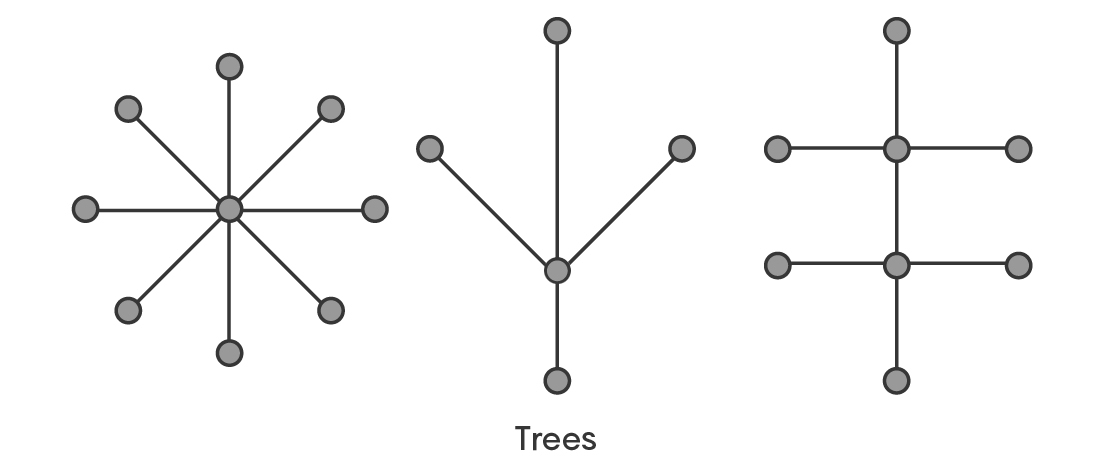
Many mathematical puzzles connect deeply to graph theory, the study of networks of vertices and edges. The Königsberg bridge problem, which founded graph theory, asked whether a path existed traversing each bridge once, fundamentally a graph connectivity question. Puzzle solutions often translate into graph algorithms, while graph theoretical concepts illuminate puzzle structures.
Combinatorics, studying discrete structures and counting problems, provides frameworks for analyzing puzzles involving arrangements, selections, and configurations. Puzzles often ask for the number of solutions, optimal solutions, or whether solutions exist under constraints, precisely the questions combinatorics addresses. Research in combinatorics draws examples and motivation from puzzles while providing tools for solving them.
The relationship flows in both directions. Puzzles motivate mathematical investigation, suggesting questions worth formalizing and analyzing rigorously. Simultaneously, mathematical tools developed for other purposes prove valuable for understanding puzzles. This reciprocal relationship enriches both recreational puzzles and formal mathematics.
Discrete Mathematics And Puzzle Structures
Discrete mathematics, dealing with countable rather than continuous structures, encompasses much puzzle theory. Integer solutions, finite sets, logical conditions, and discrete optimization characterize both discrete mathematics and mathematical puzzles. The alignment makes puzzles natural examples and exercises in discrete mathematics courses.
Graph coloring, satisfiability, scheduling, and optimization problems studied in discrete mathematics appear naturally in puzzle contexts. Sudoku exemplifies constraint satisfaction problems. Logic grid puzzles demonstrate satisfiability concepts. Arrangement puzzles explore permutations and combinations. These connections make puzzles valuable for teaching discrete mathematics concepts.
Research questions in discrete mathematics often resemble puzzle questions in form. Can a structure satisfying certain properties be constructed? What's the minimum or maximum of some quantity under constraints? How many ways can something be arranged? The similarity between research problems and puzzles isn't coincidental but reflects shared mathematical foundations.
Puzzles That Generated New Mathematical Questions
Some recreational puzzles sparked significant mathematical investigation. The Four Color Theorem, stating that any map can be colored with four colors so that adjacent regions differ, began as a maa pmaker's puzzle. Proving it required developing new techniques in graph theory and becoming the first major theorem proved with computer assistance.
Conway's Game of Life, though not a puzzle in the traditional sense, generated extensive research in cellular automata, complexity theory, and artificial life. What began as a recreational mathematical game revealed deep questions about self-organization, computation, and emergent behavior. Entire research fields trace origins to this deceptively simple system.
The study of tilings and tessellations, motivated partly by puzzle interest in covering planes with shapes, led to the discovery of Penrose tilings and quasicrystals, bridging recreational mathematics to materials science. These examples demonstrate how recreational puzzles can pose questions that, when investigated rigorously, generate substantial mathematical knowledge.
Computational Complexity And Computer Science
NP-Complete Puzzles And Computational Difficulty
Computational complexity theory classifies problems by how their difficulty scales as problem size increases. Some puzzles are proven NP-complete, a class of problems for which no known efficient algorithm exists; finding one would solve thousands of other important problems. This connection makes puzzle analysis relevant to fundamental computer science questions.
Sudoku, Minesweeper, and many other popular puzzles are NP-complete, meaning that while checking a proposed solution is quick, finding solutions becomes exponentially harder as puzzle size increases. This explains why larger Sudoku puzzles feel dramatically harder than small ones. The exponential growth means even powerful computers struggle with sufficiently large instances.
Understanding which puzzles are NP-complete reveals fundamental computational limits. It shows that difficulty isn't just about current technology or clever programming but reflects inherent mathematical structure. Recreational puzzles thus provide accessible examples of deep computational complexity principles, demonstrating that some problems are intrinsically hard.
Constraint Satisfaction Problems
Many puzzles exemplify constraint satisfaction problems, where solutions must satisfy multiple simultaneous requirements. Sudoku requires each row, column, and box to contain digits 1 through 9 without repetition. This constraint structure appears throughout computer science in scheduling, resource allocation, and planning problems.
Studying puzzle-based constraint satisfaction problems informs algorithm development for practical applications. Techniques like backtracking, constraint propagation, and heuristic search developed for solving puzzles apply to engineering, logistics, and artificial intelligence challenges. The clean structure of puzzles makes them ideal test cases for developing and evaluating constraint-solving approaches.
The relationship benefits both puzzle solving and practical problem solving. Algorithms developed for real-world applications often apply to puzzles, while puzzle-solving techniques inspire approaches for practical problems. This reciprocal exchange makes puzzle theory valuable beyond recreational interest.
Puzzles As Algorithm Benchmarks
Computer scientists use puzzles as benchmark problems for testing algorithms and comparing approaches. The well-defined nature of puzzles makes them reproducible test cases where performance can be measured objectively. Puzzle collections provide diverse difficulty levels for evaluating how algorithms scale and where they struggle.
Classic puzzles like the Traveling Salesman Problem, Eight Queens, and Tower of Hanoi appear frequently in algorithm textbooks as examples illustrating different algorithmic techniques. Students learning algorithms practice on puzzles before applying techniques to less structured real-world problems. The progression from puzzle to application helps build algorithmic thinking.
Competitions in combinatorial optimization and artificial intelligence often feature puzzle-solving challenges. These competitions drive algorithm development as researchers compete to solve puzzles faster or more efficiently. While framed as games, the techniques developed often transfer to practical computational problems.
Artificial Intelligence And Puzzle Solving
Early artificial intelligence research focused heavily on puzzle and game playing as test domains for intelligent systems. Puzzles provided well-defined problems where success could be measured clearly, making them attractive for AI development. Early successes in game playing demonstrated AI potential and motivated further research.
Modern AI still uses puzzles for developing and testing approaches. Machine learning systems train on puzzles to develop problem-solving abilities. Puzzles test whether AI can generalize from examples, recognize patterns, and develop strategies without explicit programming. Progress on puzzle-solving benchmarks indicates advances in AI capabilities.
The relationship reveals interesting parallels between human and artificial intelligence. Puzzles that humans find easy may challenge AI systems, while puzzles humans struggle with may yield quickly to computational approaches. These differences illuminate what makes human intelligence distinctive and inform both cognitive science and AI research.
Types And Categories Of Mathematical Puzzles
Combinatorial And Logic Puzzles
This new type of logic puzzle is wildly fun
Combinatorial puzzles involve arranging, selecting, or counting discrete objects under constraints. These puzzles connect directly to combinatorics and often require systematic enumeration or clever counting arguments. Examples include arrangement puzzles, covering problems, and configuration challenges where objects must be placed according to rules.
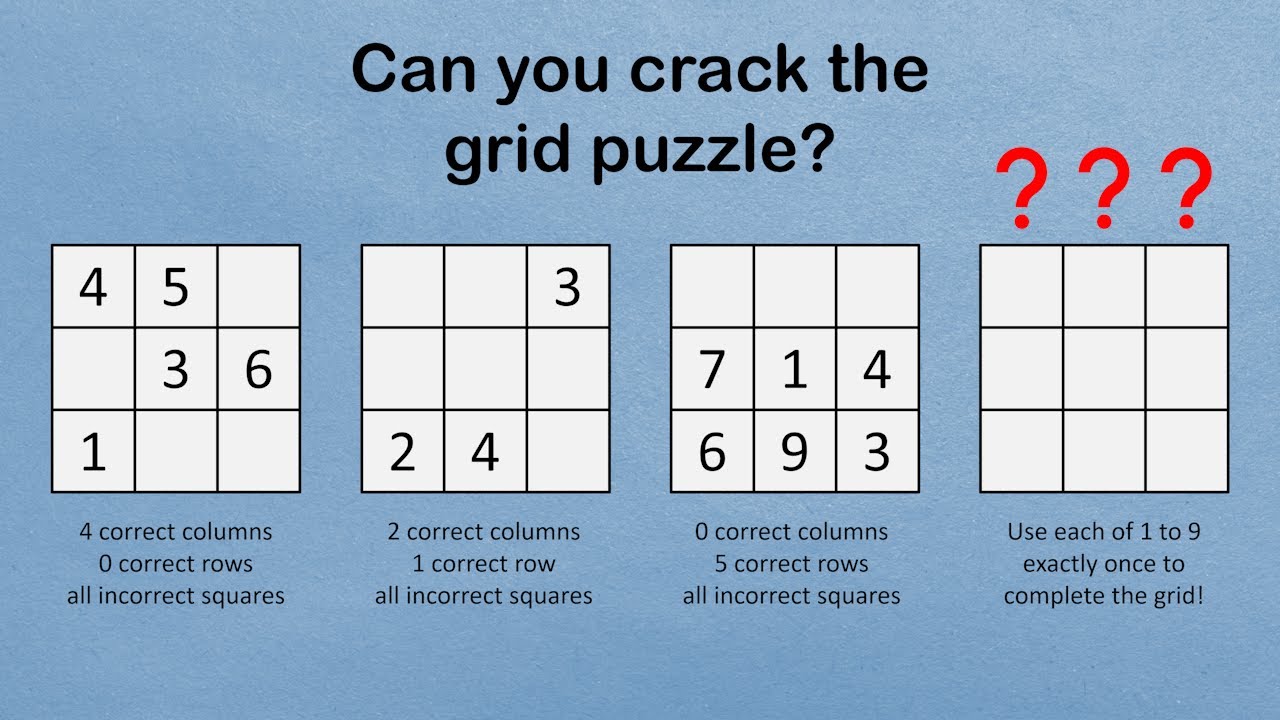
Logic puzzles require deductive reasoning to determine solutions from given clues. Grid-based logic puzzles provide information about relationships and require solvers to deduce configurations satisfying all constraints. These puzzles develop systematic logical thinking and teach how to track multiple implications simultaneously.
Common types:
- Grid logic puzzles requiring constraint deduction
- Arrangement puzzles involving permutations or combinations
- Covering and packing problems with geometric or numerical objects
- Matching puzzles p, pairing elements according to rules
- Elimination puzzles using clues to narrow possibilities
Geometric And Spatial Puzzles
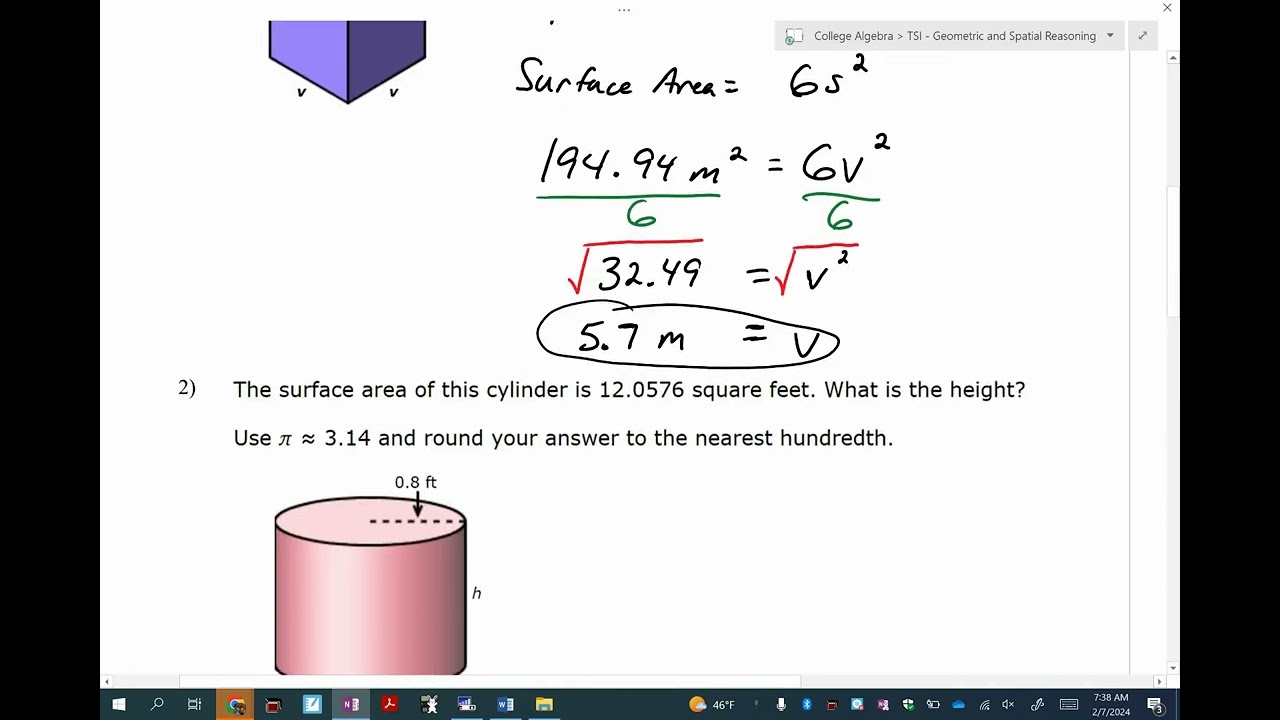
G.S.R. #1 - Surface area of prisms and cylinders
Geometric puzzles involve shapes, spatial relationships, and transformations. These range from simple tangram arrangements to complex three-dimensional mechanical puzzles. Solving requires spatial visualization, mental rotation, and understanding geometric properties and transformations.
Dissection puzzles challenge solvers to cut shapes into pieces that rearrange into different shapes, exploring area conservation and geometric transformations. Folding puzzles investigate what three-dimensional forms can be created from two-dimensional patterns. These puzzles develop spatial reasoning valuable in fields from architecture to engineering.
Mechanical puzzles like the Rubik's Cube combine geometric constraints with group theory and permutation mathematics. Understanding why certain move sequences work requires grasping how transformations combine and how group structure constrains possible configurations. These puzzles blend hands-on manipulation with abstract mathematical reasoning.
Number And Arithmetic Puzzles
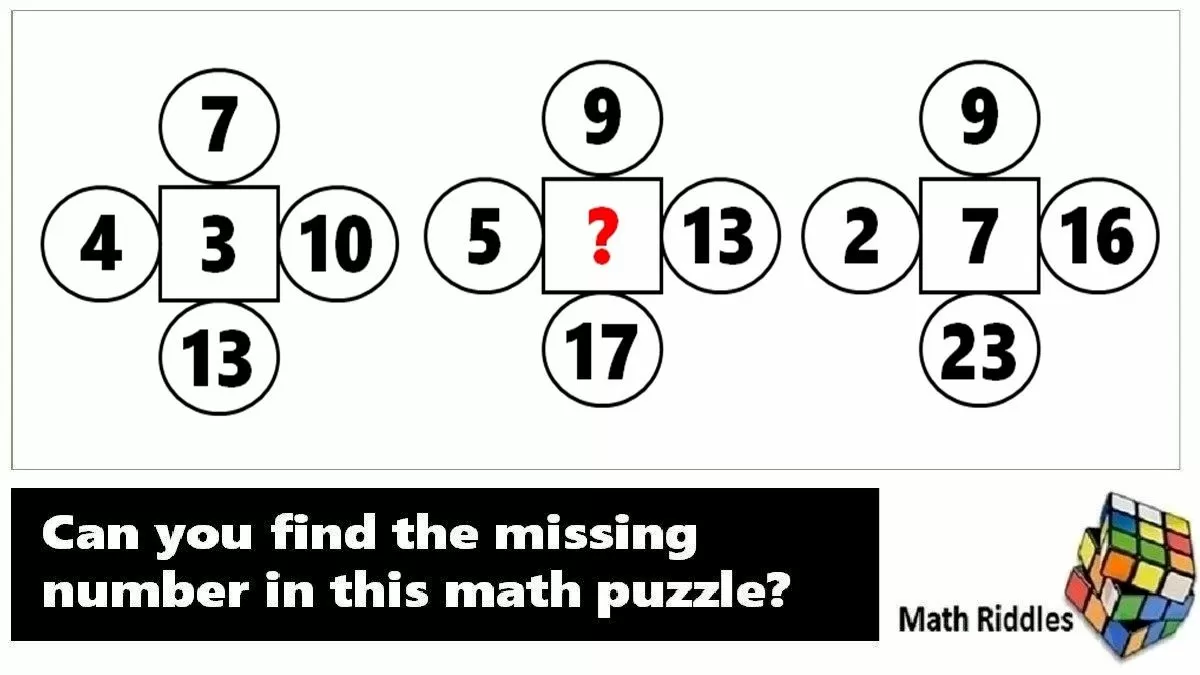
Number puzzles explore properties of integers, arithmetic operations, and numerical relationships. These include magic squares where rows, columns, and diagonals sum to the same value; cryptarithmetic w, where digits are replaced by letters in arithmetic problems; and divisibility puzzles exploiting number theory properties.
Arithmetic puzzles teach number sense and computational strategies while requiring logical reasoning. Solvers must understand how operations affect numbers and use constraints to narrow possibilities. These puzzles demonstrate that arithmetic involves reasoning and pattern recognition, not just mechanical calculation, or the rote memorization of a multiplication table.
Many number puzzles connect to deeper number theory concepts. Exploring why certain patterns work reveals properties of integers, modular arithmetic, and algebraic structures. What begins as recreational number play can lead to substantial mathematical insights about numerical properties and relationships.
Graph And Network Puzzles

Graph Puzzles
Graph puzzles involve navigating or arranging networks of connected points. Classic examples include path-finding puzzles where routes must visit locations under constraints, or coloring problems where vertices receive colors subject to adjacency requirements. These puzzles directly model graph theory concepts.
The Königsberg bridge problem, asking whether a path existed crossing seven bridges each exactly once, founded graph theory as a mathematical field. Similar Eulerian path problems continue appearing in puzzles requiring routes traversing edges or visiting vertices according to specific rules. Understanding graph concepts illuminates puzzle structure.
Network flow puzzles, where resources move through networks subject to capacity constraints, model real-world logistics and distribution problems. Solving these puzzles requires understanding how local constraints affect global possibilities, developing intuition valuable for network analysis across many applications.
Famous Examples And Case Studies
Tower Of Hanoi And Recursive Thinking
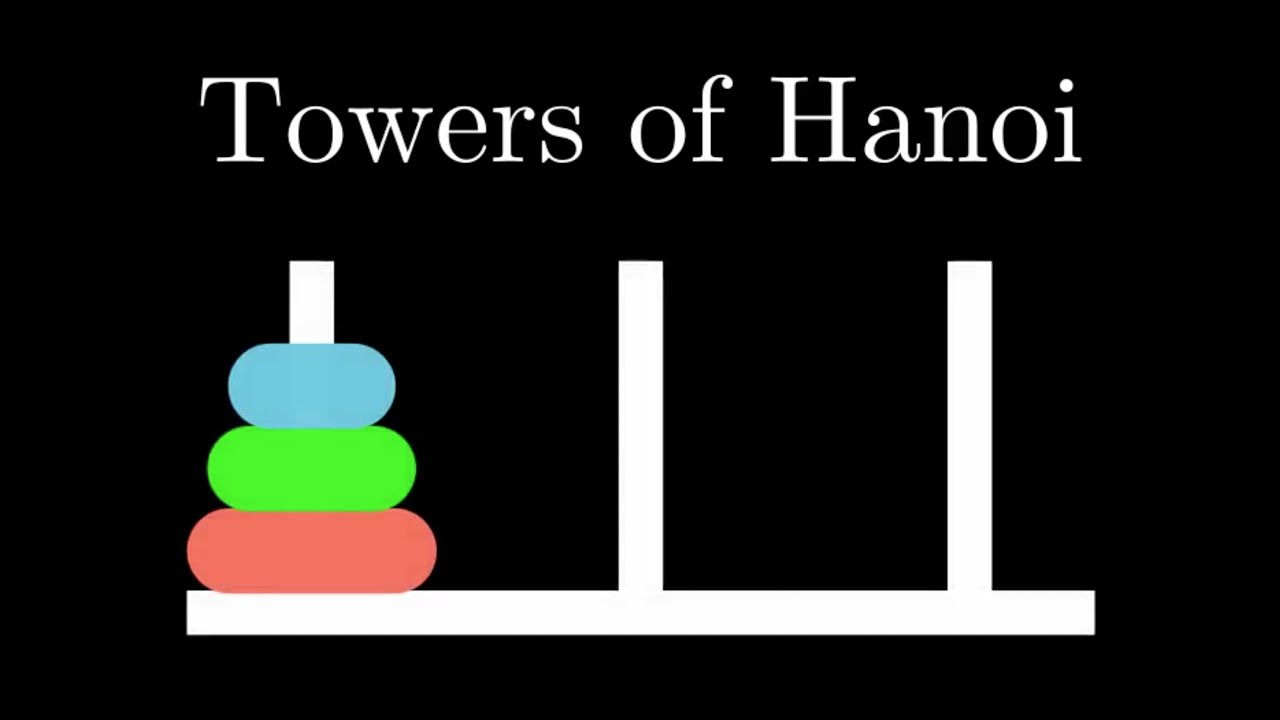
Towers of Hanoi: A Complete Recursive Visualization
The Tower of Hanoi puzzle demonstrates recursive thinking and exponential growth. The puzzle involves moving a stack of disks from one peg to another using a spare peg, with larger disks never resting on smaller ones. The solution naturally breaks into recursive steps, making it ideal for teaching recursion.
The mathematical structure reveals elegant properties. The minimum number of moves required equals 2 to the power n minus 1, where n represents the dithe sk count. This exponential growth means adding one disk doubles the required moves plus one, quickly becoming impractical for computers to solve by brute force with many disks.
Beyond teaching recursion, the Tower of Hanoi models problems requiring sequential steps where later stages depend on earlier setup. The puzzle appears in algorithm courses, cognitive science studies of problem-solving, and discussions of computational complexity. Its simple rules hide surprising mathematical depth.
Rubik's Cube And Group Theory
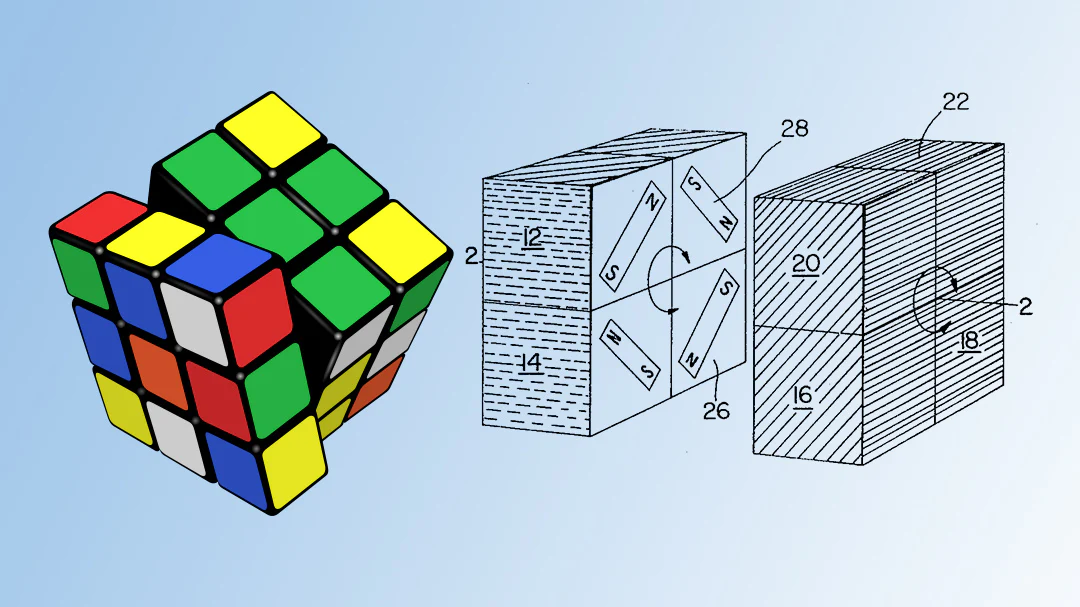
The Rubik's Cube connects recreational puzzles to abstract algebra through group theory. The cube's possible positions form a mathematical group under the operation of applying moves. Understanding this group structure explains why certain move sequences work and why the cube can always be solved.
Group theory provides powerful tools for analyzing the cube. The cube has over 43 quintillion possible positions, yet group theory shows any position can be solved in 20 moves or fewer, proven in 2010 using both theoretical analysis and extensive computation. This "God's number" demonstrates how pure mathematics illuminates puzzle properties.
The cube's popularity sparked mathematical investigation into similar puzzles and their group-theoretic properties. Research on cube variations explores how puzzle structure relates to underlying algebraic structure, bridging recreational interest and abstract algebra in ways that make both more accessible and interesting.
Sudoku And Constraint Satisfaction
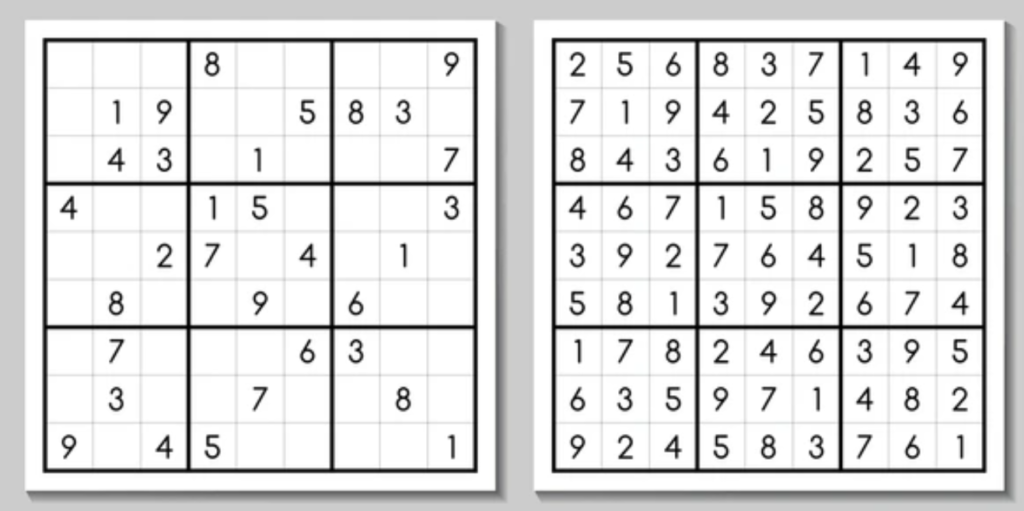
Sudoku exemplifies constraint satisfaction problems where solutions must simultaneously satisfy multiple requirements. Each row, column, and box must contain digits 1 through 9 exactly once. Solving requires systematically applying constraints to eliminate possibilities until solutions emerge.
The puzzle's computational complexity is well-studied. Sudoku is NP-complete, meaning no efficient general algorithm exists for finding solutions. Yet humans solve Sudoku through pattern recognition and logical deduction, demonstrating how heuristic approaches can effectively tackle computationally hard problems in practice.
Sudoku variants explore how changing constraints affects difficulty and properties. Research investigates minimum clue requirements for unique solutions, how symmetry affects solving, and what makes some puzzles harder than others despite having similar structures. These questions blend recreational puzzle interest with mathematical investigation.
The Königsberg Bridge Problem
How the Königsberg bridge problem changed mathematics - Dan Van der Vieren
Euler's 1736 analysis of whether a path could cross Königsberg's seven bridges each exactly once marks the founding of graph theory and topology. Euler proved no such path existed by abstracting the problem to a graph where land masses became vertices and bridges became edges, then analyzing vertex degree properties.
This problem demonstrates how recreational questions can generate new mathematical fields. Euler's abstraction revealed that the specific geography mattered less than the connectivity pattern, a key insight in thinking mathematically about networks. The question was simple, but the solution required inventing new mathematical concepts.
The Königsberg problem shows puzzle theory's potential for generating mathematical knowledge. What began as a recreational challenge became a foundational example in graph theory, taught in courses worldwide. The progression from puzzle to research to educational example illustrates how recreational mathematics feeds into formal mathematics.
Criticisms And Limitations Of Puzzle Theory
The Recreation Vs. Research Debate
The academic status of puzzle theory remains contested. Traditional mathematics often views puzzles as frivolous distractions from serious research, suitable for recreation but not scholarly pursuit. This perspective holds that while puzzles may accidentally touch on interesting mathematics, they don't constitute a legitimate research focus.
Defenders argue this distinction is arbitrary and counterproductive. Many significant mathematical results emerged from recreational questions, and dismissing puzzles as unserious ignores their contributions. The historical record shows recreational mathematics generating research questions, pedagogical tools, and public engagement with mathematics.
The debate reflects tension between pure and applied mathematics, between abstract theory and concrete problems, between elite academic mathematics and public mathematical culture. Puzzle theory challenges boundaries by operating across these divides, making some mathematicians uncomfortable while exciting others about mathematics' broader relevance.
When Puzzles Don't Transfer To Mathematical Ability
Critics note that puzzle-solving ability doesn't automatically transfer to general mathematical competence. Students who excel at puzzles may struggle with formal proof-writing, abstract reasoning, or theoretical mathematics. The engaging surface of puzzles can distract from deeper mathematical concepts requiring sustained abstract thought.
Research on transfer supports caution. Puzzle skills often remain domain-specific unless deliberately connected to broader mathematical concepts. Someone who solves thousands of Sudoku puzzles may improve at Sudoku without developing general logical reasoning or mathematical ability. Transfer requires explicit instruction connecting puzzle strategies to mathematical principles.
This limitation suggests puzzles work best as part of varied mathematical instruction rather than a sole approach. They provide engagement and accessible entry but must be supplemented with formal concept development, proof practice, and abstract reasoning. Puzzle enthusiasm doesn't replace systematic mathematical education.
Overemphasis On Tricks Rather Than Understanding
Some puzzle-solving approaches emphasize memorizing tricks or patterns rather than understanding underlying mathematical principles. Students learn that specific configurations require specific moves without grasping why those moves work. This procedural approach may solve puzzles efficiently while missing educational opportunities.
The trick-based approach creates surface competence without deep understanding. Students apply memorized procedures successfully but can't explain their reasoning, adapt to variations, or recognize when familiar patterns apply in new contexts. This shallow learning limits both mathematical development and puzzle-solving transfer.
Effective puzzle-based education requires emphasizing understanding over tricks. Teachers should encourage students to explain reasoning, explore why strategies work, and connect puzzle structures to mathematical concepts. The goal isn't just solving puzzles but using puzzles as vehicles for developing mathematical thinking.
Future Directions And Open Questions
Emerging Puzzle Research Areas
Contemporary puzzle research explores puzzles in virtual and augmented reality environments, investigating how spatial reasoning develops differently with immersive technologies. Digital platforms enable puzzle types impossible to solve traditionally, creating new research questions about human problem-solving in digital contexts.
Collaborative puzzle-solving, where multiple people solve puzzles together or compete against each other online, raises questions about social cognition, distributed problem-solving, and how social dynamics affect mathematical thinking. Research investigates optimal collaboration structures and how individual differences combine in group puzzle solving.
Cross-cultural puzzle research examines how different cultural backgrounds affect puzzle approaches, preferences, and performance. This work illuminates how culture shapes mathematical thinking and problem-solving strategies, with implications for mathematics education in multicultural contexts.
Technology And Interactive Puzzles
Digital puzzles offer feedback, hints, and adaptive difficulty impossible with physical puzzles. Research explores how these affordances affect learning, whether scaffolding helps or hinders puzzle-based mathematical development, and how technology can personalize puzzle experiences to individual learners.
Automated puzzle generation creates custom puzzles matching desired difficulty or emphasizing specific mathematical concepts. Algorithms can generate unlimited practice opportunities while ensuring quality and appropriate challenge levels. Research investigates how to generate puzzles algorithmically while maintaining mathematical richness.
Machine learning and AI create new possibilities for puzzle research. Systems can analyze which puzzles humans find difficult and why, potentially revealing cognitive patterns. AI puzzle-solvers provide baselines for human performance and demonstrate alternative problem-solving approaches. The interaction between human and artificial puzzle-solving generates insights about both.
Cross-Disciplinary Applications
Puzzle theory increasingly informs other fields beyond mathematics. Cognitive scientists use puzzles to study expertise development, examining how experts differ from novices in puzzle approach. Educational psychologists investigate how puzzle-based learning affects motivation, persistence, and academic identity formation.
Game designers draw on puzzle theory to create engaging educational games, balancing challenge and accessibility. Understanding puzzle structures and difficulty factors helps designers craft experiences that teach while entertaining. The boundary between educational puzzle and educational game becomes increasingly blurred.
Neuroscience research uses puzzles as experimental tasks while measuring brain activity, mapping which neural networks activate during different puzzle-solving processes. This work connects behavioral observations about puzzle-solving to underlying neural mechanisms, though interpretation requires caution about oversimplifying brain-behavior relationships.
Frequently Asked Questions
What Is Mathematical Puzzle Theory?
Mathematical puzzle theory studies puzzles as mathematical objects, examining their underlying structures, problem-solving strategies, and connections to formal mathematics. The field investigates how puzzles relate to established mathematical domains like graph theory and combinatorics, while exploring their roles in education, cognition, and computation. It treats puzzles not just as recreational challenges but as worthy of serious mathematical analysis.
Why Are Mathematical Puzzles Important?
Mathematical puzzles serve multiple important functions. They develop problem-solving skills and mathematical reasoning in accessible contexts. They contribute to research in complexity theory and algorithm development. They provide concrete models for abstract mathematical concepts in education. They reveal cognitive processes underlying human problem-solving. These multiple roles make puzzles valuable across mathematics, computer science, education, and cognitive science.
How Do Puzzles Help Learn Mathematics?
Puzzles engage students through challenge and curiosity while embedding mathematical content. They provide concrete contexts for abstract concepts, making mathematics feel relevant and accessible. Puzzles develop pattern recognition, logical deduction, and strategic thinking transferable to formal mathematics. The immediate feedback and satisfaction from solving puzzles build persistence and positive mathematical identity. However, effectiveness depends on explicitly connecting puzzle experiences to broader mathematical concepts.
What Differentiates Puzzles From Mathematical Problems?
Puzzles typically feature well-defined rules, clear success conditions, and single correct solutions within closed systems. Mathematical problems may be open-ended with multiple approaches and no guaranteed solutions. Puzzles exist within constrained domains where all necessary information is provided, while problems often require formulating the question itself. The distinction isn't absolute but represents different emphases from highly constrained to open-ended investigation.
Are Mathematical Puzzles Real Mathematics?
Yes, many puzzles connect deeply to legitimate mathematical fields. Graph theory began with the Königsberg bridge puzzle. Computational complexity theory studies puzzle difficulty. Puzzles model constraint satisfaction problems important in computer science. The Four-Color Theorem originated from a mapmaker's puzzle. While not all recreational puzzles contribute to research, many have sparked significant mathematical investigation and continue informing multiple fields.
How Do Puzzles Contribute To Research?
Puzzles contribute by modeling computational complexity classes, illustrating theoretical concepts, generating new mathematical questions, and providing test cases for algorithms. Some recreational puzzles have sparked entire research fields. Puzzle analysis reveals fundamental principles about computation and problem difficulty. The clean structure of puzzles makes them valuable for developing and testing theoretical approaches later applied to messier real-world problems.
What Cognitive Skills Do Puzzles Develop?
Puzzles strengthen working memory, pattern recognition, logical deduction, spatial reasoning, strategic planning, and mental flexibility. They develop hypothesis formation and testing abilities. Regular puzzle solving improves attention to detail and systematic checking. However, these skills don't automatically transfer to other domains without explicit instruction connecting puzzle strategies to broader applications. The cognitive benefits depend partly on how puzzles are framed and taught.
Why Study Puzzle Theory Formally?
Formal study reveals mathematical structures underlying puzzles, formalizes problem-solving strategies applicable across puzzle types, analyzes computational complexity to understand inherent difficulty, and develops educational theory for puzzle-based learning. Academic study elevates puzzles from recreational activities to objects of serious inquiry, revealing connections to established mathematical fields and cognitive science. This formal framework generates knowledge benefiting both pure research and practical applications.
Which Mathematicians Worked On Puzzles?
Leonhard Euler's bridge problem founded graph theory. Martin Gardner popularized recreational mathematics for decades. John Conway explored combinatorial games and cellular automata. Paul Erdős engaged with combinatorial problems, bridging puzzles and research. Lewis Carroll created mathematical puzzles exploring logic. Many accomplished mathematicians have worked on puzzles, demonstrating that recreational and serious mathematics aren't opposites but complementary aspects of mathematical inquiry.
How Are Puzzles Used In Education?
Educators use puzzles to engage students, provide problem-solving practice, introduce mathematical concepts through concrete contexts, develop computational thinking, and create accessible entry points to abstract mathematics. Effective puzzle-based education selects puzzles aligned with learning objectives, facilitates discussions connecting puzzles to formal concepts, and explicitly teaches generalizable strategies rather than puzzle-specific tricks. Puzzles work best as part of varied instructional approaches.
What Is Recreational Mathematics?
Recreational mathematics explores mathematical concepts through puzzles, games, and problems pursued for enjoyment and insight rather than applications. Despite the recreational framing, this work often reveals deep mathematical connections and generates serious research questions. The field bridges professional mathematics and public mathematical culture, making sophisticated concepts accessible while maintaining intellectual rigor. Recreational mathematics demonstrates that learning and enjoyment aren't mutually exclusive.
Do Puzzles Improve Mathematical Ability?
Evidence suggests puzzles develop specific skills like pattern recognition and logical reasoning, but transfer to general mathematical ability requires connecting puzzle strategies to formal mathematical concepts. Puzzle solving alone doesn't automatically create mathematical competence. However, when puzzles are used deliberately within broader mathematical instruction with explicit connections to theory, they effectively support mathematical development by providing engaging practice and concrete contexts for abstract ideas.
What Makes A Puzzle Mathematical?
A puzzle qualifies as mathematical when its structure, rules, or solution requires mathematical reasoning. The puzzle may be based on mathematical relationships, require logical deduction or pattern recognition, or connect to established mathematical concepts like graph theory or combinatorics. Mathematical puzzles differ from general puzzles through their foundation in mathematical structures, even when solvers don't consciously recognize the underlying mathematics.
How Complex Can Puzzles Become?
Puzzle complexity ranges from simple to computationally intractable. Some puzzles are proven NP-complete or harder, meaning no efficient solution algorithm exists. The difficulty can increase exponentially with puzzle size, making even powerful computers struggle with sufficiently large instances. This inherent complexity connects recreational puzzles to fundamental questions in computer science about computational limits and whether certain problem classes can ever be solved efficiently.
What Role Do Puzzles Play In AI Research?
Puzzles provide test domains for developing and evaluating artificial intelligence systems. They offer well-defined problems where success is clear, making them attractive for AI research. Early AI focused heavily on game playing. Modern systems use puzzles for training and benchmarking. Comparing human and AI puzzle-solving approaches reveals insights about both human cognition and artificial intelligence capabilities, informing both cognitive science and AI development.
Conclusion
Mathematical puzzle theory occupies a distinctive niche connecting recreation to research, education to cognition, and accessibility to sophistication. The field demonstrates that activities pursued for enjoyment can simultaneously generate serious knowledge and develop important skills.
This integration of play and scholarship enriches both aspects rather than diminishing either. The multiple roles puzzle theory plays across different domains justifies its continued study and application.
Puzzles engage students, contribute to mathematical and computational research, model cognitive processes, and make mathematics accessible to broader audiences. Understanding these interconnected functions reveals why puzzles deserve recognition as legitimate mathematical objects rather than mere diversions.
Jump to
The Mathematical Puzzle Theory In Learning And Research
Mathematical Puzzle Theory: Key Roles
Defining Mathematical Puzzle Theory
Historical Development Of Puzzle Theory
The Educational Role Of Mathematical Puzzles
Cognitive Science And Problem-Solving Development
Contributions To Mathematical Research
Computational Complexity And Computer Science
Types And Categories Of Mathematical Puzzles
Famous Examples And Case Studies
Criticisms And Limitations Of Puzzle Theory
Future Directions And Open Questions
Frequently Asked Questions
Conclusion
Latest Articles
Popular Articles