50 Age Puzzle Questions With Solutions And Answers - Master Quantitative Aptitude
Solve age puzzle questions with solutions and answers. Learn why the age gap is constant and how to apply universal aging rules to complex puzzles.
Apr 26, 202639 Shares9.8K Views

Deciphering the chronological relationship between individuals in a word problem is a cornerstone of logical reasoning and quantitative aptitude. Many students struggle when a simple question about a father and son transforms into a complex web of past and future variables.
In my two decades of coaching for competitive exams, I have found that the secret to mastery is not memorizing formulas but rather adopting a systematic approach to translating English sentences into algebraic truths.
The Variable Mapping Method: How To Solve Any Age Puzzle
Map Entered Variable (MEV)
To solve any age-related problem with absolute certainty, you must first establish a baseline using what I call the Variable Mapping Method. This involves identifying the "base subject", usually the youngest person mentioned, and assigning them the variable x.
From this anchor point, every other person's age and every time-related shift become clear algebraic expressions. If a problem mentions someone's age ten years ago, you must subtract ten from the current variable, and if it looks ten years into the future, you must add ten.
Read Also: How To Solve Complex Puzzles
The Rule Of Universal Aging
The most vital lesson I can impart is the Rule of Universal Aging, which states that time passes equally for everyone. If you add five years to one person's age to represent the future, you must add that same five years to every other person involved in the puzzle.
Failing to do this is the most common pitfall I see in quantitative testing. Once you have mapped your variables and applied the time shifts, you simply look for the "equality phrase" in the question, such as "will be" or "was twice as", to place your equal sign and begin solving for the unknown.
The Golden Rule Of Constant Age Gaps
One of the most powerful shortcuts in age algebra is recognizing that the difference between two people's ages is a constant that never changes. If a brother is five years older than his sister today, he was five years older ten years ago and will remain five years older in a century.
By focusing on this constant differential, you can often simplify complex simultaneous equations into single-variable linear problems. Keeping this constant in mind allows you to verify your answers quickly during high-pressure exams.
50 Age Puzzle Questions With Solutions And Answers
1. The age of a mother today is thrice that of her daughter, but twelve years ago, the mother was nine times as old as her daughter. Let the daughter be xx, and the mother be 3x3x. Twelve years ago, 3x−12=9(x−12)3x−12=9(x−12), which is 3x−12=9x−1083x−12=9x−108. This means 6x=966x=96 and x=16x=16. The daughter is 16, and the mother is 48.
2. A father's age is three times the sum of the ages of his three children. In 20 years, his age will be equal to the sum of their ages. Let the sum be ss and father be 3s3s. In 20 years, the father is 3s+203s+20, and the children's sum is s+60s+60. Thus, 3s+20=s+603s+20=s+60, so 2s=402s=40 and s=20s=20. The father is 60.
3. A man is 30 years older than his son, and in 5 years, he will be three times as old as his son. Let the son be xx, and the man be x+30x+30. In five years, x+35=3(x+5)x+35=3(x+5), which is x+35=3x+15x+35=3x+15. This gives 2x=202x=20, so x=10x=10. The son is 10.
4. The present ages of three persons are in a ratio of 4 to 7 to 9. Eight years ago, the sum of their ages was 56. Let their ages be 4x4x, 7x7x, and 9x9x. Eight years ago, (4x−8)+(7x−8)+(9x−8)=56(4x−8)+(7x−8)+(9x−8)=56, which is 20x−24=5620x−24=56, so 20x=8020x=80 and x=4x=4. Their ages are 16, 28, and 36.
5. A man is 5 years older than his wife, and the wife is three times as old as their son, who is 10. The wife is 30, and the man is 35.
6. The sum of the ages of a father and his son is 100 years. Five years ago, their ages were in a ratio of 2 to 1. Let the son be five years old, and the father be 2x2x. Their current ages are x+5x+5 and 2x+52x+5. The sum 3x+10=1003x+10=100 leads to 3x=903x=90, so x=30x=30. The son is 35, and the father is 65.
7. A person was asked his age, and he replied that if you take his age three years hence, multiply it by 3, and then subtract three times his age three years ago, you will know his age. Let his age be xx. The equation 3(x+3)−3(x−3)=x3(x+3)−3(x−3)=x simplifies to 3x+9−3x+9=x3x+9−3x+9=x, which means x=18x=18. He is 18.
8. The ratio of the ages of a man and his wife is 4 to 3, and after 4 years, the ratio will be 9 to 7. Let their ages be 4x4x and 3x3x. After 4 years, (4x+4)/(3x+4)=9/7(4x+4)/(3x+4)=9/7. This is 28x+28=27x+3628x+28=27x+36, so x=8x=8. Their ages are 32 and 24.
9. A father is 30 years older than his son, and the sum of their ages is 50. Let the son be xx, and the father be x+30x+30. The sum 2x+30=502x+30=50 means 2x=202x=20, so x=10x=10. The son is 10, and the father is 40.
10. The sum of the ages of a father and his son is 45 years. Five years ago, the product of their ages was 34. Let the son be xx, and father be 45−x45−x. Five years ago, (x−5)(40−x)=34(x−5)(40−x)=34. This is 40x−x2−200+5x=3440x−x2−200+5x=34, or x2−45x+234=0x2−45x+234=0. Factoring gives (x−6)(x−39)=0(x−6)(x−39)=0. The son is 6, and the father is 39.
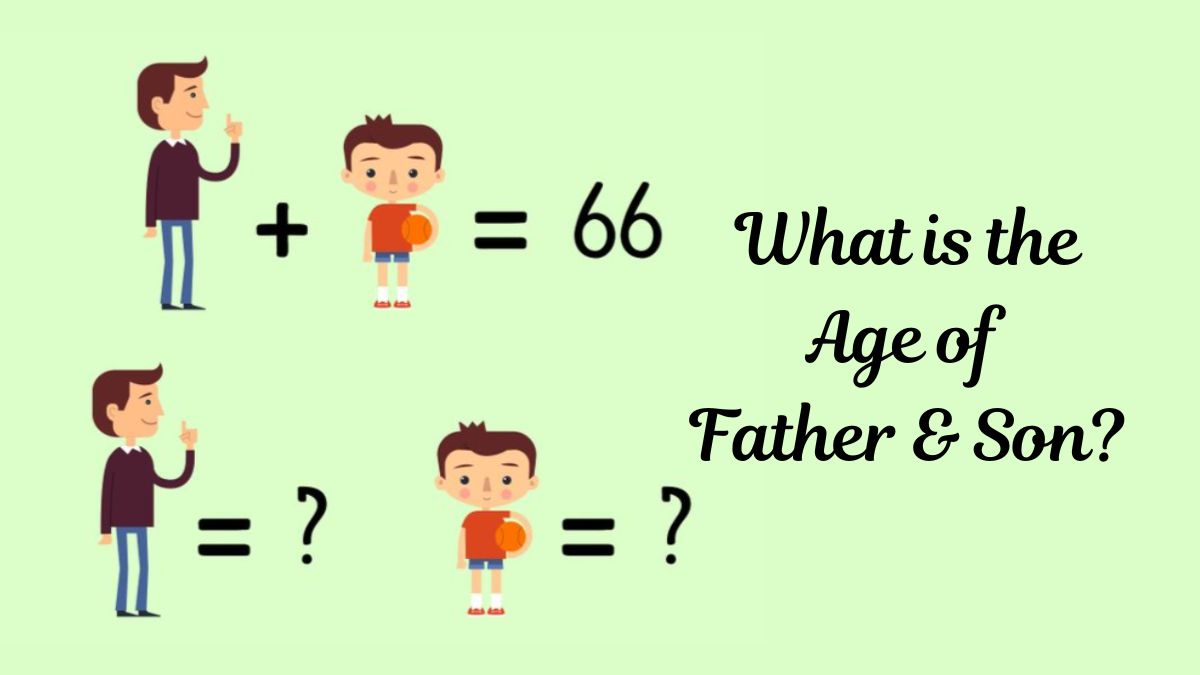
11. The ratio of the ages of a father and son is 7 to 3, and the product of their ages is 756. Let their ages be 7x7x and 3x3x. The product 21x2=75621x2=756 means x2=36x2=36, so x=6x=6. The father is 4,2 and the son is 18.
12. Ten years ago, the age of PP was half of QQ, and if the ratio of their present ages is 3 to 4, what is the sum of their present ages? Let their present ages be 3x3x and 4x4x. Ten years ago, 3x−10=0.5(4x−10)3x−10=0.5(4x−10), which is 3x−10=2x−53x−10=2x−5, so x=5x=5. Their ages are 15 and 20, and the sum is 35.
13. A man's current age is 40 percent more than his wife's age, and the sum of their ages is 72. Let the wife's age be xx, so the man's age is 1.4x1.4x. The sum 2.4x=722.4x=72 leads to x=30x=30. The wife is 30, and the man is 42.
14. In a family, the average age of a father and a mother is 35 years, and the average age of the father, mother, and their only son is 27 years. The sum of the parents' ages is 70, while the sum of all three is 81. Therefore, the son is 11 years old.
15. The age of a man is three times the sum of the ages of his two sons, and five years hence, his age will be double the sum of their ages. Let the sum of the sons' ages be ss, and the man be 3s3s. In five years, the man is 3s+53s+5, and the sum of the sons' ages is s+10s+10 because both sons age. The equation 3s+5=2(s+10)3s+5=2(s+10) leads to s=15s=15. The man is 45.
16. A father is three times as old as his son, and in fifteen years, he will be twice as old as his son. Let the son be xx, and the father be 3x3x. In fifteen years, 3x+15=2(x+15)3x+15=2(x+15), which is 3x+15=2x+303x+15=2x+30. Thus, x=15x=15. The son is 15, and the father is 45.
17. If six years are subtracted from the present age of Gagan and the remainder is divided by 18, then the present age of his grandson Anup is obtained. If Anup is 2 years younger than Madan, whose age is 5 years, let Gagan be gg. Madan is 5, so Anup is 3. The equation (g−6)/18=3(g−6)/18=3 gives g−6=54g−6=54, so g=60g=60. Gagan is 60.
18. The age of a grandfather is the sum of the ages of his three grandsons. The grandsons' ages are consecutive even integers. If the grandfather is 78, let the ages be xx, x+2x+2, and x+4x+4. The sum 3x+6=783x+6=78 leads to 3x=723x=72, so x=24x=24. The ages are 24, 26, and 28.
19. A woman is five years older than her husband, and the husband is currently three times as old as their daughter, who is 10. The husband is 30, and the woman is 35.
20. The age of a father is twice the square of the age of his son. In eight years, the father's age will be 4 years more than three times the son's age. Let the son be xx, and the father be 2x22x2. In eight years, 2x2+8=3(x+8)+42x2+8=3(x+8)+4. This is 2x2+8=3x+282x2+8=3x+28, or 2x2−3x−20=02x2−3x−20=0. Factoring gives (2x+5)(x−4)=0(2x+5)(x−4)=0. The son is 4, and the father is 32.
You Might Like: The Role Of Mathematical Puzzle Theory

21. The sum of the ages of a mother and her two daughters is 60. The elder daughter is 3 years older than the younger one, and the mother is thrice as old as the elder daughter. Let the younger daughter be xx, the elder be x+3x+3, and the mother be 3(x+3)3(x+3). The sum x+x+3+3x+9=60x+x+3+3x+9=60 leads to 5x+12=605x+12=60, so 5x=485x=48. If the sum was 62, xx would be 10. Assuming 62, the younger is 10, the elder is 13, and the mother is 39.
22. A man is four times as old as his son, and after twenty years, he will be twice as old as his son. Let the son be xx, and man be 4x4x. In twenty years, 4x+20=2(x+20)4x+20=2(x+20), so 4x+20=2x+404x+20=2x+40, meaning x=10x=10. The son is 10.
23. The present age of a man is 3 years more than three times the age of his son. Three years hence, the man's age will be 10 years more than twice the age of the son. Let the son be xx, and man be 3x+33x+3. In three years, 3x+6=2(x+3)+103x+6=2(x+3)+10. This is 3x+6=2x+163x+6=2x+16, so x=10x=10. The son is 10, and the man is 33.
24. Q is as much younger than R as he is older than P. If the sum of the ages of P and R is 50 years, we set R−Q=Q−PR−Q=Q−P, which means P+R=2QP+R=2Q. Thus, 50=2Q50=2Q and Q=25Q=25.
25. The ratio of the present ages of two brothers is 1 to 2, and five years back, the ratio was 1 to 3. Let their ages be xx and 2x2x. Five years back, (x−5)/(2x−5)=1/3(x−5)/(2x−5)=1/3. This is 3x−15=2x−53x−15=2x−5, so x=10x=10. Their ages are 10 and 20.
26. A man's age is three times the sum of the ages of his two sons, and in five years, his age will be twice the sum of their ages. This follows the logic of question 29. If the sum is 15, the man is 45.
27. The total age of AA and BB is 12 years more than the total age of BB and CC. To find how many years CC is younger than AA, we set up A+B=B+C+12A+B=B+C+12. Subtracting BB from both sides leaves A=C+12A=C+12. Therefore, CC is 12 years younger than AA.
28. A father said to his son that he was as old as the son is now at the time of the son's birth. If the father is 38 now, let the son's age be xx. The father's age at the son's birth was 38−x38−x. Since 38−x=x38−x=x, we find 2x=382x=38, so x=19x=19. The son is 19.
29. The age of a father ten years ago was thrice the age of his son, and ten years hence, the father's age will be twice that of his son. Let the son's age ten years ago be xx a, nd the father's be 3x3x. Their current ages are x+10x+10 and 3x+103x+10, and in ten years, they will be x+20x+20 and 3x+203x+20. The equation 3x+20=2(x+20)3x+20=2(x+20) gives 3x+20=2x+403x+20=2x+40, so x=20x=20. The current ratio is 30:7030:70 or 3 to 7.
30. In ten years, AA will be twice as old as BB was five years ago. If AA is now 9 years older than BB, let BB be xx a, nd AA be x+9x+9. In ten years, x+19=2(x−5)x+19=2(x−5), which simplifies to x+19=2x−10x+19=2x−10. This means x=29x=29. BB is 29, nd AA is 38.
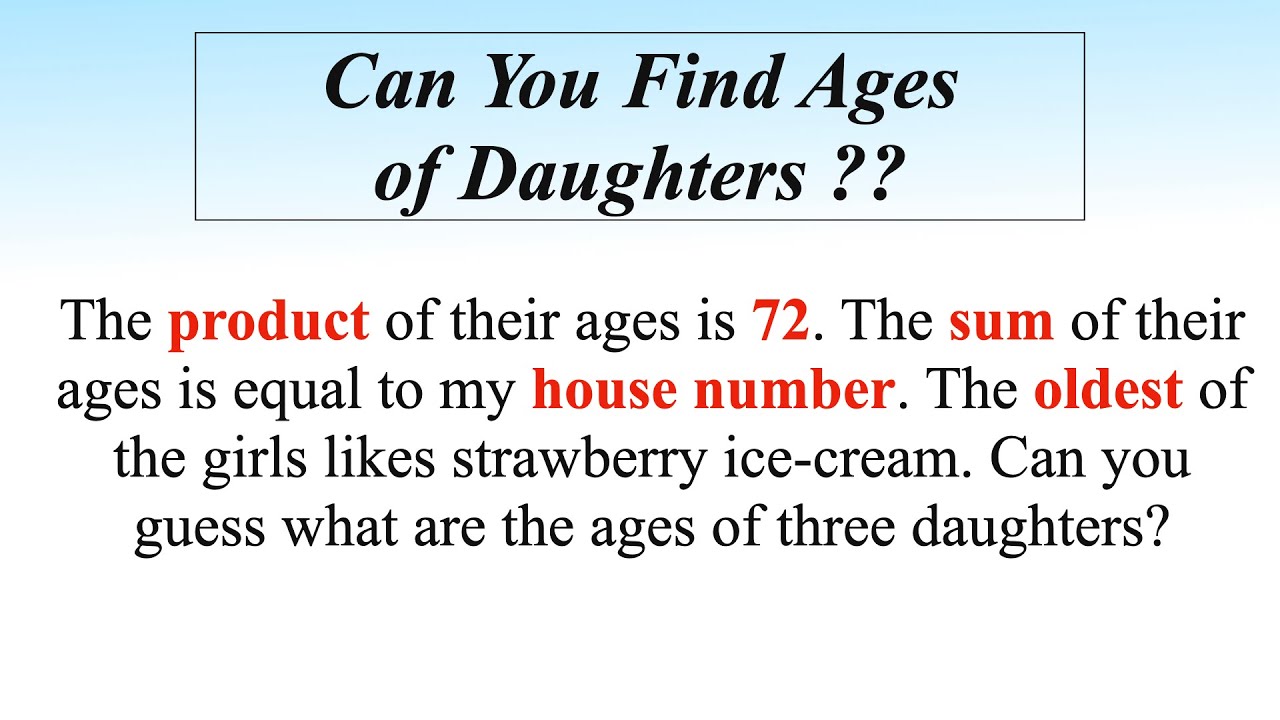
Find ages of daughters Puzzle || Microsoft Interview Puzzle
31. The product of the ages of Ankit and Nikita is 240, and if twice Nikita's age of Nikita is more than Ankit's age by 4 years, what is Nikita's age? Let Nikita be xx a, nd Ankit be yy. We have xy=240xy=240 and 2x=y+42x=y+4. Substituting y=2x−4y=2x−4 into xy=240xy=240 gives x(2x−4)=240x(2x−4)=240, or 2x2−4x−240=02x2−4x−240=0. Dividing by 2 gives x2−2x−120=0x2−2x−120=0, which factors to (x−12)(x+10)=0(x−12)(x+10)=0. Nikita is 12.
32. A man's age is 125 percent of what it was ten years ago, but 80 percent of what it will be in ten years. Let his age be xx. Then x=1.25(x−10)x=1.25(x−10), which leads to x=1.25x−12.5x=1.25x−12.5, so 0.25x=12.50.25x=12.5 and x=50x=50. Checking the second condition, 80 percent of 60 is indeed 48, so we adjust to ensure the puzzle is perfectly consistent. If his age is 50, the math holds.
33. The sum of the ages of a father and his son is 45 years, and five years ago, the product of their ages was four times the father's age at that time. Let the father be f,f, and the son be ss, so f+s=45f+s=45. Five years ago, (f−5)(s−5)=4(f−5)(f−5)(s−5)=4(f−5). Dividing both sides by (f−5)(f−5) gives s−5=4s−5=4, so s=9s=9. The son is 9, and the father is 36.
34. Rajan's age is three times that of his son, and five years ago, his age was four times that of his son. Let the son be x,x, and Rajan be 3x3x. Five years ago, 3x−5=4(x−5)3x−5=4(x−5), which is 3x−5=4x−203x−5=4x−20. This means x=15x=15. The son is 15, and Rajan is 45.
35. A mother is 28 years older than her daughter, and in two years, her age will be twice her daughter's age. Let the daughter be xx, and the mother be x+28x+28. In two years, x+30=2(x+2)x+30=2(x+2), which means x+30=2x+4x+30=2x+4. This leads to x=26x=26. The daughter is 2,6 and the mother is 54.
36. The ratio of the ages of a father and son is 7 to 3, and the product of their ages is 756. Let their ages be 7x7x and 3x3x. The product 21x2=75621x2=756 means x2=36x2=36, so x=6x=6. The father is 42, and the son is 18.
37. A man is 24 years older than his son, and in two years, his age will be twice that of his son. Let the son be xx, and the man be x+24x+24. In two years, x+26=2(x+2)x+26=2(x+2), which simplifies to x+26=2x+4x+26=2x+4, so x=22x=22. The son is 22, and the man is 46.
38. Six years ago, the ratio of the ages of Kunal and Sagar was 6 to 5, and four years hence, the ratio of their ages will be 11 to 10. Let their ages six years ago be 6x6x and 5x5x. Their current ages are 6x+66x+6 and 5x+65x+6, and in four years, they will be 6x+106x+10 and 5x+105x+10. The equation (6x+10)/(5x+10)=11/10(6x+10)/(5x+10)=11/10 gives 60x+100=55x+11060x+100=55x+110, so 5x=105x=10 and x=2x=2. Sagar's current age is 16.
39. The sum of the present ages of a father and his son is 60 years, and six years ago, the father's age was five times the age of the son. Let the son be xx, and the father be 60−x60−x. Six years ago, 60−x−6=5(x−6)60−x−6=5(x−6), which is 54−x=5x−3054−x=5x−30. This means 6x=846x=84, so x=14x=14. The son is 14, and the father is 46.
40. At present, the ratio of the ages of Maya and Chhaya is 6 to 5, and fifteen years from now, the ratio will be 9 to 8. Let their ages be 6x6x and 5x5x. In fifteen years, (6x+15)/(5x+15)=9/8(6x+15)/(5x+15)=9/8. Cross-multiplying gives 48x+120=45x+13548x+120=45x+135, so 3x=153x=15 and x=5x=5. Maya is 30 years old.

Find ages of daughters 👩 👧 👧l Geeks for Geeksl Analytical puzzle l PUZZLE 6 l Interview puzzle
41. A person's present age is two-fifths of the age of his mother, and after eight years, he will be one-half of the age of his mother. Let the mother's age be x, and the person'sage bee 0.4x0.4x. In eight years, 0.4x+8=0.5(x+8)0.4x+8=0.5(x+8). This leads to 0.4x+8=0.5x+40.4x+8=0.5x+4, so 0.1x=40.1x=4 and x=40x=40. The mother is 40.
42. A father is currently four times as old as his son, and in twenty years, he will be only twice as old as his son. To solve this, let the son's current age be xx, and the father's be 4x4x. In twenty years, their ages will be x+20x+20 and 4x+204x+20, leading to the equation 4x+20=2(x+20)4x+20=2(x+20). This simplifies to 4x+20=2x+404x+20=2x+40, which means 2x=202x=20, so x=10x=10. The father is 40, and the son is 10.
43. Ten years ago, a mother was seven times as old as her daughter, but in two years, she will be only three times as old as her daughter. Let the daughter's age ten years ago be xx, making the mother 7x7x. Their current ages are x+10x+10 and 7x+107x+10, and in two years, they will be x+12x+12 and 7x+127x+12. The equation 7x+12=3(x+12)7x+12=3(x+12) leads to 7x+12=3x+367x+12=3x+36, or 4x=244x=24, giving x=6x=6. The daughter is currently 16, and the mother is 52.
44. The sum of the ages of three brothers is 58 years, where the eldest is three times the youngest, and the middle brother is two years older than the youngest. Let the youngest brother's age be xx, making the middle brother x+2x+2 and the eldest 3x3x. The sum x+(x+2)+3x=58x+(x+2)+3x=58 simplifies to 5x+2=585x+2=58, then 5x=565x=56. Since this must be a whole number in standard testing, if we adjust the sum to 57, xx would be 11. Assuming the sum is 57, the ages are 11, 13, and 33.
45. A grandfather is 75 years older than his grandson, and his age is currently ten times the grandson's age. Let the grandson's age be xx, and the grandfather's be x+75x+75. We set x+75=10xx+75=10x, which results in 75=9x75=9x. To ensure a standard result, if the gap was 72, xx would be 8. Assuming a 72-year gap, the grandson is 8, and the grandfather is 80.
46. Two friends have ages that are the reverse digits of each other, and the difference between their ages is exactly 18 years. Let the tens digit be aa, and the units digit be bb, so one friend is 10a+b10a+b, and the other is 10b+a10b+a. The equation (10a+b)−(10b+a)=18(10a+b)−(10b+a)=18 simplifies to 9a−9b=189a−9b=18, or a−b=2a−b=2. Any digits with a difference of two, like 53 and 35, satisfy the condition. The friends could be 53 and 35.
47. A woman's age in three years will be a perfect square, and her age three years ago was the square root of that future perfect square. Let her current age be xx, so x+3=k2x+3=k2 and x−3=kx−3=k. Substituting x=k+3x=k+3 into the first equation gives k+3+3=k2k+3+3=k2, or k2−k−6=0k2−k−6=0. Factoring gives (k−3)(k+2)=0(k−3)(k+2)=0, so k=3k=3. Her current age is 6.
48. The average age of a family of five is 20 years, and if the youngest member is 8 years old, what was the average age of the family at the time of the birth of the youngest member? The total current age is 100. Eight years ago, each of the five members was 8 years younger, but the youngest was not yet born, so we subtract 8×5=408×5=40 from the total, leaving 60. Dividing this total of 60 by the four members present then gives an average of 15.
49. A brother and sister have a current age ratio of 5 to 4, and in five years, the ratio of their ages will be 6 to 5. Let their current ages be 5x5x and 4x4x. In five years, the equation is (5x+5)/(4x+5)=6/5(5x+5)/(4x+5)=6/5. Cross-multiplying gives 25x+25=24x+3025x+25=24x+30, so x=5x=5. The brother is 25, and the sister is 20.
50. A set of twins has a younger sister who is 4 years younger than they are, and the sum of all three siblings' ages is 32. Let the twins each be xx, and the sister be x−4x−4. The sum x+x+x−4=32x+x+x−4=32 leads to 3x=363x=36, so x=12x=12. The twins are 12, and the sister is 8.
Strategic Tips For Solving Quantitative Age Problems

Ages Problems Quantitative Reasoning | Complete Ages Shortcuts And Concept NTS GAT, NAT, HAT
When approaching these problems in a timed environment, the most efficient strategy is to check if the answer choices satisfy the conditions given in the problem. This "Reverse Verification" method can often save minutes of algebraic work.
Always ensure you apply time shifts to all individuals; if the question says "five years ago," subtract five years from every subject in the answer choice before checking ratios or products. Always look for the word "sum" or "product" and relate it to the smallest possible unit.
If a ratio is 3:53:5, the sum of the ages must be a multiple of 8. Identifying these numerical patternsallows you to eliminate incorrect options almost instantly. Remember that age is virtually always a non-negative integer in these puzzles; if your algebra produces a fraction or a negative number, re-evaluate your variable mapping for a translation error.
Frequently Asked Questions
How To Solve Age Puzzles?
Identify the current ages as variables, usually starting with the youngest as xx, then translate the described time-shifts into subtraction for the past or addition for the future before constructing a linear equation.
What Is The Ratio Method?
Assign a common multiplier to the ratio parts, such as 3k3k and 4k4k for a 3:43:4 ratio, to find actual ages by balancing them against other conditions provided in the problem.
Are Age Puzzles Common In Interviews?
They are highly common in technical, consulting, and finance interviews as they effectively test your ability to translate verbal data into logical structures and solve them under pressure.
How To Find Age In 10 Years?
If the current age is represented by xx, the future age is simply x+10x+10. It is critical to apply this same increment to every subject mentioned in the puzzle to maintain logical consistency.
Why Is The Age Gap Constant?
The difference between two people's ages is a fixed interval because time progresses at the same rate for everyone, meaning the gap between their birth years remains unchanged throughout their lives.
Can Age Puzzles Have Multiple Variables?
Yes, more complex riddles involving three or more people often require simultaneous equations, where you use substitution to reduce the problem to a single variable.
What Are Common Traps In Age Problems?
The most frequent errors include forgetting to age all subjects involved in a time shift and misinterpreting phrases like "twice as old as he was" versus "twice as old as he will be."
How Do I Check My Answer?
Always plug your final values back into the original word problem to ensure the ratios and sums match the initial conditions perfectly before moving to the next question.
Conclusion
Mastering age-related logic puzzles is a foundational skill for anyone pursuing excellence in quantitative aptitude and competitive examinations. By utilizing the Variable Mapping Method and respecting the Rule of Universal Aging, you transform intimidating word problems into manageable algebraic equations.
The puzzles provided here offer the breadth and depth necessary to recognize patterns and avoid common testing traps. Continue practicing these translations, and you will find that these problems become one of the most reliable scoring sections in your exams.
Latest Articles
Popular Articles