50 Best MTG Blue Counterspells List & Pro Strategies 2026
Say 'No!' to any threat in 2026. Discover 50 top MTG blue counterspells. Master expert timing, mana, & bluffing tactics. Elevate your game now.
Feb 02, 20261K Shares358.7K Views

Master The Art Of Saying "No": Magic The Gathering Blue Counterspells
Blue mana holds a unique and commanding position in Magic: The Gathering, often hailed as the game's most potent color. This dominance stems from its unparalleled mastery over two critical game actions: efficient card draw and, most importantly, potent countermagic.
Drawing more cards provides a fundamental resource advantage, ensuring you consistently have the answers you need. As for countermagic, the sheer ability to simply "say no" to an opponent's spell is an unparalleled strategic maneuver. It denies their value, negates their invested mana, and frequently dismantles their entire turn, granting an immense strategic and tempo advantage.
Magic the Gathering blue counterspellsare iconic instants that define blue's identity of unyielding defense, intellect, and foresight. When wielded effectively, a precisely timed counterspell can unravel an opponent's entire game plan, safeguard your vital permanents, or clear the path for your own decisive victory.
This isn't just about stopping spells; it's about disrupting their rhythm, conserving your own resources, and ultimately, dictating the very flow of the game. For any player aiming to embody the quintessential "blue player" archetype, a thorough understanding of these powerful tools is absolutely essential.
What Are Blue Counterspells In MTG?
Understanding blue counterspells goes beyond their basic function; it's about recognizing their strategic implications, mana efficiency, and how they seamlessly integrate into your overarching game plan.
When seeking the best counterspells MTG has to offer, efficiency and spell type are paramount. You ideally want your countermagic to be as cheap as possible for mana-positive exchanges and fluid sequencing of your plays.
Counterspells generally fall into three broad categories:
- Hard Counters:These are the definitive "no." They unconditionally stop a spell, regardless of its cost or type, leaving no room for your opponent to bypass the effect.
- Situational Counters:These often function as hard counters but require the targeted spell to meet a specific condition (e.g., being a creature, having a certain mana value, or belonging to a specific color). They are incredibly powerful when their conditions are met, offering efficient answers to specific threats.
- Soft Counters:These usually counter a spell but provide the opponent with an "out," typically by paying additional mana. They excel at disrupting early-game plays, creating significant tempo advantages, and forcing opponents to make difficult resource decisions.
Also Check Out: Top Fan Favorite Games That Stand The Test Of Time
Best Magic The Gathering Blue Counterspells List
Below, we delve into some of the most impactful blue counterspells, revealing their unique strengths and why they are vital additions to your arsenal.
1. Counterspell
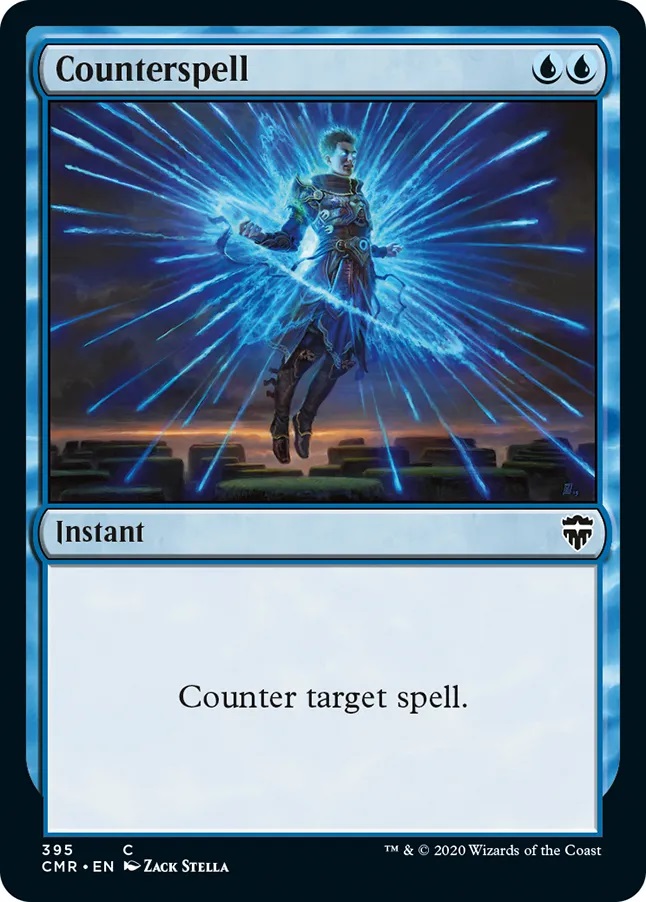
A timeless classic from Alpha (1993), Counterspell(UU) unconditionally cancels any spell at just two blue mana. It remains a staple in control decks across Legacy, Vintage, and EDH.
Its efficiency supports strategies like Azorius Control, Grixis Delver, or decks running Wastelandfor mana denial. However, its double-blue cost demands a strong commitment to blue in multicolor builds.
- Best in: Vintage Control, Mono-Blue Tempo, Legacy Ux Shells
- Watch for: Multicolor mana consistency
2. Mana Drain
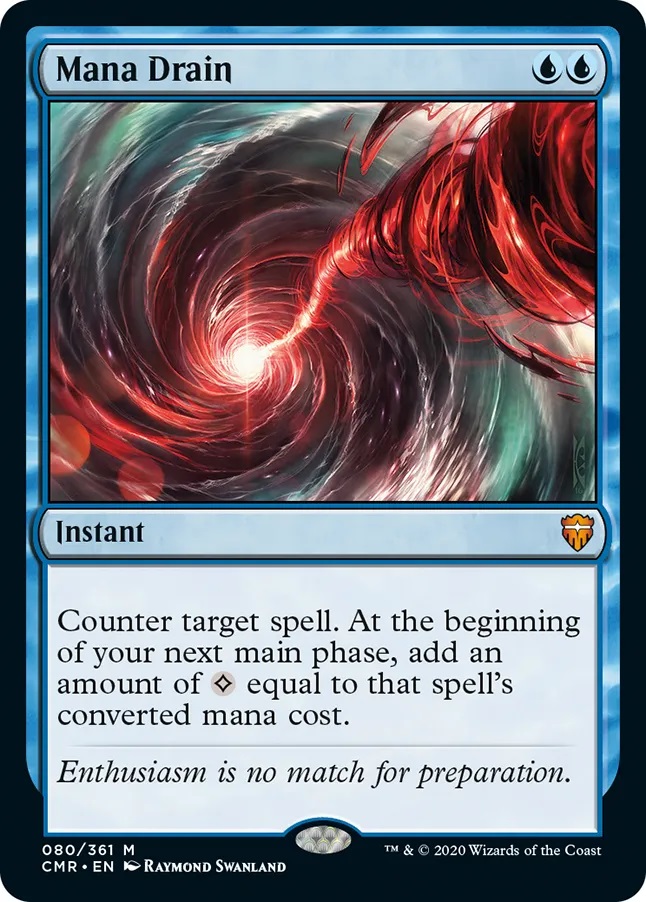
Mana Drain (UU), first printed in Legends(1994), counters any spell and adds colorless mana equal to its mana value to your next main phase. This mana acceleration can enable explosive plays, like casting Jace, the Mind Sculptor, or a massive Sphinx’s Revelation.
A Vintage and Legacy staple, it’s also a Commander powerhouse in decks like Urza, Lord High Artificer. Its high secondary market cost reflects its rarity and power, but beware of overextending into a wipe after the mana burst. Pair with card draw to maximize its potential.
- Use for: Explosive follow-ups like Jace, the Mind Sculptoror Sphinx's RevelationSynergy: Big-mana spells, artifact ramp, card draw
- Caution: Don't overextend into board wipes
3. Force Of Will
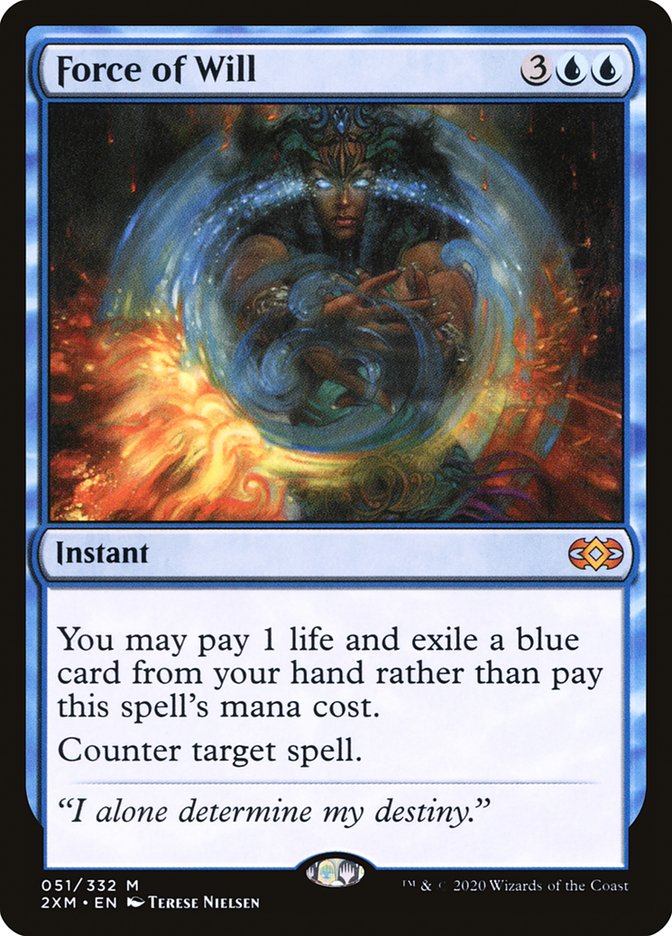
Force of Will (3UU or exile a blue card and pay 1 life) is a free counterspell from Alliances(1996), defining high-power formats like Legacy and Vintage. It counters any spell, making it critical in combo decks (e.g., Sneak and Show) or control shells (e.g., Miracles).
Its alternate cost mitigates mana constraints but demands a blue-heavy deck to fuel the pitch cost. Historically banned in some formats for its power, it’s less common in Commander due to card disadvantage but shines in cEDH for protecting fast combos.
- Ideal in: Sneak and Show, Miracles, cEDH
- Build tip: High blue card density needed for pitch cost
4. Force Of Negation
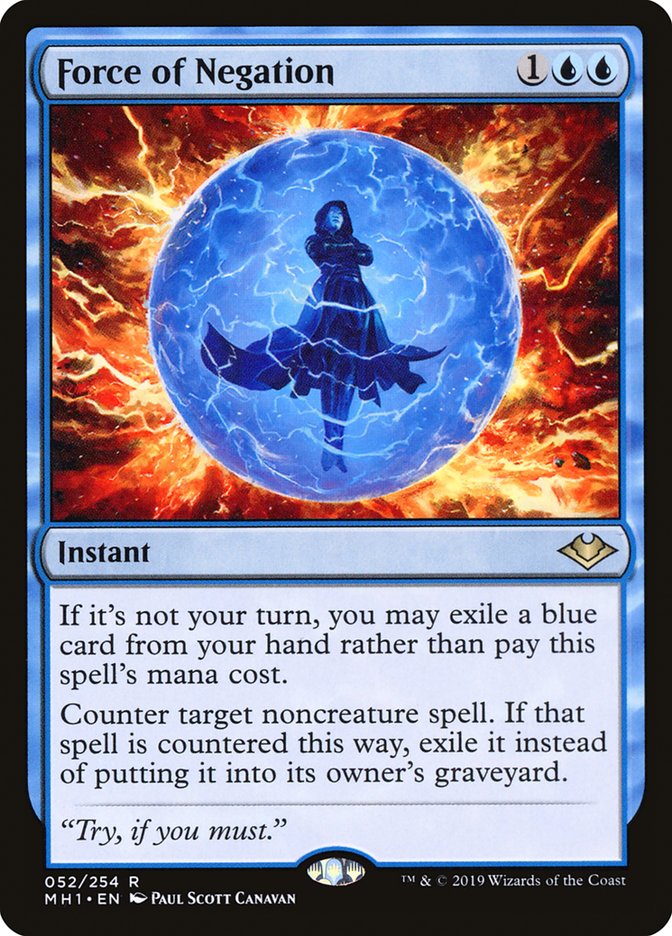
Force of Negation (1UU or exile a blue card and pay 1 life on an opponent’s turn), from Modern Horizons(2019), counters non-creature spells. It’s a Modern and Legacy staple in decks like Izzet Phoenix or Dimir Control, excelling against combo pieces (e.g., Through the Breach) or Planeswalkers like Wrenn and Six.
Its restriction to opponents’ turns makes it a reactive tool, but its free casting mode ensures protection when tapped out. Build around blue card density to leverage its alternate cost.
- Format fit: Modern, Legacy, cEDH
- Limit: Doesn’t stop creatures, and only free on opponent’s turn
5. Fierce Guardianship
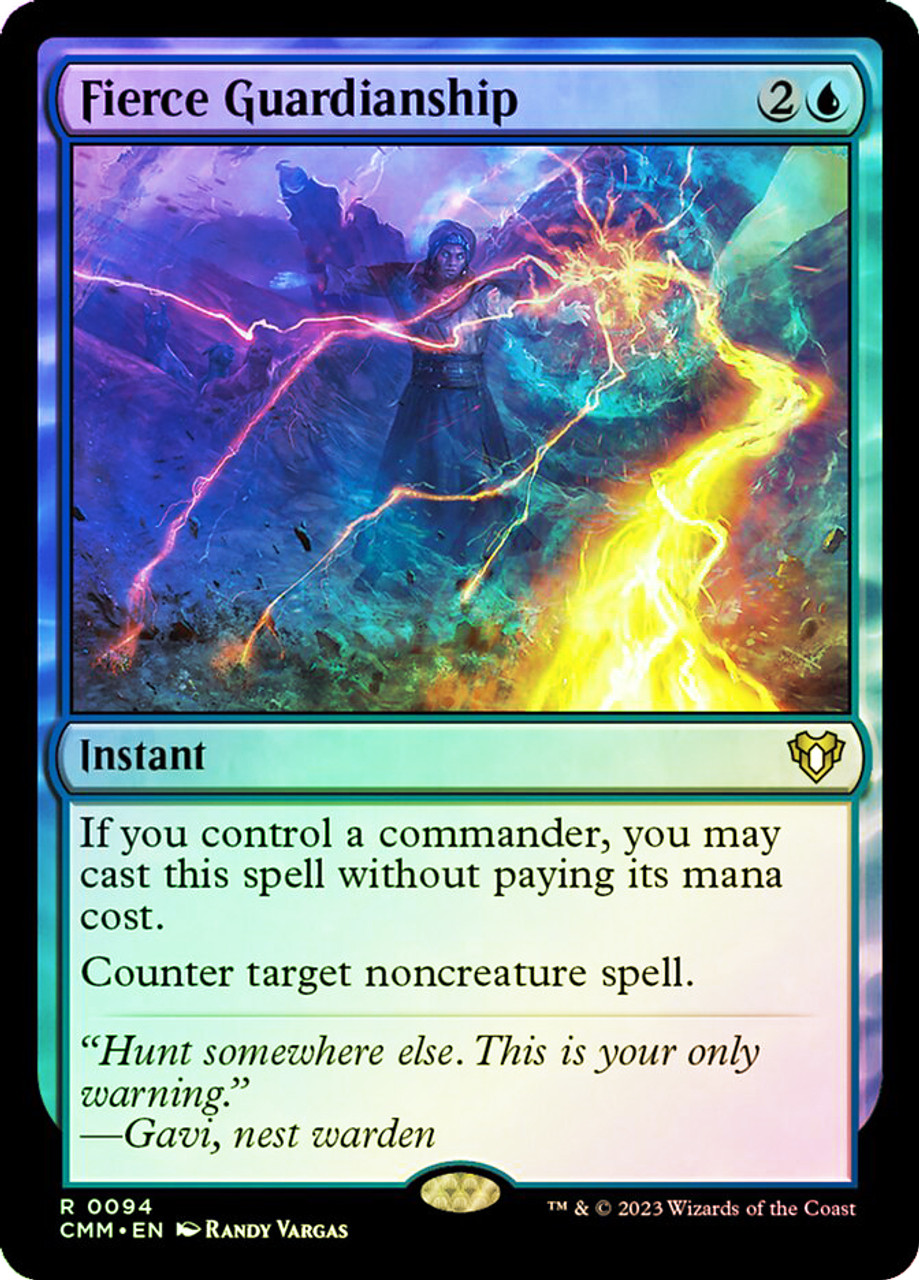
Fierce Guardianship(2U or free if you control your commander), from Commander 2020, counters non-creature spells. A cEDH staple, it protects commanders like Niv-Mizzet, Parun, or stops game-ending spells like Cyclonic Rift.
Its free casting in Commander makes it a premium choice, but its three-mana backup cost is steep in non-Commander formats. Pair with low-cost commanders or flicker effects to maximize uptime. Its exclusivity to Commander products makes it a pricey but powerful addition.
- Use with: Low-cost, value commanders
- Not for: Constructed formats outside Commander
6. Pact Of Negation
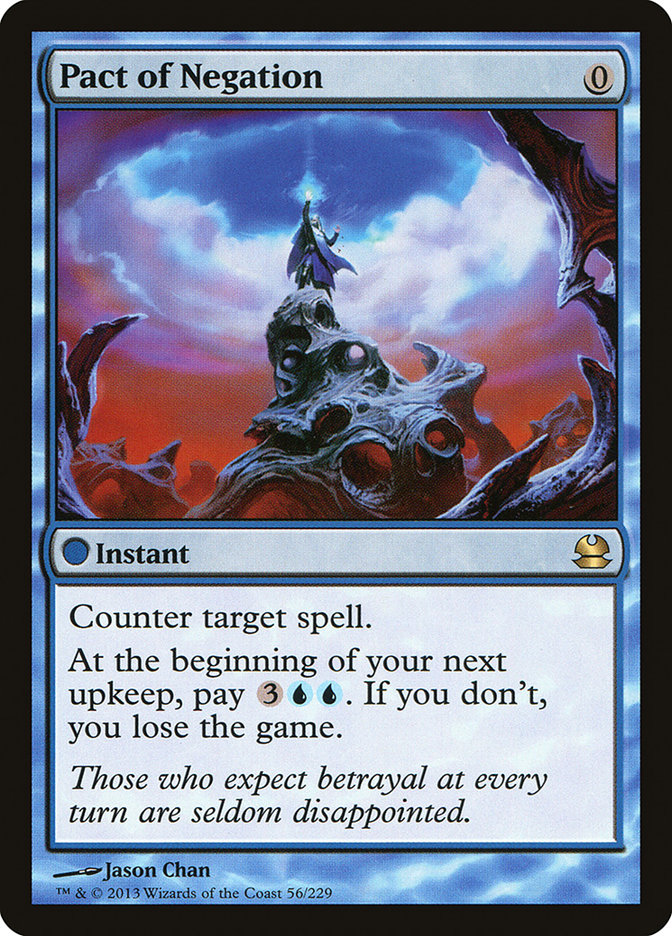
Pact of Negation (0 mana), from Future Sight(2007), counters any spell but requires 2UUU on your next upkeep or you lose. It’s a combo enabler in Modern (Ad Nauseam), Legacy (Doomsday), and cEDH (Thassa’s Oracle decks), ensuring your win condition resolves.
The upkeep cost is irrelevant if you win the turn you cast it, but mismanaging it can be fatal. Synergizes with mana ramps like Dark Ritual or mana rocks in Commander to cover the upkeep.
- Great in: Glass cannon combos, backup win protection
- Key synergy: Fast mana, rituals, mana rocks
- Fail condition: Losing on upkeep if mismanaged
7. Mana Leak
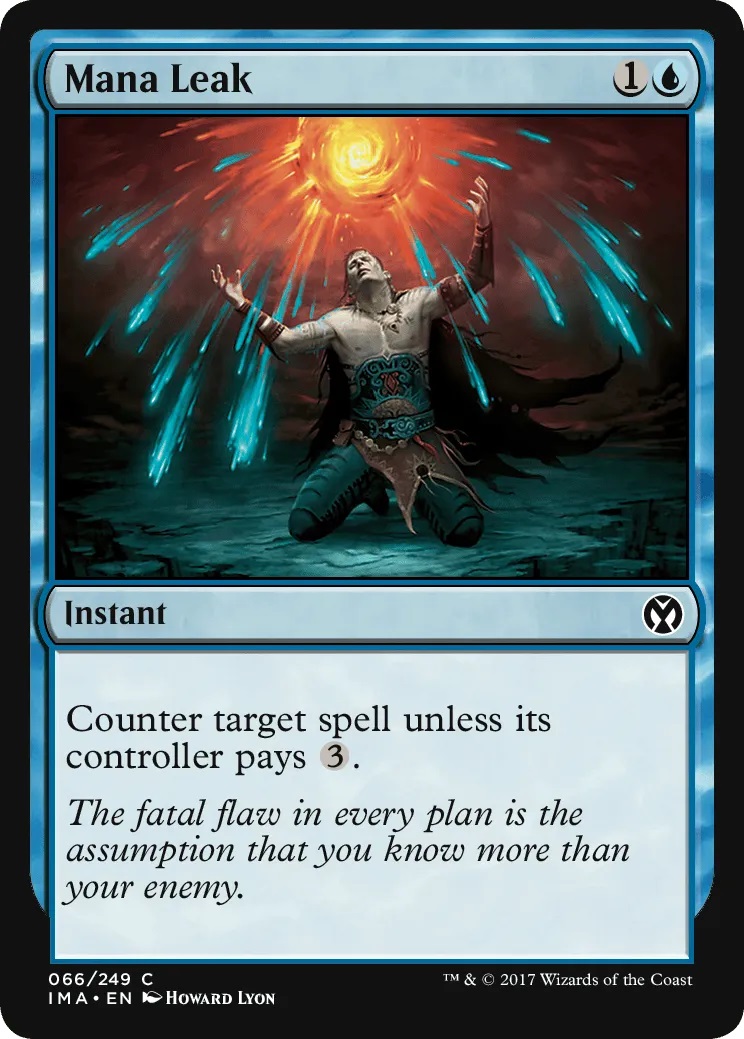
Mana Leak (1U), from Stronghold(1998), counters a spell unless its controller pays 3. Its early-game disruption shines in Standard and Modern tempo decks like Azorius Spirits, taxing opponents’ mana curves.
It weakens against ramp decks or late-game mana flood, so prioritize it in aggressive metas. Historically a budget staple, it pairs well with cards like Remand for tempo swings. Its simplicity makes it a great sideboard filler in control-heavy formats.
- Budget pick: Entry-level control builds
- Best use: Early disruption in fast formats
8. Miscalculation
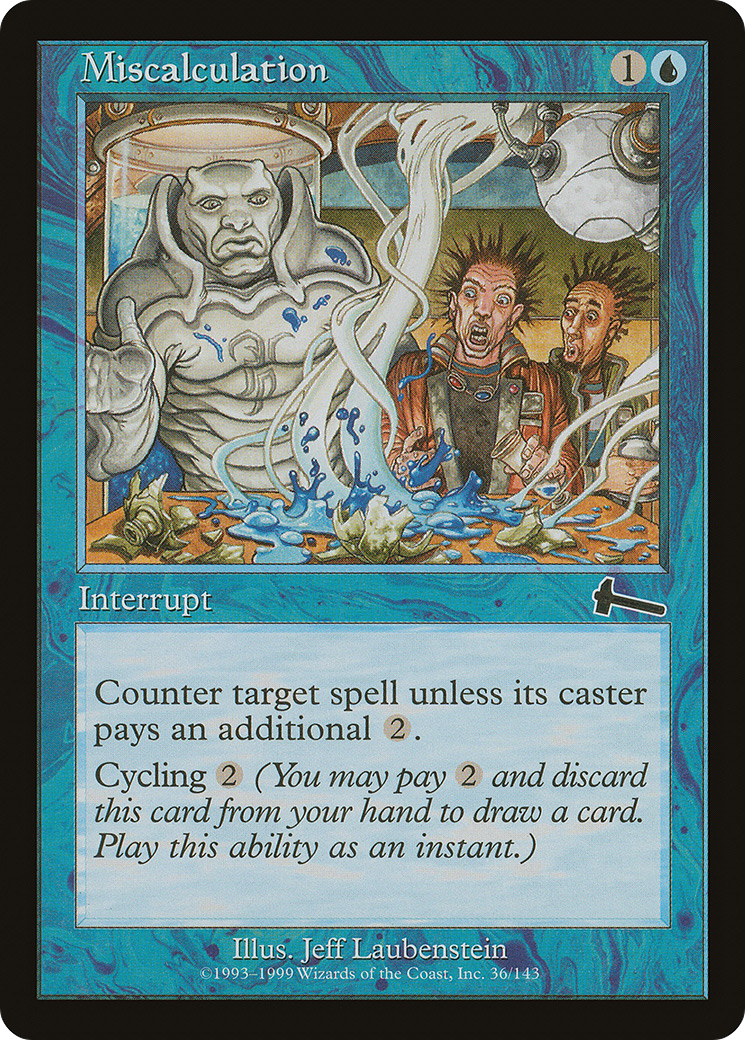
Miscalculation (1U), from Urza’s Legacy(1999), counters a spell unless its controller pays 2 and has cycling for 2 mana. Its cycling ability makes it versatile in Legacy tempo decks like Grixis Delver, where it can be swapped for a new card if unneeded.
It synergizes with delve cards (e.g., Gurmag Angler) by fueling the graveyard. Its low cost allows holding up interaction while developing threats, but its soft counter nature limits late-game impact.
- Value add: Card draw when counter window closes
- Deck fit: Legacy Delver, Reanimator, or Grixis Control
9. Spell Pierce
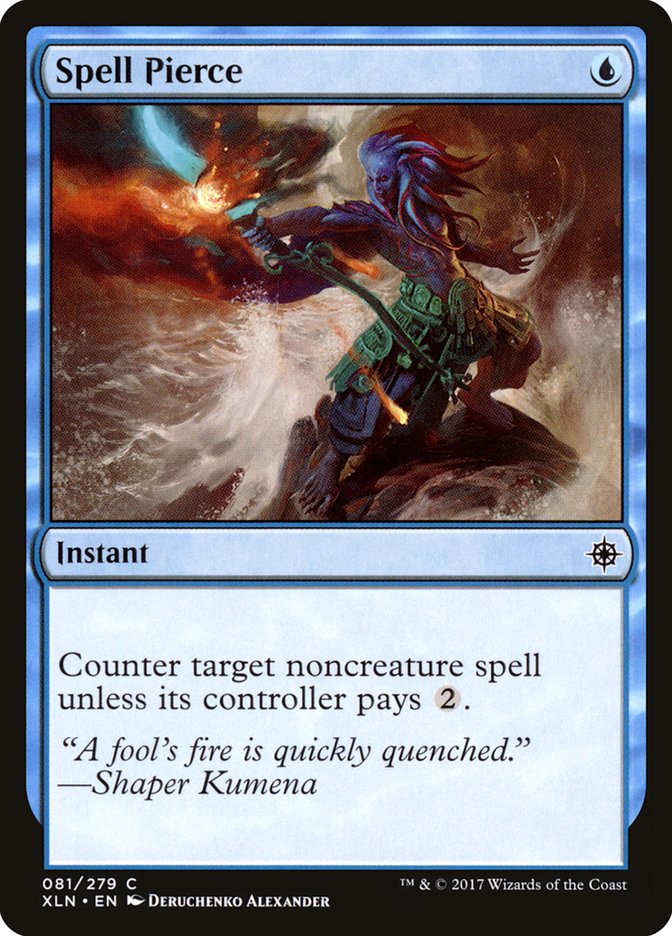
Spell Pierce (U), from Zendikar(2009), counters a non-creature spell unless its controller pays 2. Its one-mana cost makes it a tempo staple in Modern (Izzet Phoenix) and Legacy (Delver), disrupting early combo pieces or Planeswalkers.
In Commander, it’s a budget sideboard card against control decks. Pair with aggressive creatures like Delver of Secrets to maintain pressure. Its efficiency wanes in mana-rich late games, so prioritize early disruption.
- Key decks: Izzet Phoenix, Delver, Mono-U Tempo
- Limit: Poor late-game unless pressure is applied early
10. Swan Song
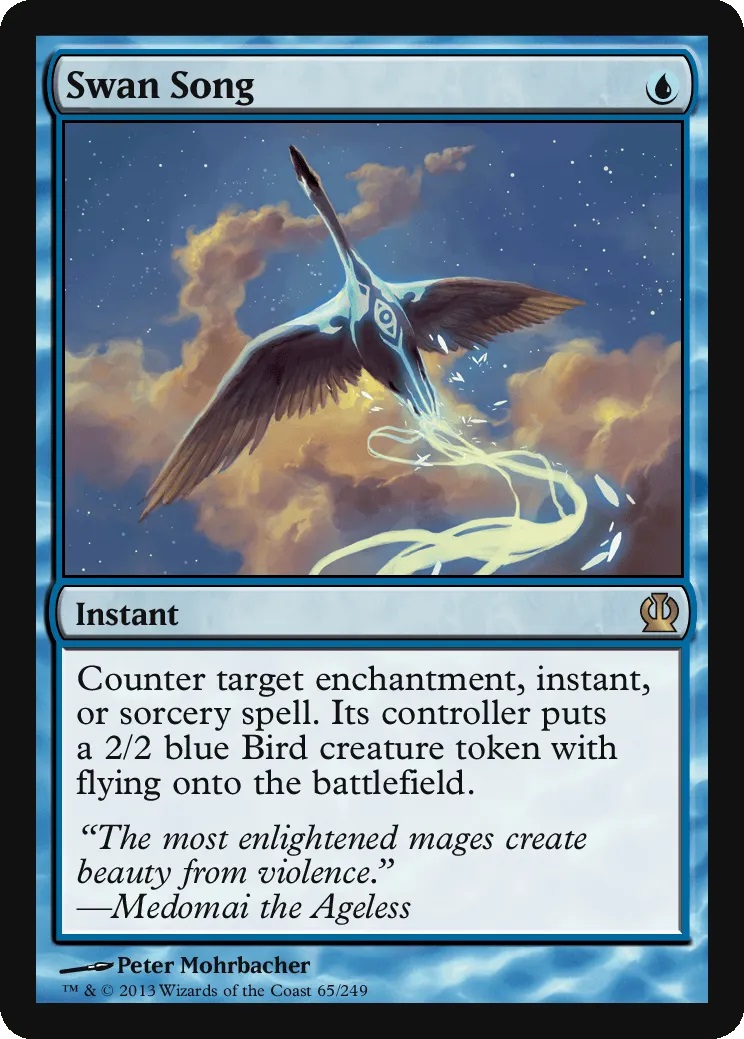
Swan Song (U), from Theros(2013), counters an instant, sorcery, or enchantment, giving the opponent a 2/2 Bird token. Its hyper-efficiency makes it a Commander and Legacy favorite, stopping cards like Ad Nauseam or Smothering Tithe.
The Bird token is rarely relevant in high-power formats, but beware in creature-heavy metas. It synergizes with board wipes in Commander to negate the drawback. Its low cost makes it a counter-war staple.
- Counter targets: Ad Nauseam, Rhystic Study, Smothering Tithe
- Bonus tip: Token downside is negligible in most metas
11. Daze
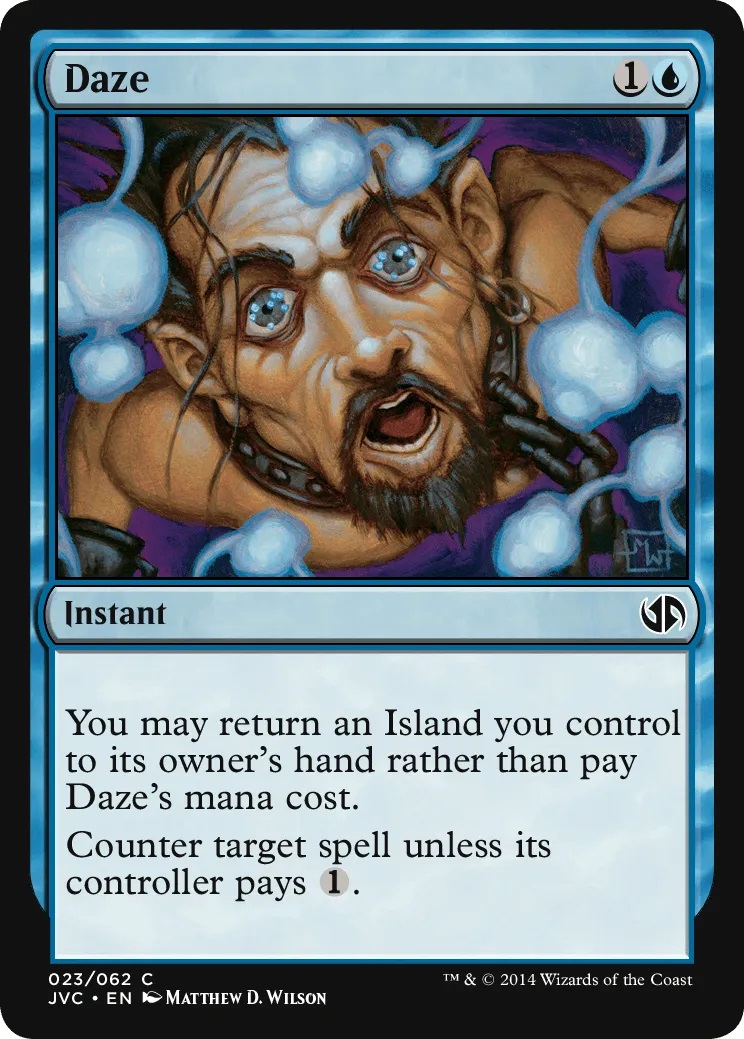
Daze (1U or return an Island), from Nemesis (2000), is a “free” soft counter for tempo decks like Legacy Delver. Bouncing an Island allows tapping out for threats while holding up interaction, perfect for decks with cheap threats like Delver of Secrets
Its drawback requires careful land sequencing, especially in mana-light decks. Synergizes with Wasteland for mana denial. Its power in early-game disruption makes it a Legacy cornerstone.
- Use when:Playing tempo or low-curve control
- Deck synergy:Island-heavy builds, Ponder/Brainstorm shells
12. Negate
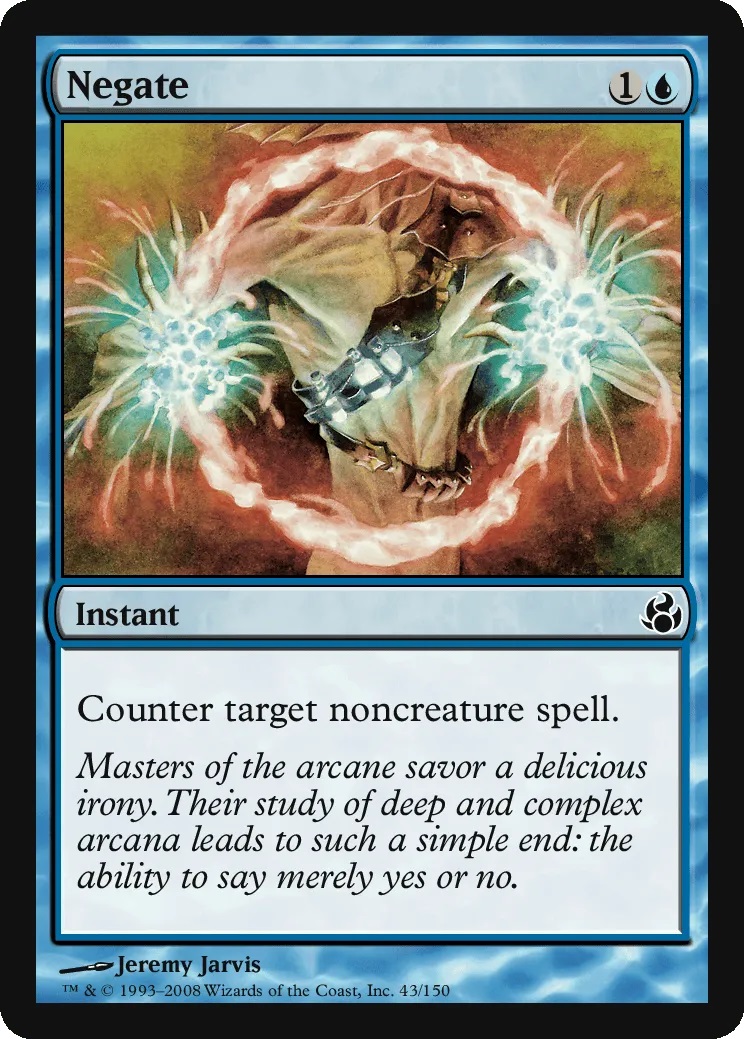
Negate (1U), from Morningtide (2008), counters non-creature spells, targeting artifacts, enchantments, and Planeswalkers. It’s a Standard, Modern, and Commander sideboard staple in metas with cards like Teferi, Time Raveler, or Smothering Tithe.
Its precision makes it a maindeck choice in control decks like Dimir Control. Pair with creature removal like Fatal Push for a balanced control suite. Its low cost ensures flexibility in tight mana situations.
- Key in:Control mirrors, midrange protection
- Budget tip:Swap in for Swan Song if on a budget
- Weakness:Dead card vs creature-heavy metas
13. Disdainful Stroke
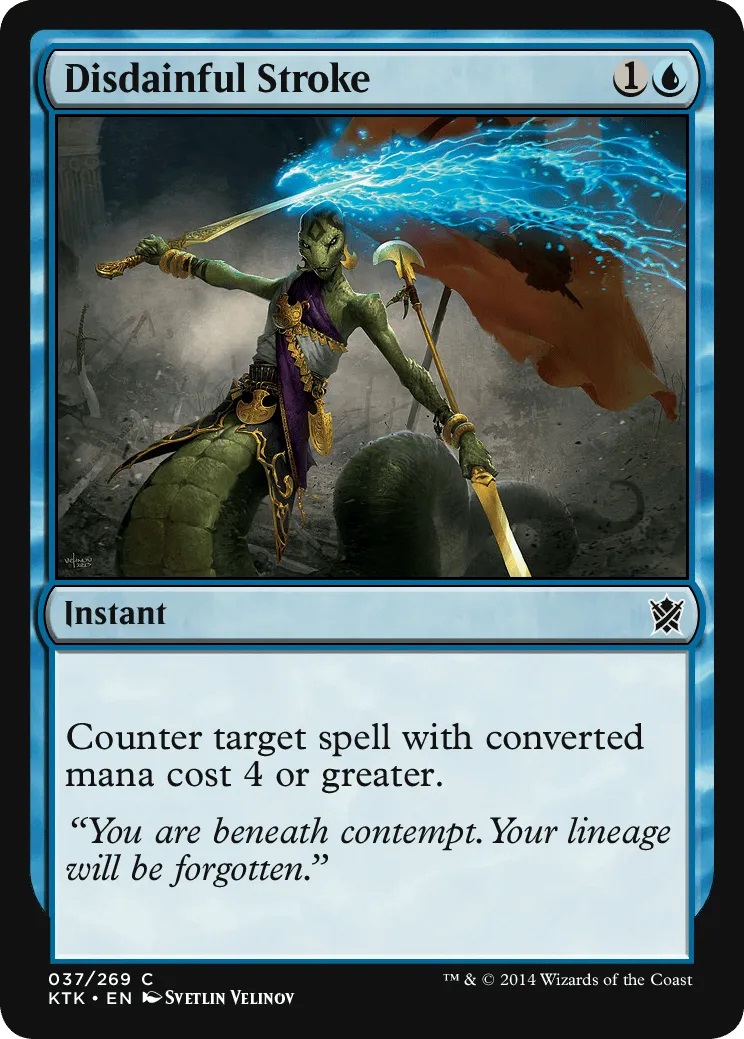
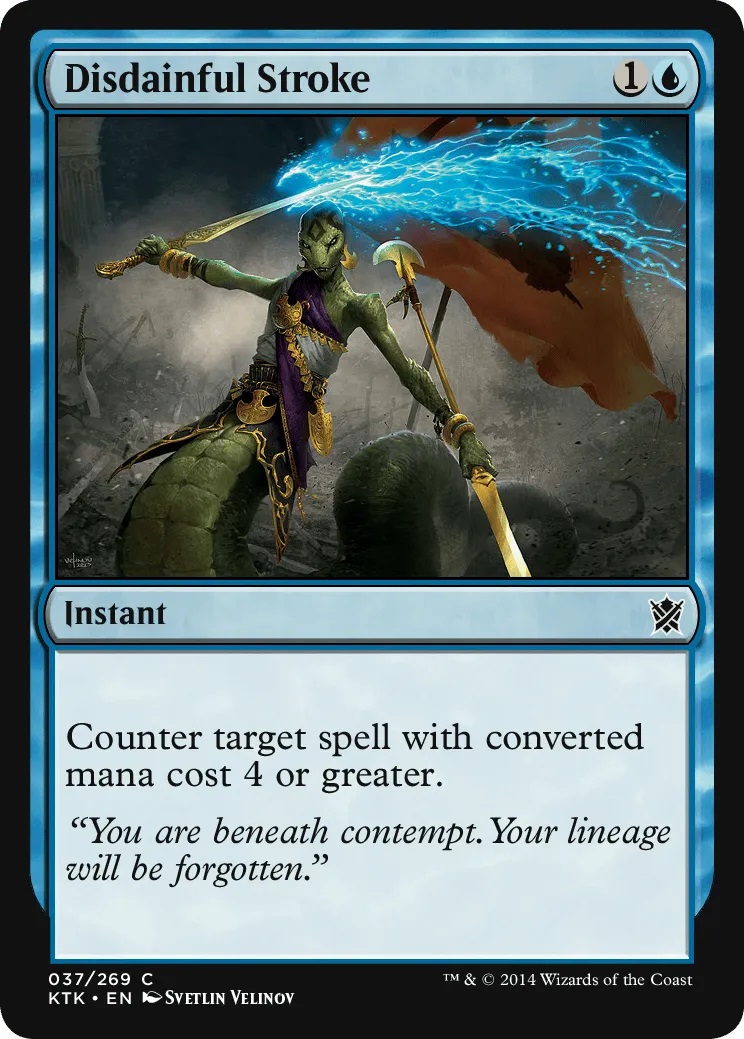
Disdainful Stroke (1U), from Khans of Tarkir (2014), counters spells with mana value 4 or greater. It’s a sideboard star in Standard and Modern against ramp decks (e.g., Domain Zoo) or bombs like Ulamog.
In Commander, it stops high-cost commanders or board wipes. Its situational nature requires a meta call, but its tempo advantage is massive. Synergizes with early pressure to capitalize on delayed threats.
- Best In:Control mirrors, midrange-heavy pods
- Synergy:Early pressure, tempo decks
- Watch For:Ulamog, Craterhoof, Cyclonic Rift
14. Dispel
Dispel (U), from Worldwake (2010), counters an instant spell with pinpoint accuracy. In Legacy and Modern, it’s a sideboard gem for counter wars or stopping instant-speed removal like Lightning Bolt.
In Commander, it protects your spells from counters or disruption like Abrupt Decay. Its one-mana cost makes it a budget-friendly choice, but its narrow focus limits maindeck utility. Pair with broader counters like Negate for versatility.
- Best In:Spell-heavy metas, budget builds
- Synergy:Counter backup, value spells
- Watch For:Lightning Bolt, Swan Song, Abrupt Decay
15. Spell Snare
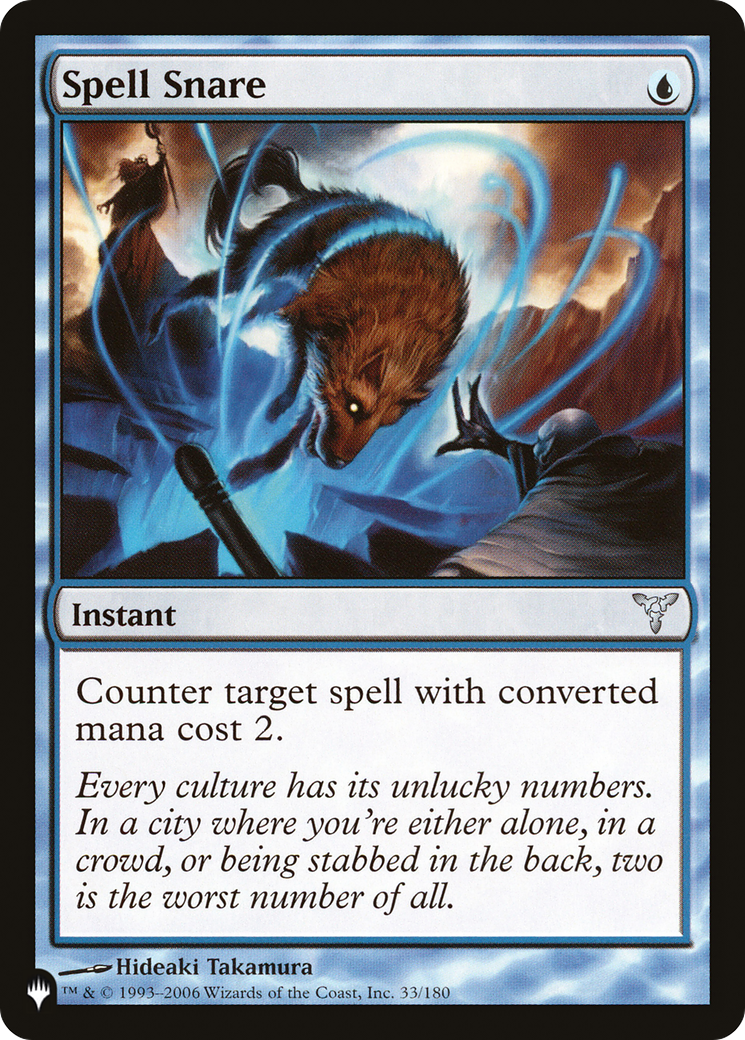
Spell Snare (U), from Dissension (2006), counters spells with mana value 2, hitting staples like Tarmogoyf or Counterspell. In Modern and Legacy, it’s a meta-dependent powerhouse in control decks like Blue Moon.
Its situational nature requires precise metagame knowledge, but its tempo advantage is unmatched. In Commander, it’s niche but effective in cEDH against low-cost combo pieces. Synergizes with snap-casting effects like Snapcaster Mage.
- Best In:Modern, cEDH, fast pods
- Synergy:Snapcaster Mage, cheap interaction
- Watch For:Underworld Breach, Isochron Scepter
16. Mystical Dispute
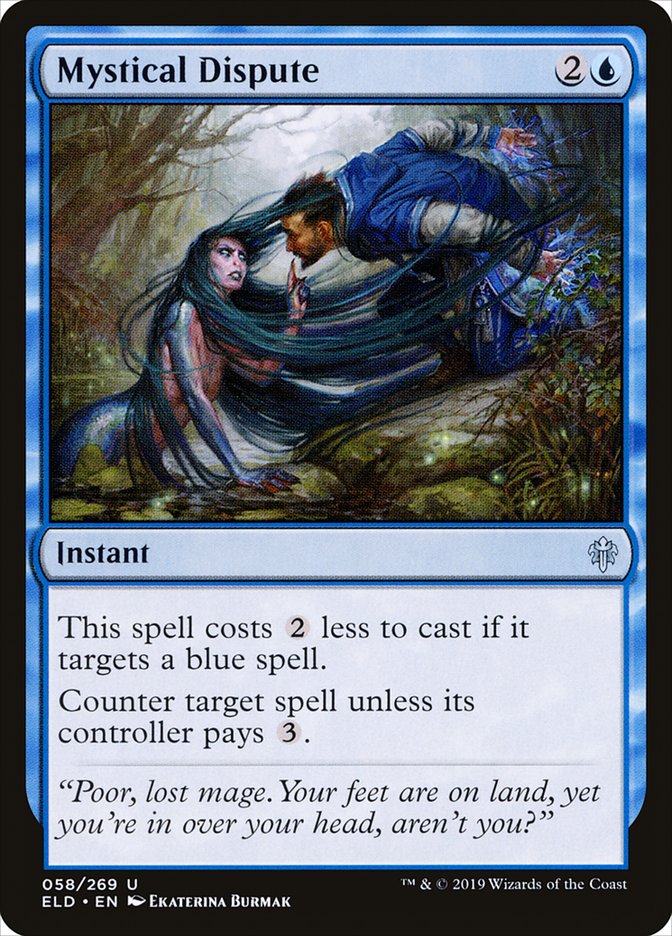
Mystical Dispute(2U or U vs. blue spells), from Throne of Eldraine (2019), counters a spell unless its controller pays 3. Its reduced cost against blue spells makes it a Modern and Pioneer staple in blue mirrors (e.g., Azorius Control).
In Commander, it’s a sideboard answer to blue-heavy commanders like Talrand. Synergizes with mana denial like Spreading Seas to lock out opponents. Its flexibility makes it a control deck favorite.
- Best In:Blue-heavy metas (e.g., Azorius, Talrand)
- Synergy:Spreading Seas, mana denial
- Watch For:Rhystic Study, opposing counters
17. Cryptic Command
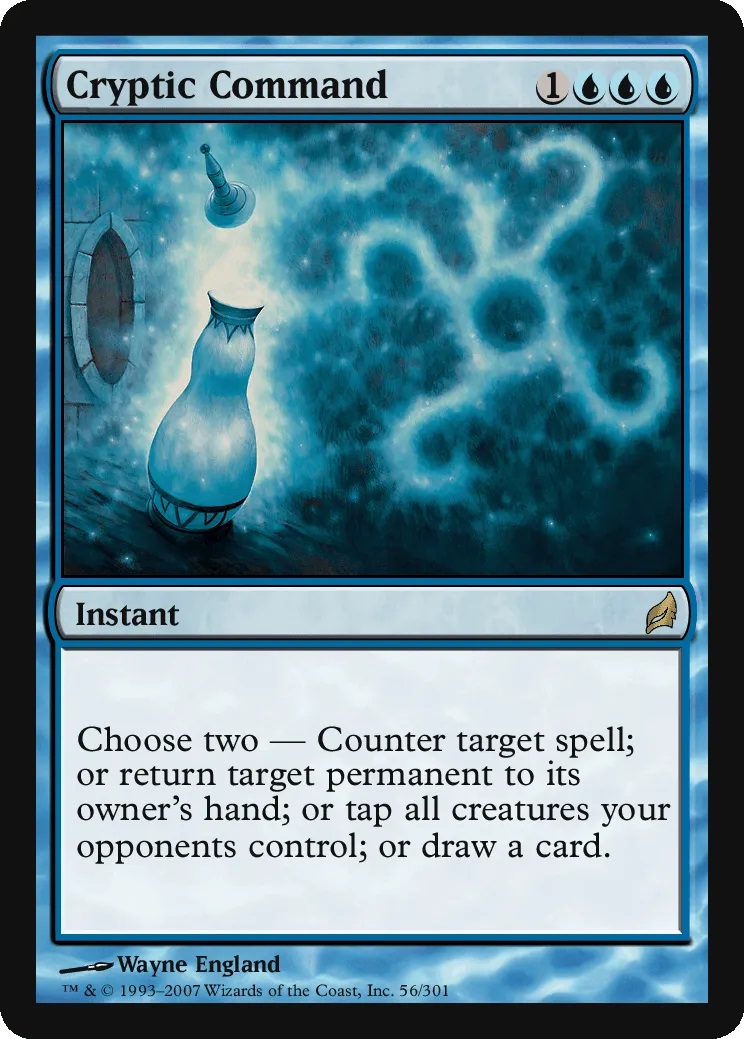
Cryptic Command (1UUU), from Lorwyn (2007), offers four modes: counter a spell, draw a card, return a permanent, or tap all opponent’s creatures. Most often used to counter and draw, it’s a Modern (Azorius Control) and Commander staple.
Its triple-blue cost demands heavy blue mana bases, but its versatility provides card advantage and board control. Synergizes with flicker effects like Yorion, Sky Nomad, for repeated value.
- Best In:Modern Control, slow Commander decks
- Synergy:Yorion, Snapcaster, flicker engines
- Watch For:Creature swarm, utility spells
18. Mental Misstep
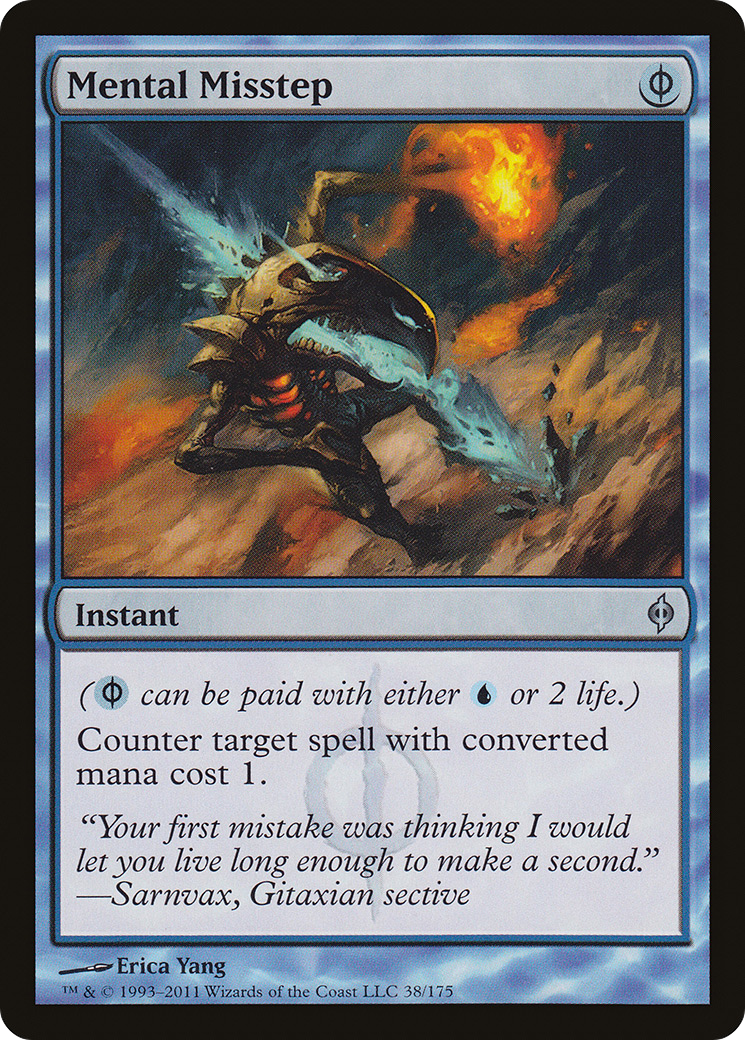
Mental Misstep (U or 2 life via Phyrexian mana), from New Phyrexia (2011), counters spells with mana value 1. Banned in Modern and restricted in Vintage for its dominance, it’s a Legacy staple against cards like Brainstorm or Ponder.
In cEDH, it’s a niche sideboard card for fast metas. Its life cost is negligible in aggressive formats but requires health management in longer games. Pair with cheap cantrips to maintain card flow.
- Best In:Fast formats, cEDH
- Synergy:Cheap cantrips, tempo decks
- Watch For:Sol Ring, Brainstorm, Deathrite Shaman
19. Flusterstorm
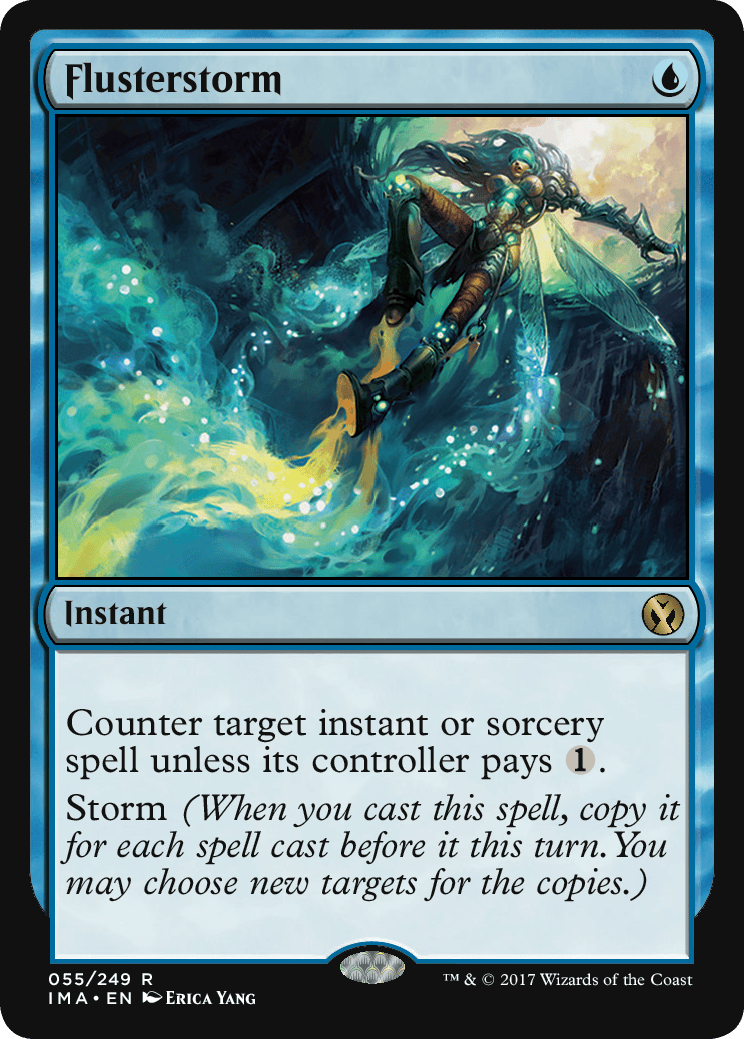
Flusterstorm (U), from Commander 2011, counters an instant or sorcery, creating copies for each spell cast this turn. It’s a Legacy and Vintage powerhouse against storm decks (e.g., The Epic Storm) or control mirrors.
In cEDH, it dismantles spell-heavy combos like Consultation. Its storm mechanic rewards timing, so hold it for stacked turns. Synergizes with cantrips like Ponder to set up optimal use.
- Best In:cEDH, Legacy, spell-slinging decks
- Synergy:Cantrips, free spells, counter wars
- Watch For:Ad Nauseam, Consultation combos
20. Exclude
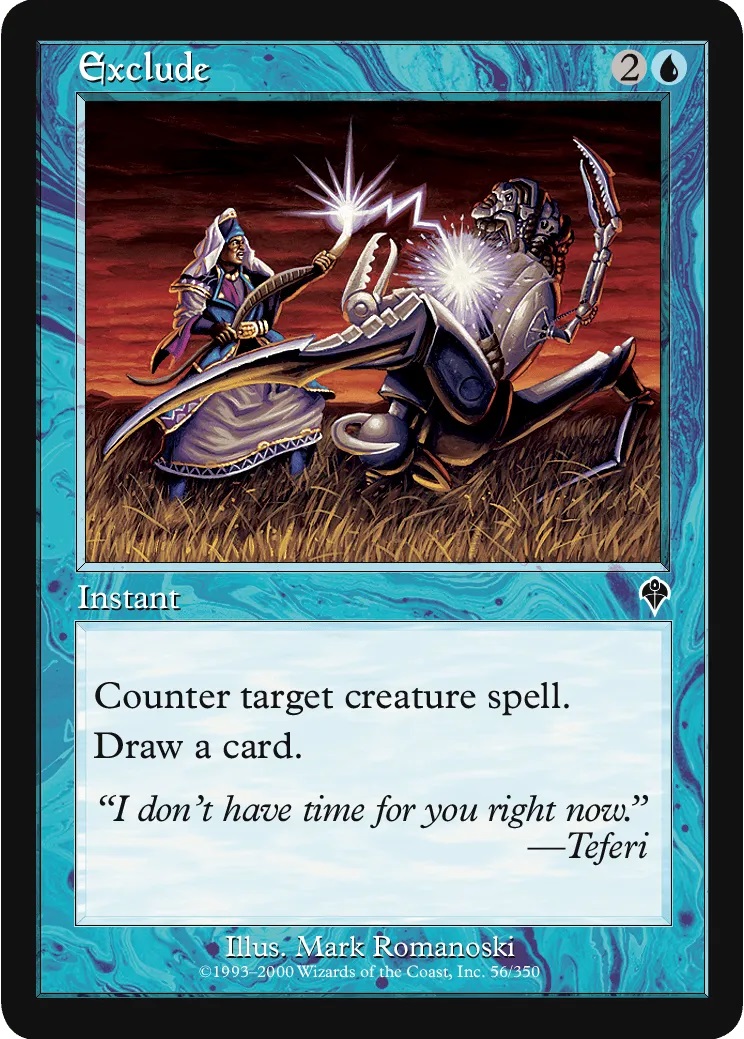
Exclude (2U), from Invasion (2000), counters a creature spell and draws a card. In Commander, it’s a tempo play against creature-heavy decks, while in Limited, it’s a two-for-one against bombs.
Synergizes with flicker effects like Ephemerate or bounce spells like Unsummon to reuse creatures. Its higher cost limits its use in fast formats, but its card advantage shines in grindy games.
- Best In:Commander midrange/control
- Synergy:Ephemerate, Unsummon, flicker loops
- Watch For:Dockside, combo creatures, tribal decks
21. Muddle The Mixture
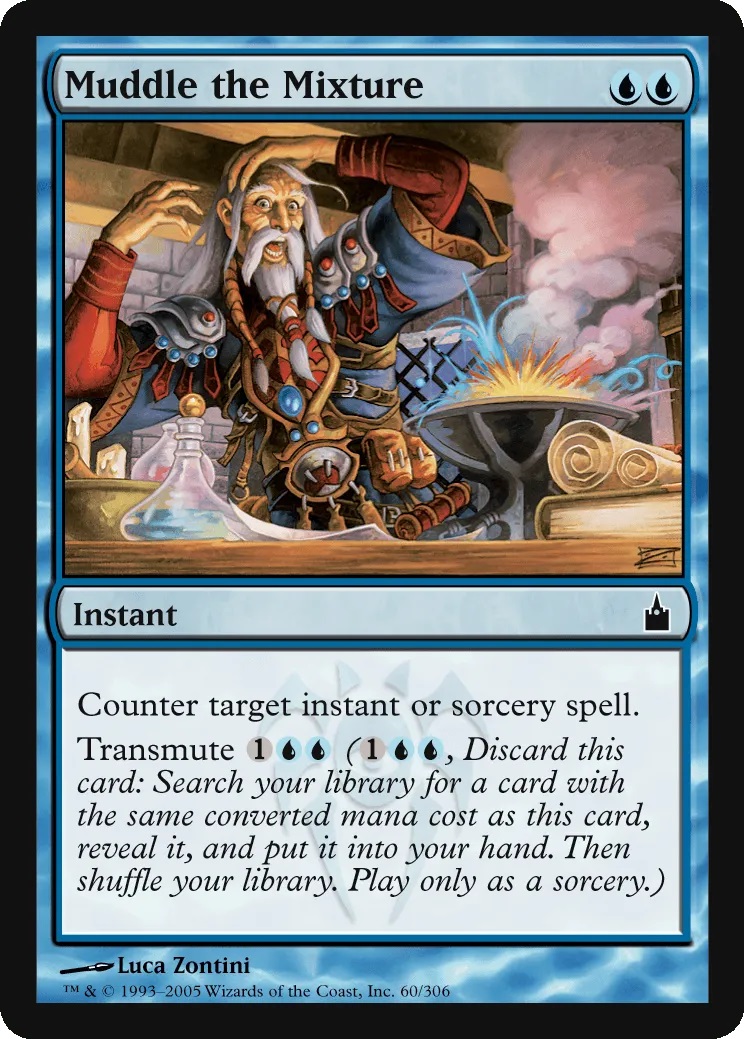
Muddle the Mixture (UU), from Ravnica (2005), counters an instant or sorcery and transmutes for a mana value 2 card. In Modern, it’s a combo piece in Ad Nauseam, tutoring Lightning Storm. In Commander, it fetches Isochron Scepter or Cyclonic Rift.
Its dual role as disruption and tutor makes it versatile, but its double-blue cost demands a blue-heavy mana base. Pair with card draw to maximize transmute value.
- Best In: Modern combo, Commander toolbox decks
- Synergy:Lightning Storm, Isochron Scepter, Cyclonic Rift
- Watch For:Blue-heavy mana demands, telegraphed plays
22. Unified Will
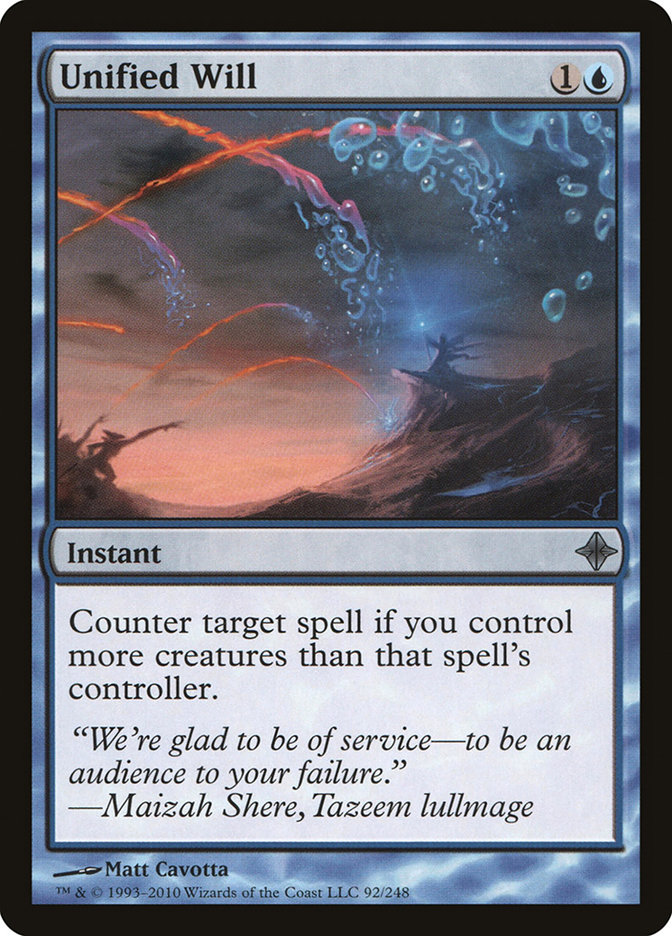
Unified Will (1U), from Rise of the Eldrazi (2010), counters a spell if you control more creatures. It’s a Modern and Pioneer staple in Simic Merfolk or Bant Spirits, rewarding board presence.
In Commander, it fits creature-heavy blue decks like Kumena, Tyrant of Orazca. Its conditionality requires creature-based strategies, so pair with token generators like Young Pyromancer. Its efficiency makes it a hidden gem.
- Best In: Modern Merfolk, Commander tokens
- Synergy:Kumena, Young Pyromancer, Kykar
- Watch For: Creature-light boards, instant-speed wipes
23. Abjure
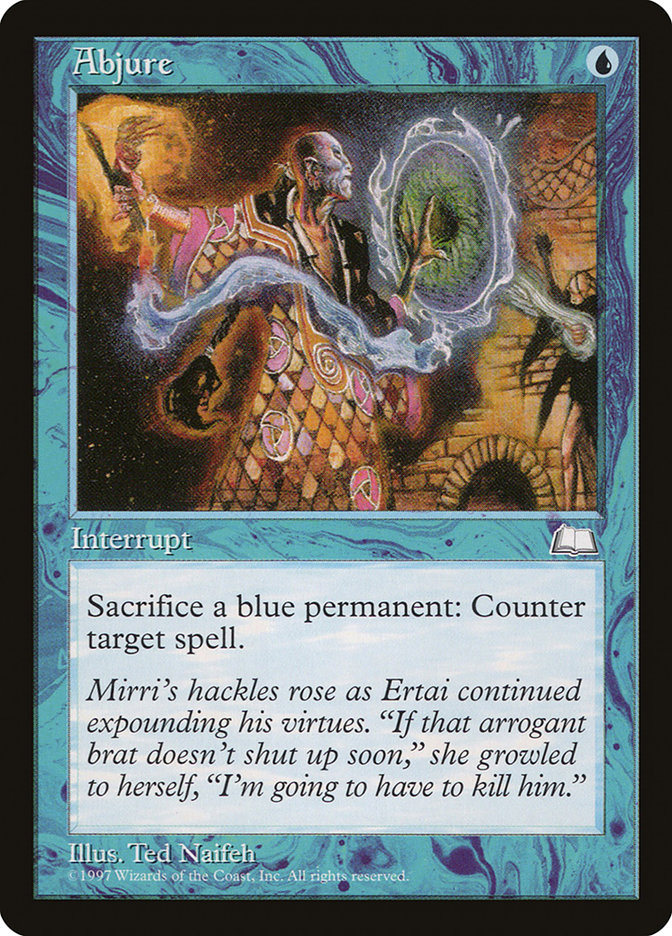
Abjure (U), from Weatherlight (1997), counters a spell by sacrificing a blue permanent. It’s a budget gem in Commander decks with expendable blue tokens (e.g., Thassa, Deep-Dwelling) or permanents like Saprazzan Skerry.
Its sacrifice cost requires synergy, but its one-mana efficiency is unmatched in the right build. Historically overlooked, it’s a niche pick for creative deck-builders.
- Best In:Commander budget blue, combo shells
- Synergy:Thassa, Saprazzan Skerry, Mystic Remora
- Watch For:Limited blue permanents, tempo loss
24. Spell Swindle
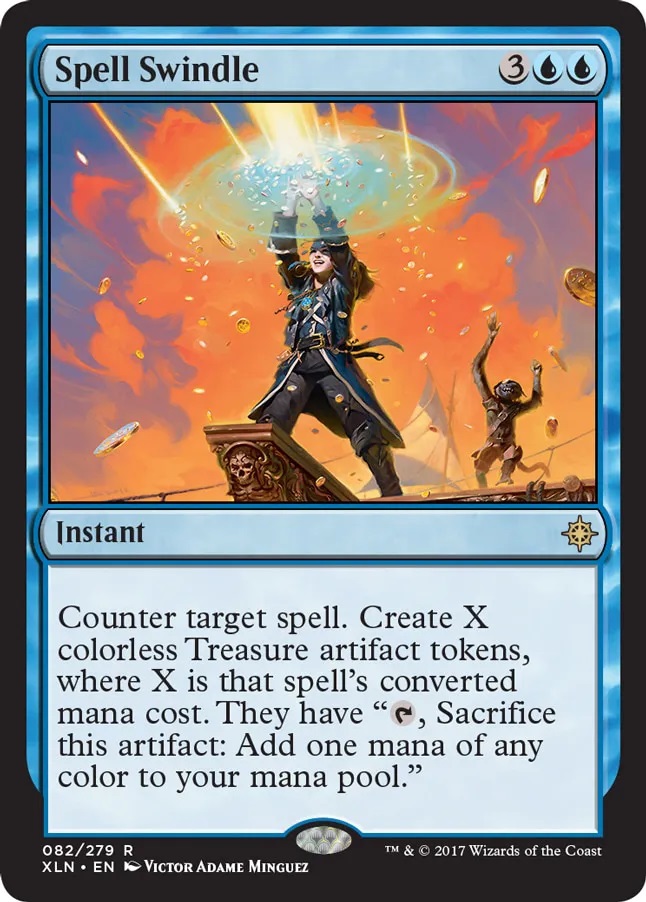
Spell Swindle (3UU), from Ixalan (2017), counters a spell and creates Treasure tokens equal to its mana value. In Commander, it’s a powerhouse in artifact decks like Galazeth Prismari, turning disruption into mana ramp.
Its high cost limits its use in Modern or Legacy, but its payoff is massive in slower metas. Synergizes with artifact synergies like Inspiring Statuary for explosive turns.
- Best In: Commander artifact/ramp decks
- Synergy:Galazeth Prismari, Inspiring Statuary, Academy Manufactor
- Watch For: High cost, dead early-game draws
25. Desertion
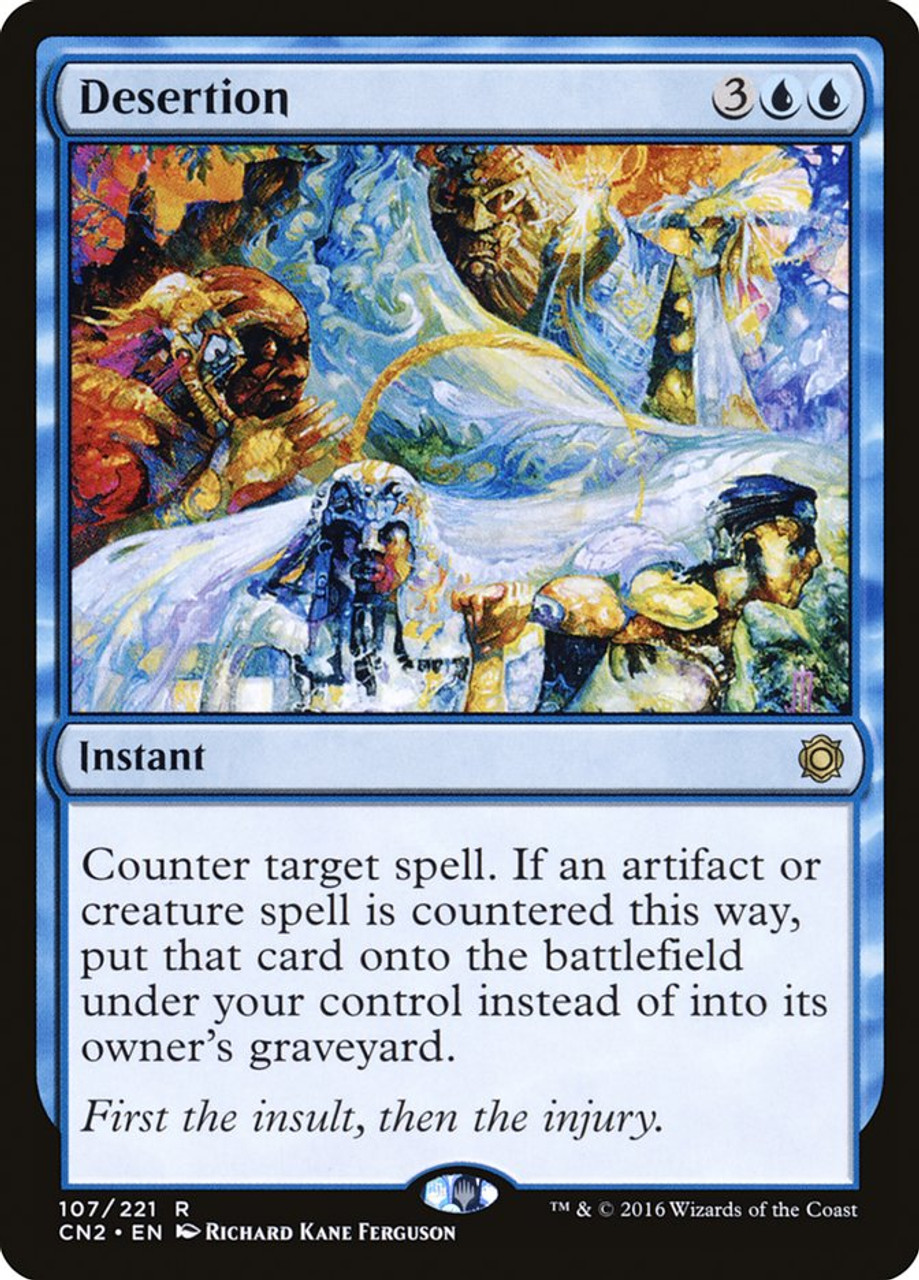
Desertion (3UU), from Visions (1997), counters a creature or artifact spell and puts it under your control. In Commander, it steals commanders or bombs like Blightsteel Colossus, swinging games.
Its high cost makes it situational in constructed formats, but its impact is unmatched in casual play. Synergizes with flicker effects like Deadeye Navigator to reuse stolen permanents. A classic for control enthusiasts.
- Best In:Commander control, blink decks
- Synergy:Deadeye Navigator, Teleportation Circle, Bribery
- Watch For:High CMC, few creature targets
26. Mindbreak Trap
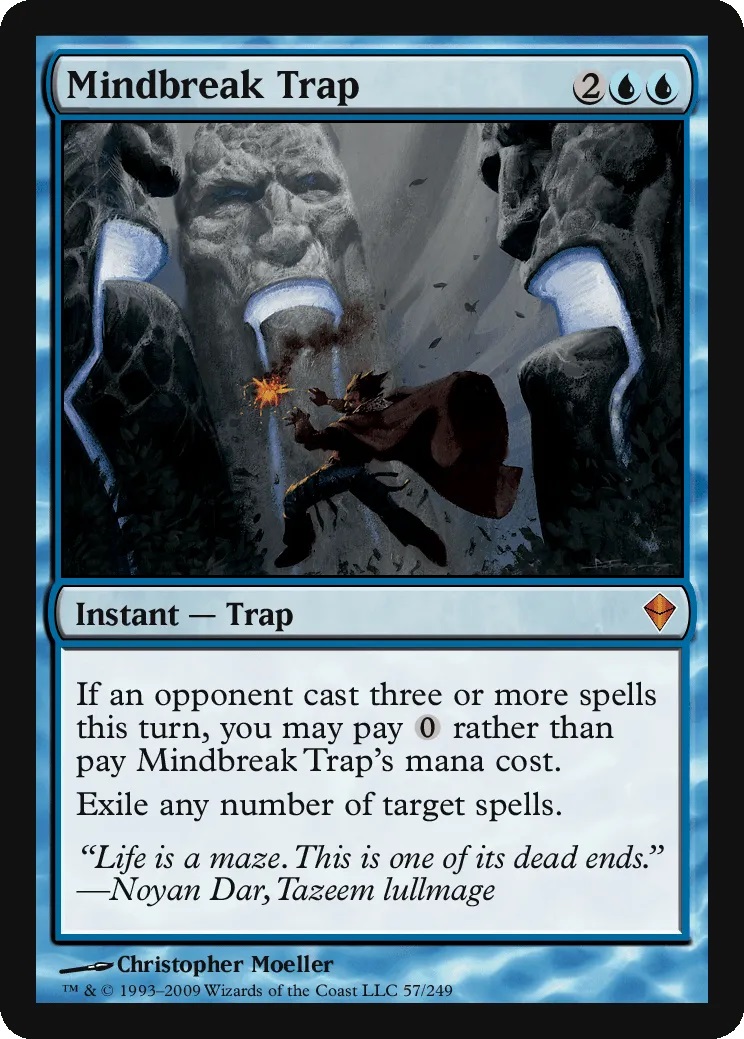
Mindbreak Trap (2UU or free if an opponent cast three spells this turn), from Zendikar (2009), exiles a spell, bypassing “cannot be countered” effects. A Legacy and Vintage staple against storm decks, it’s also a cEDH answer to spell-slingers like Kess.
Its free mode rewards timing, so hold it for combo turns. Synergizes with graveyard hate like Rest in Peace to prevent recursion.
- Best In:Legacy/Vintage Storm hate, cEDH
- Synergy: Notion Thief, Narset, Rest in Peace
- Watch For:Timing misplays, reactive use only
27. Stern Scolding
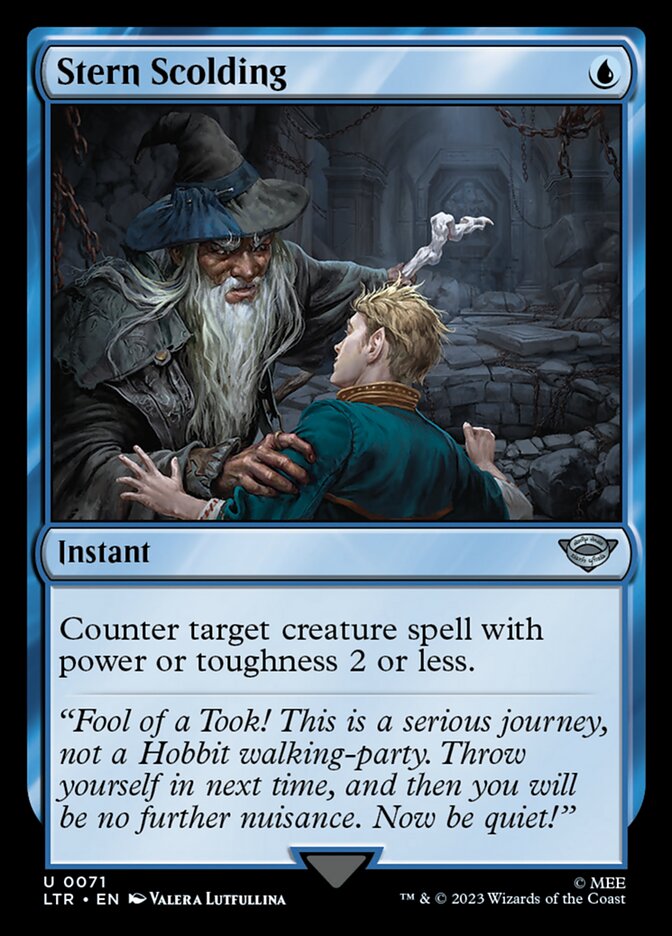
Stern Scolding (U), from The Lord of the Rings: Tales of Middle-earth (2023), counters a creature spell with power or toughness 2 or less. It hits Modern and Legacy staples like Ragavan or Delver of Secrets.
In Commander, it’s a budget answer to utility creatures like Esper Sentinel. Its situational nature requires meta knowledge, but its efficiency shines in creature-heavy formats.
- Best In:Modern/Legacy control, budget Commander
- Synergy:Spellstutter Sprite, Snapcaster Mage, Mystic Snake
- Watch For:Narrow targeting, weak in late-game
28. Forbid
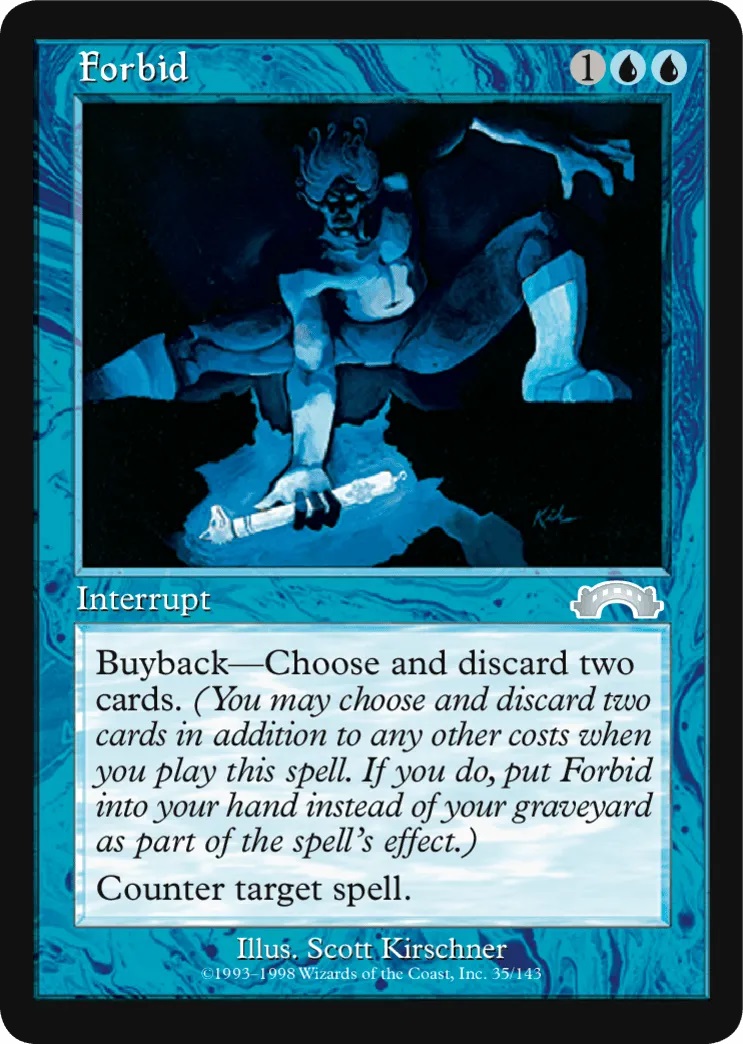
Forbid (1UU), from Exodus (1998), counters a spell with Buyback (discard two cards to return it to hand). In Commander, it’s a late-game powerhouse with draw engines like Rhystic Study, enabling repeated use.
Its discard cost limits its use in fast formats, but its recursion is unmatched in grindy games. Synergizes with wheel effects like Windfall to refill your hand.
29. Memory Lapse
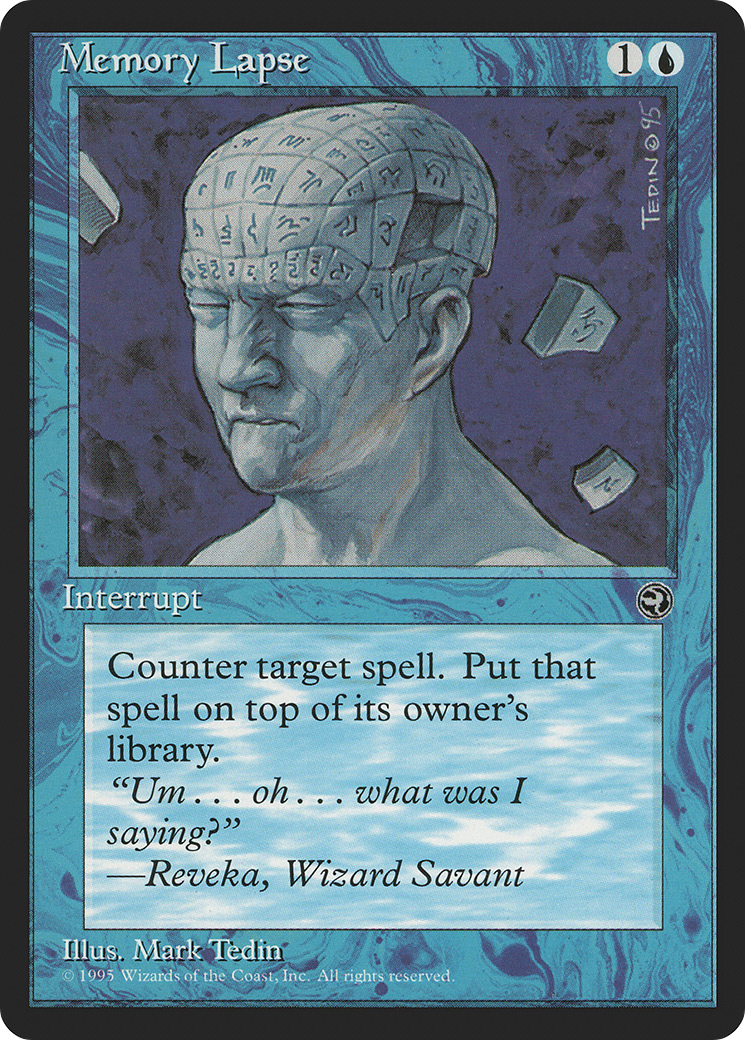
Memory Lapse (1U), from Homelands (1995), counters a spell and puts it on top of its owner’s library. In Standard and Pioneer, it’s a tempo play in control decks, delaying key spells. In Commander, it stalls commanders or bombs.
Pair with shuffle effects like Brainstorm to lock out opponents. Its historical reprint in Revised and Fifth Edition cemented its legacy as a tempo staple.
- Best In:Tempo decks, Commander stall builds
- Synergy: Brainstorm, Narset, Lantern Control
- Watch For:Doesn’t answer threats permanently
30. Miscast
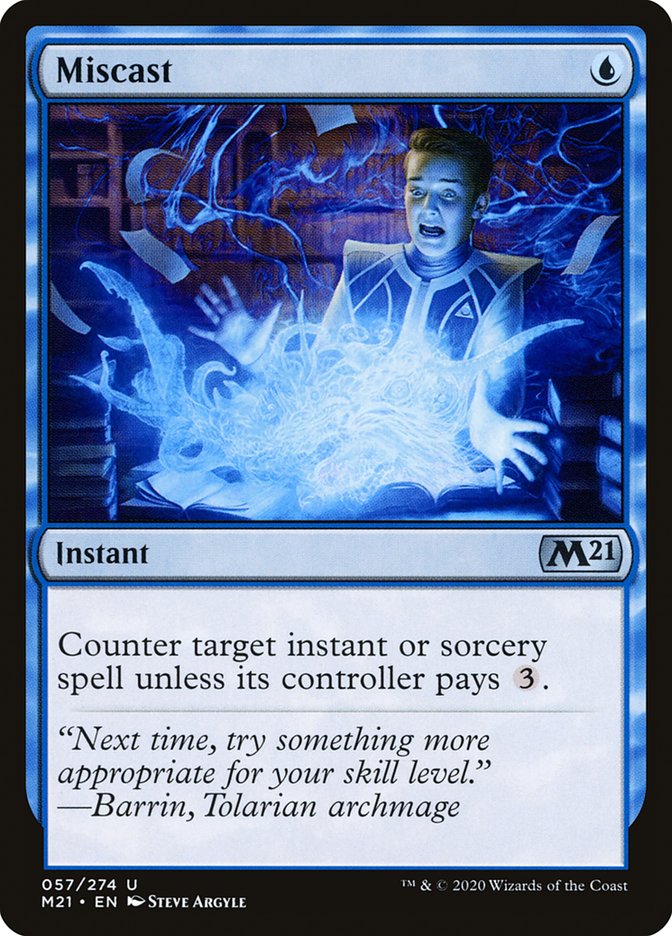
Miscast (U), from Core Set 2021, counters an instant or sorcery unless its controller pays 3. In Legacy and Modern, it’s a sideboard star against storm or control mirrors. In Commander, it protects key spells or stops Cyclonic Rift.
Its one-mana cost makes it a counter-war staple, but its narrow focus limits maindeck use. Synergizes with mana denial like Daze for maximum disruption.
- Best In:Legacy sideboards, Commander counter-wars
- Synergy:Daze, Flusterstorm, Arcane Denial
- Watch For:Useless against creatures, tempo-sensitive
31. Hydroblast / Blue Elemental Blast
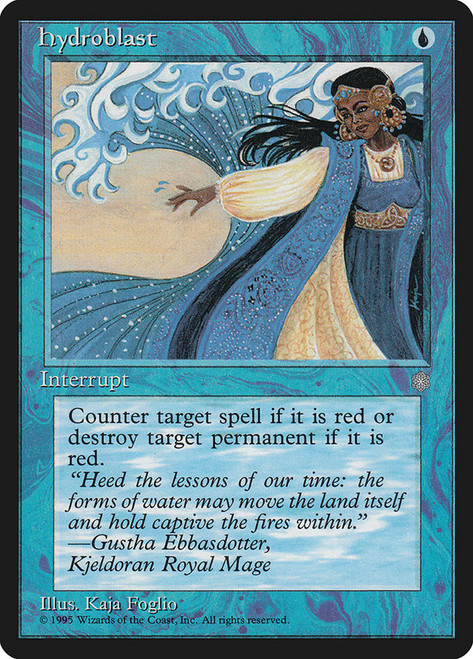
Hydroblast and Blue Elemental Blast (U), from Ice Age (1995) and Alpha (1993), counter a red spell or destroy a red permanent. Legacy and Vintage sideboard staples against Burn or Izzet Delver, they’re niche in Commander against red commanders like Torbran.
Their color-specificity requires a red-heavy meta, but their versatility shines in sideboards. Pair with dual-purpose cards like Pyroblast for flexibility.
- Best In:Legacy, Vintage sideboards
- Synergy: Pyroblast, color-hate cards, red-heavy metas
- Watch For: Torbran, Izzet Blitz, Burn spells
32. Remand
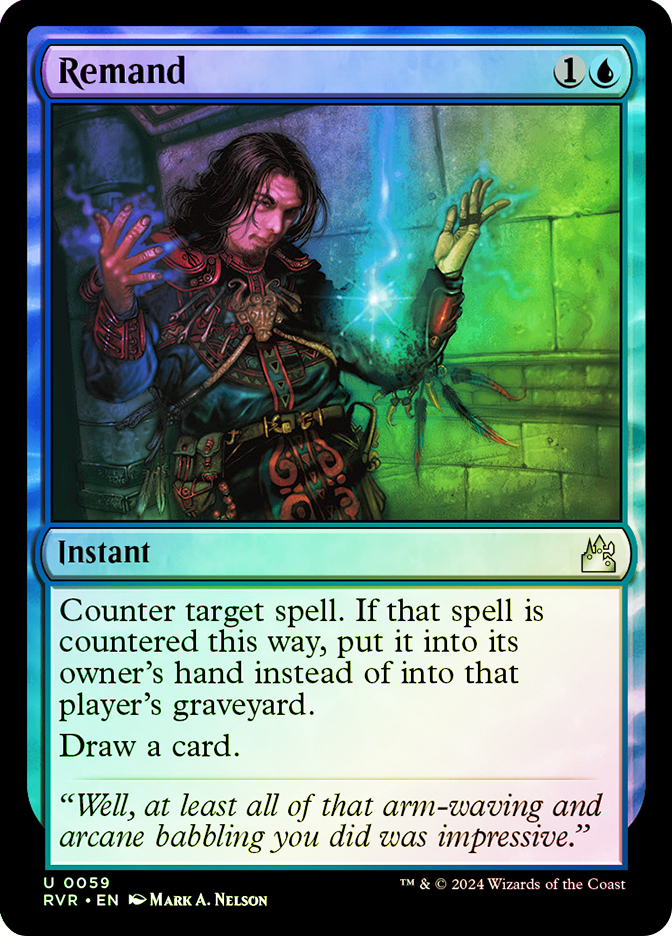
Remand (1U), from Ravnica (2005), counters a spell, returns it to hand, and draws a card. In Modern, it’s a tempo staple in Izzet Phoenix, delaying threats while cycling your hand. In Commander, it’s less impactful but disrupts key plays.
Synergizes with Snapcaster Mage for repeated use. Its tempo focus makes it less effective against resolved threats, so pair with removal.
- Best In: Modern tempo/control
- Synergy: Snapcaster Mage, Storm decks, mana denial
- Watch For: Cascade, storm triggers, uncounterable spells
33. Reverse The Polarity
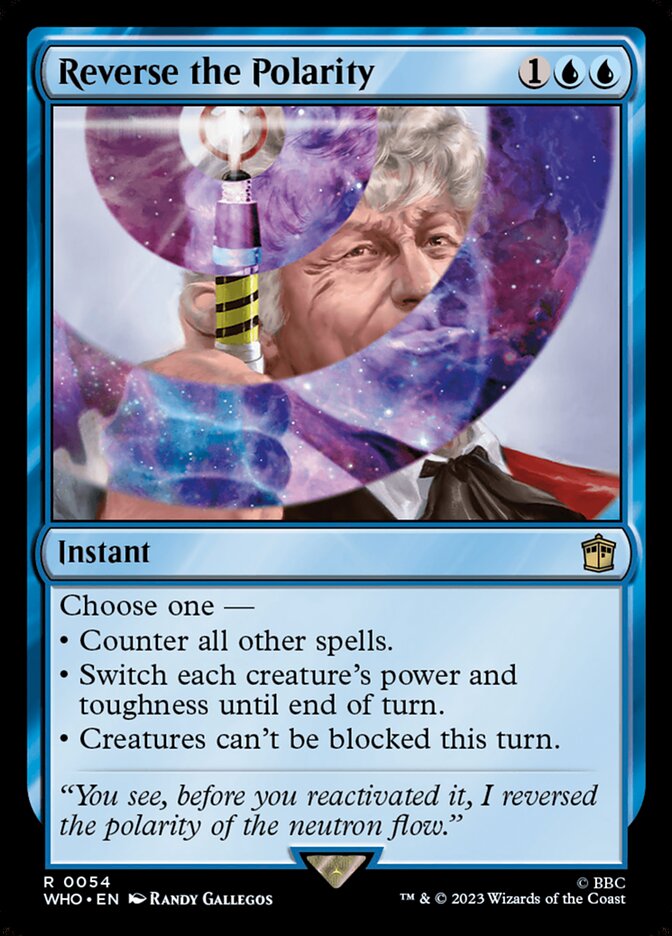
Reverse the Polarity (2UU), from Doctor Who (2023), is a Spree spell with a counterspell mode and additional stack-disruption options. In Commander, its flexibility shines in spell-heavy metas, allowing tailored responses.
Its high cost limits it in constructed formats, but its Spree mechanic synergizes with spell-copy effects like Double Vision for massive value. A flavorful addition for thematic decks.
- Best In: Commander, especially blue spell-slinger decks
- Synergy: Double Vision, Thousand-Year Storm
- Watch For: Cost inefficiency in fast metas
34. Mystic Confluence
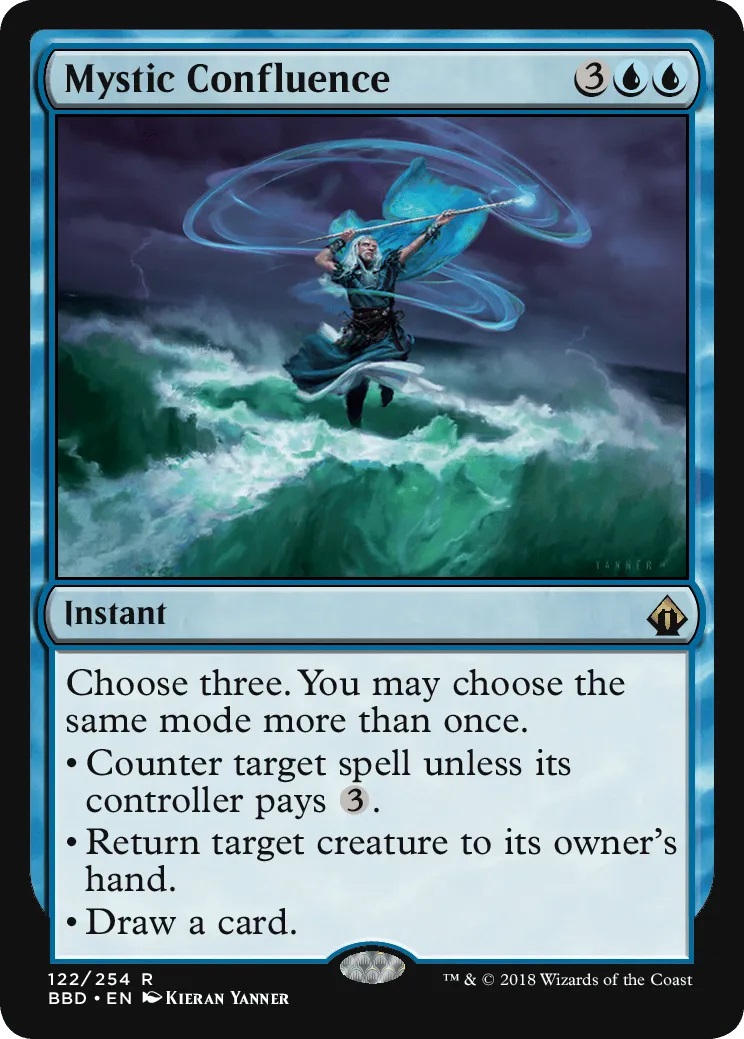
Mystic Confluence(3UU), from Battlebond (2018), chooses three modes: counter a spell, return a permanent, draw a card, or gain life based on hand size. In Commander, it’s a control powerhouse in decks like Baral, offering disruption and card advantage.
In Modern, it’s niche but effective in slow control decks. Synergizes with flicker effects like Yorion for repeated value.
- Best In: Commander, especially Baral or Talrand
- Synergy: Yorion, flicker decks, recursion
- Watch For: Mana cost, resolving full value
35. Malevolent Hermit // Benevolent Geist
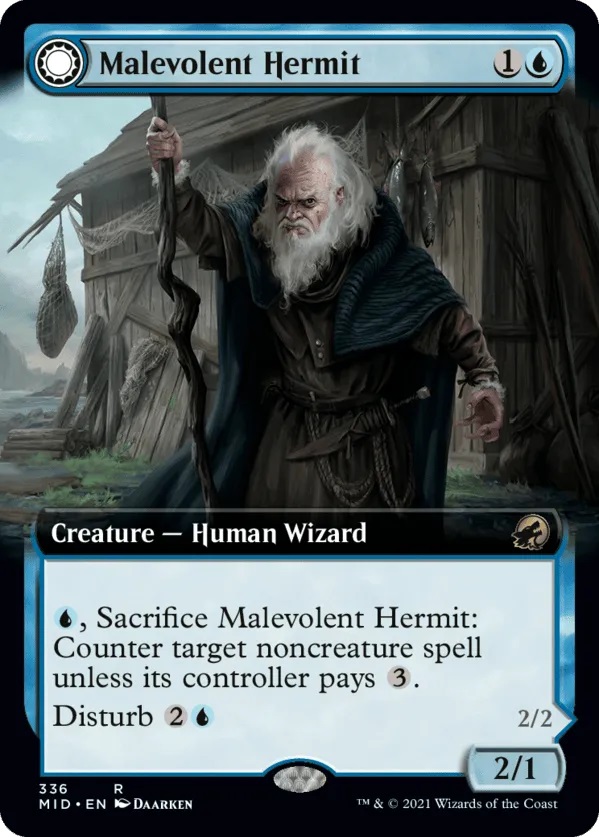
Malevolent Hermit (1U), from Innistrad: Midnight Hunt (2021), sacrifices a creature to counter a non-creature spell, while Benevolent Geist makes your non-creature spells uncounterable.
In Commander, it fits spell-heavy decks like Talrand, while in Pioneer, it shines in Azorius Spirits. Its dual nature offers both offense and defense, synergizing with token strategies or flicker effects.
- Best In: Commander spell-slinger or Pioneer Spirits
- Synergy: Talrand, flicker engines, token decks
- Watch For: Sacrifice timing, exile effects
36. Three Steps Ahead
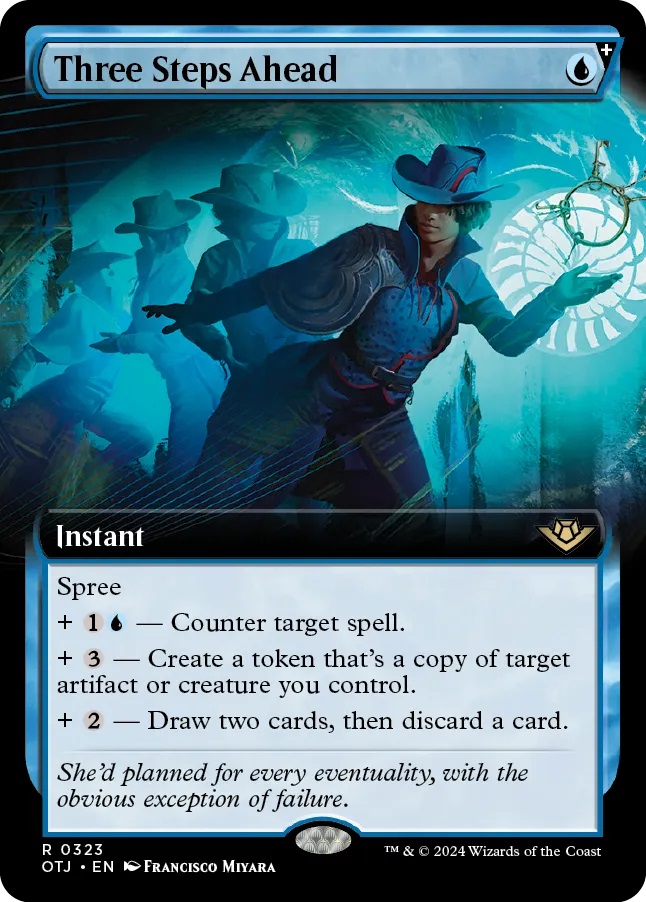
Three Steps Ahead (2UU), from Outlaws of Thunder Junction (2024), is a Spree spell with a counterspell mode, plus token creation or card draw. In Commander, its versatility suits control or tempo decks like Niv-Mizzet.
In constructed, its high cost limits it to slower metas, but its Spree mechanic synergizes with spell-copy cards like Stormchaser Mage. A modern design with broad appeal.
- Best In: Commander midrange/control
- Synergy: Stormchaser Mage, Thousand-Year Storm
- Watch For: Tempo loss in fast formats
37. Archmage’s Charm
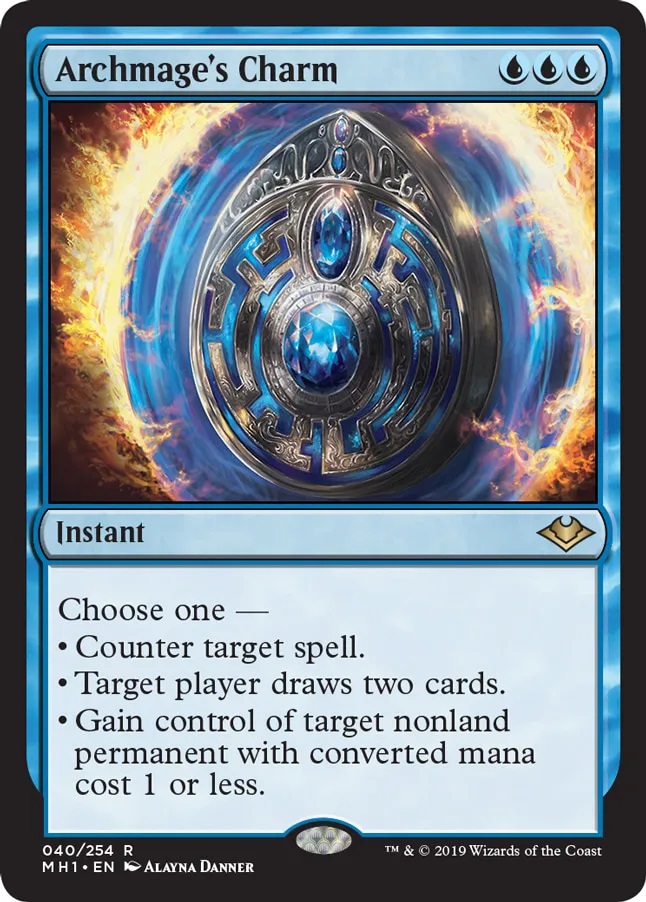
Archmage’s Charm (UUU), from Modern Horizons (2019), offers three modes: counter a spell, draw two cards, or steal a nonland permanent (mana value 1 or less). In Modern and Pioneer, it’s a control staple in Azorius or Dimir shells.
In Commander, it’s a high-value play for blue-heavy decks. Its triple-blue cost demands heavy blue commitment, but its flexibility is unmatched. Synergizes with Snapcaster Mage.
- Best In: Modern and Pioneer control decks
- Synergy: Snapcaster Mage, Isochron Scepter
- Watch For: UUU requirement, fast aggro decks
38. Sublime Epiphany
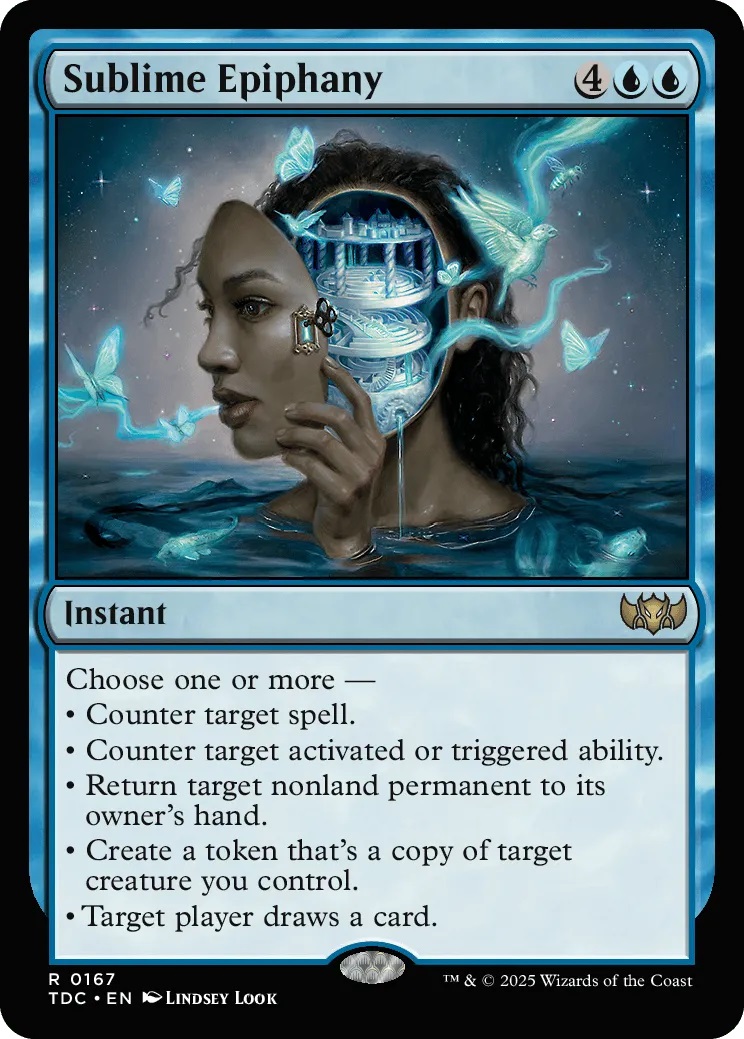
Sublime Epiphany (4UU), from Core Set 2021, offers five modes: counter a spell, draw a card, return a nonland permanent, copy a creature, or mill an opponent.
In Commander, it’s a game-changer in decks like Mizzix, turning tides with multi-effect value. Its high cost limits it in constructed, but its impact is massive. Synergizes with spell-copy cards like Narset’s Reversal for exponential value.
- Best In: Commander big-mana blue decks
- Synergy: Narset’s Reversal, Mizzix of the Izmagnus
- Watch For: Mana cost, counter wars
39. Essence Scatter
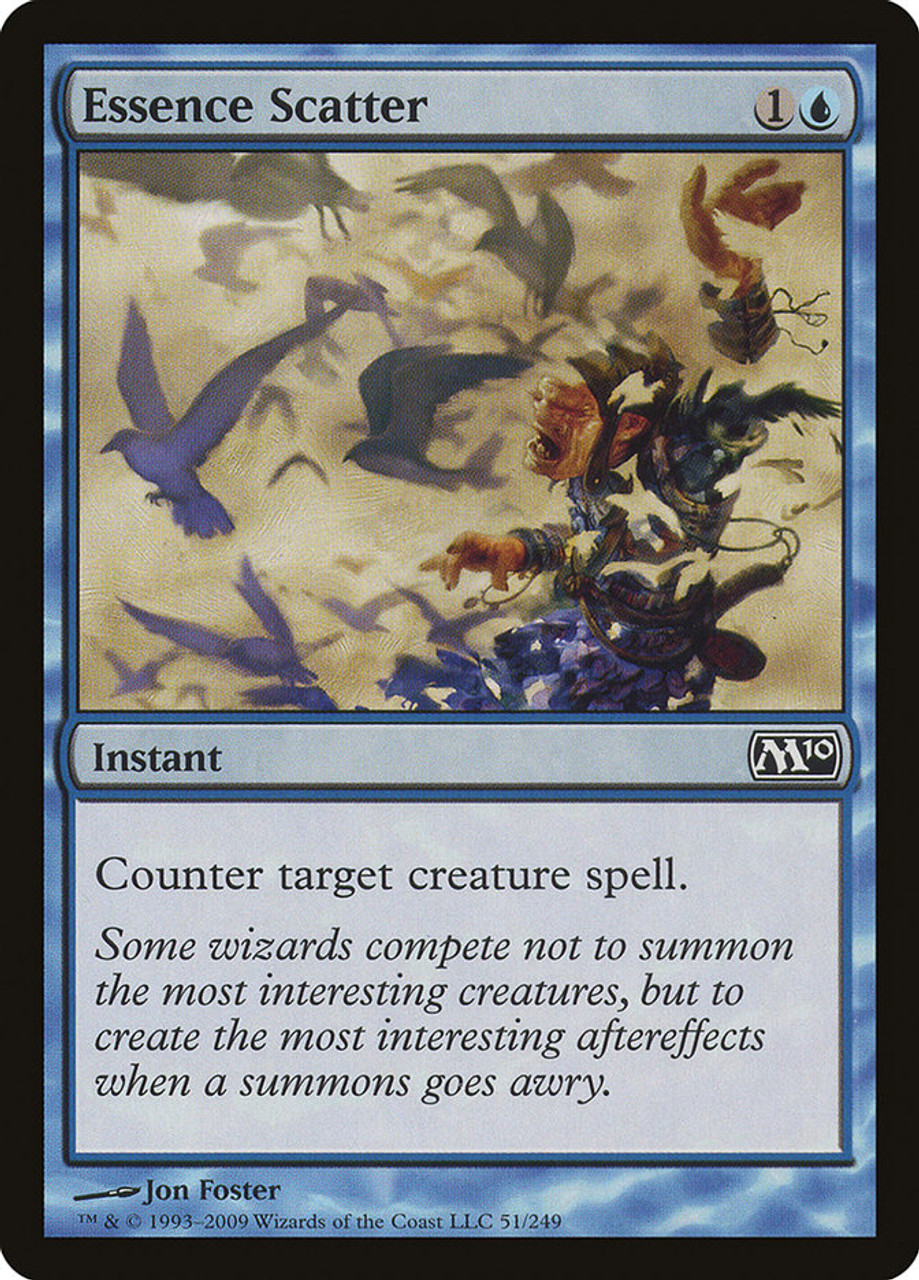
Essence Scatter (1U), from Magic 2010, counters a creature spell. A Standard and Pioneer staple against aggro decks like Mono-Green, it’s a budget Commander answer to commanders like Krenko, Mob Boss.
Its simplicity ensures maindeck viability in creature-heavy metas. Synergizes with creature removal like Heartless Act for a robust control package. A timeless budget option.
- Best In: Standard, Pioneer, budget Commander
- Synergy: Heartless Act, Doom Blade
- Watch For: Non-creature combo decks
40. Dissipate
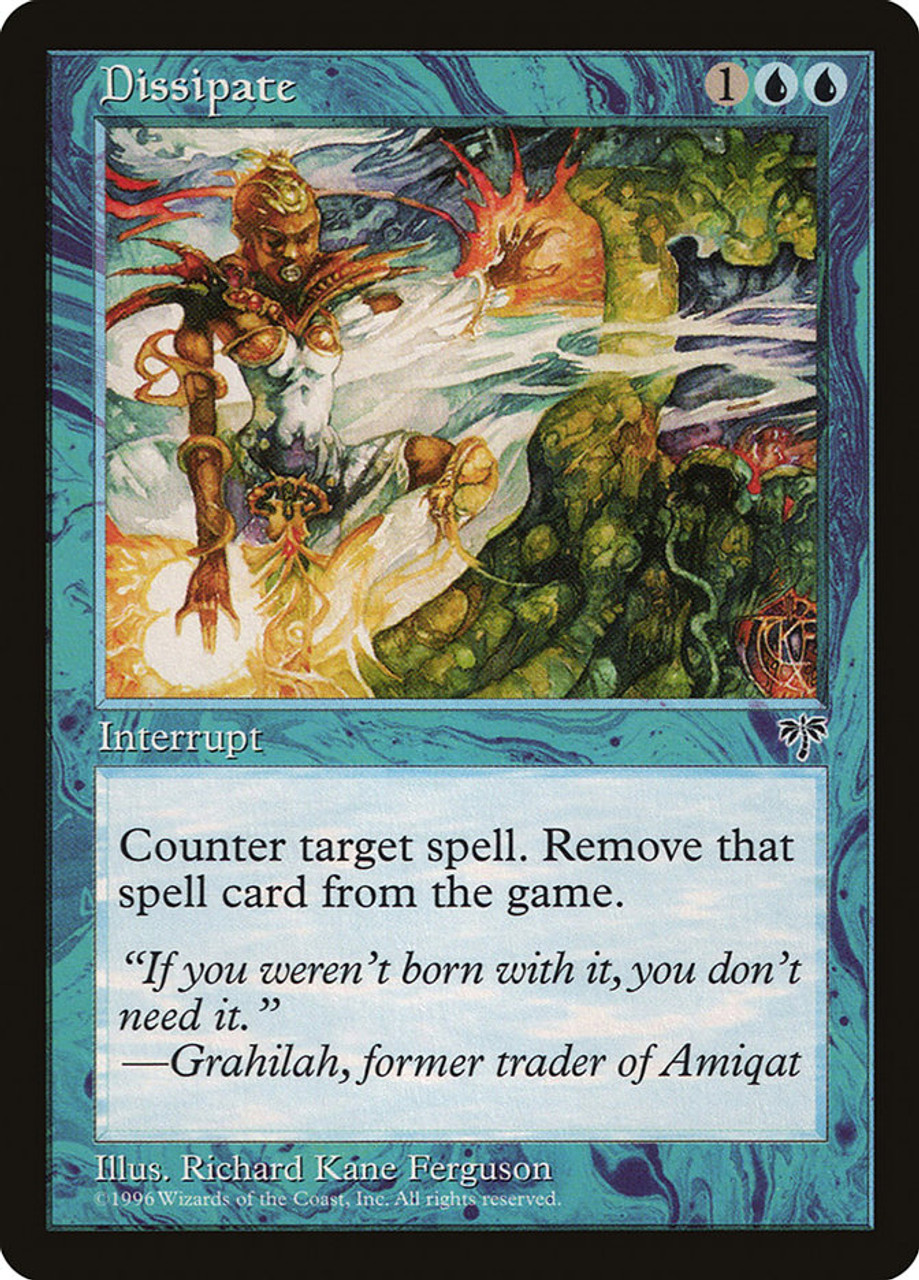
Dissipate (1UU), from Mirage (1996), counters a spell and exiles it, thwarting graveyard recursion. In Commander, it’s a strong answer to Muldrotha or reanimation decks.
In Standard and Pioneer, it’s a sideboard pick against graveyard strategies like Dredge. Its exile clause adds value over Counterspell in specific metas. Pair with graveyard hate like Tormod’s Crypt for synergy.
- Best In: Commander, graveyard-heavy metas
- Synergy: Tormod’s Crypt, Rest in Peace
- Watch For: Competing with Counterspell on efficiency
41. Sinister Sabotage
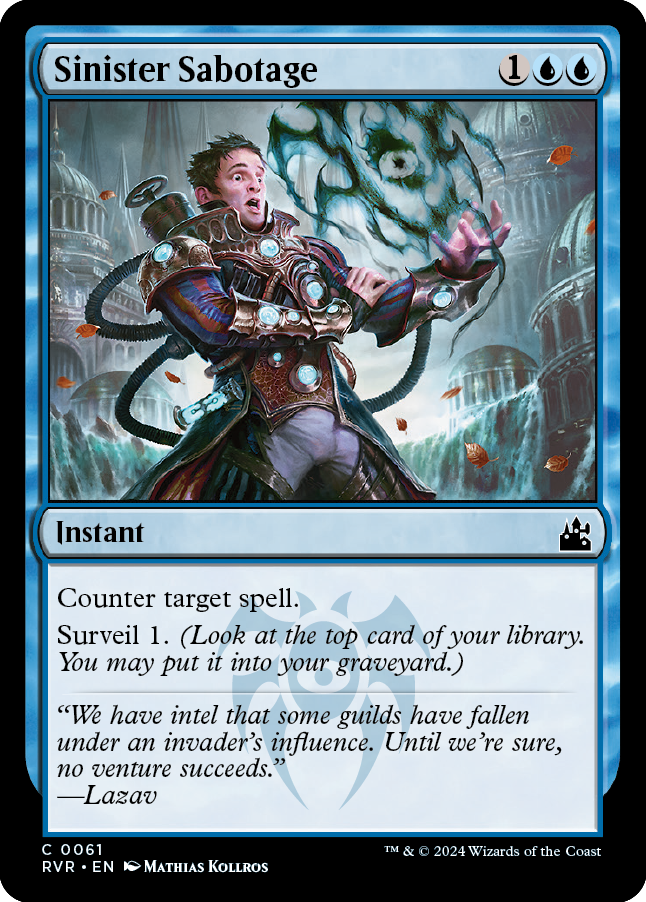
Sinister Sabotage (1UU), from Guilds of Ravnica (2018), counters a spell and surveils 1. In Standard and Pioneer, it’s a control staple in Dimir or Azorius decks, sculpting draws while disrupting.
In Commander, it synergizes with graveyard strategies like Tasigur. Its surveil mechanic adds value over Counterspell, especially in decks with delve or flashback cards.
- Best In: Pioneer and Commander control
- Synergy: Tasigur, delve, flashback spells
- Watch For: Graveyard loops, Dimir shells
42. Aether Gust
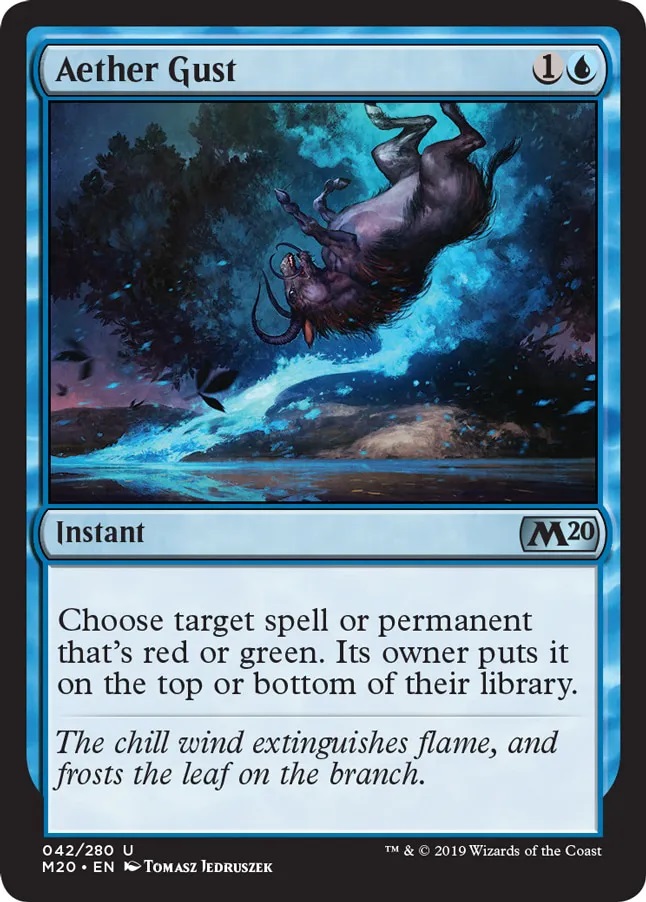
Aether Gust (1U), from Core Set 2020, counters a red or green spell or tucks a red/green permanent. In Modern and Pioneer, it’s a sideboard star against Gruul Midrange or Mono-Red Aggro.
In Commander, it’s niche but effective against red/green commanders like Xenagos. Synergizes with color-hate cards like Blood Moon. Its flexibility makes it a meta-dependent gem.
- Best In: Pioneer, Modern sideboards
- Synergy: Blood Moon, Narset, color hate
- Watch For: Xenagos, green/red combo decks
43. Tale’s End
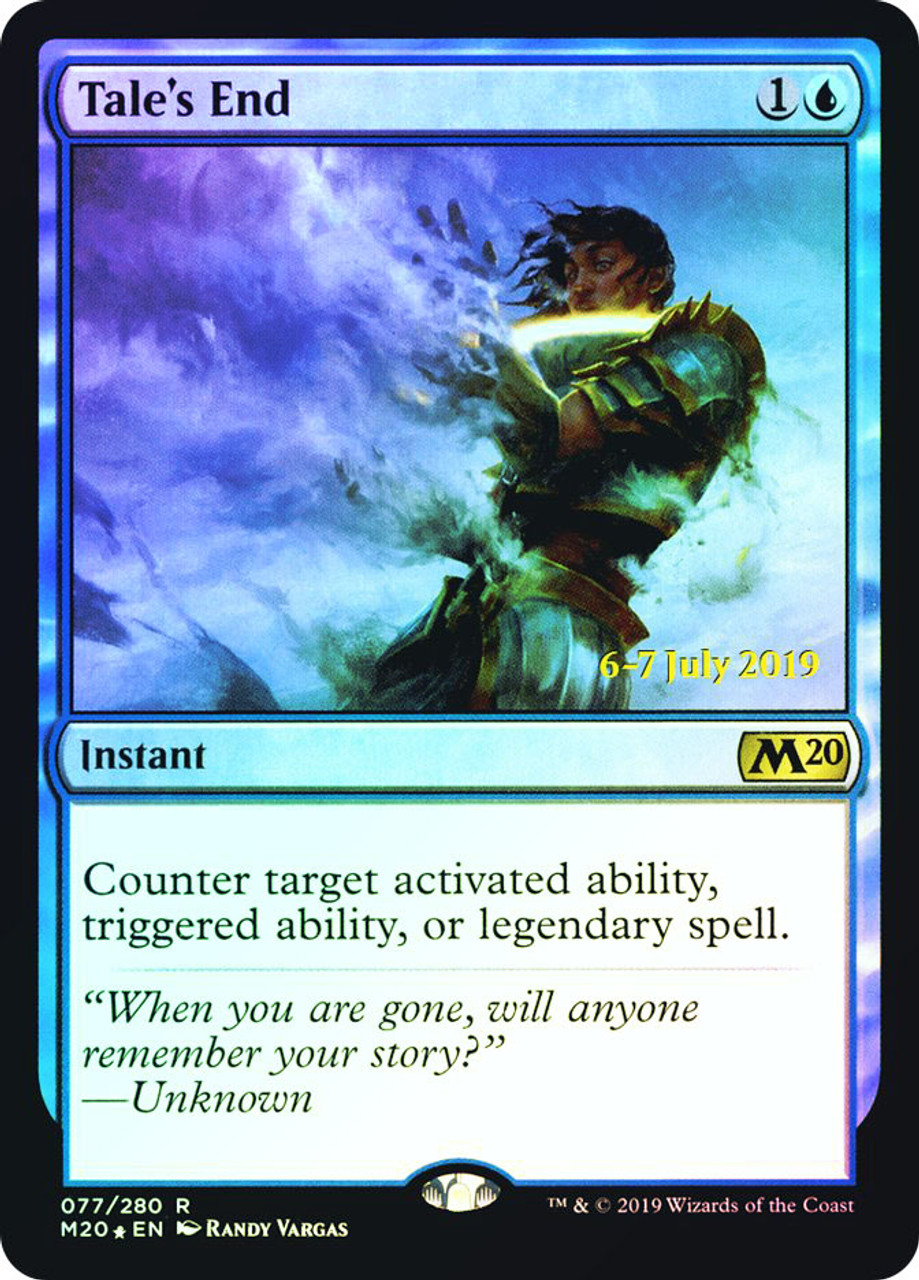
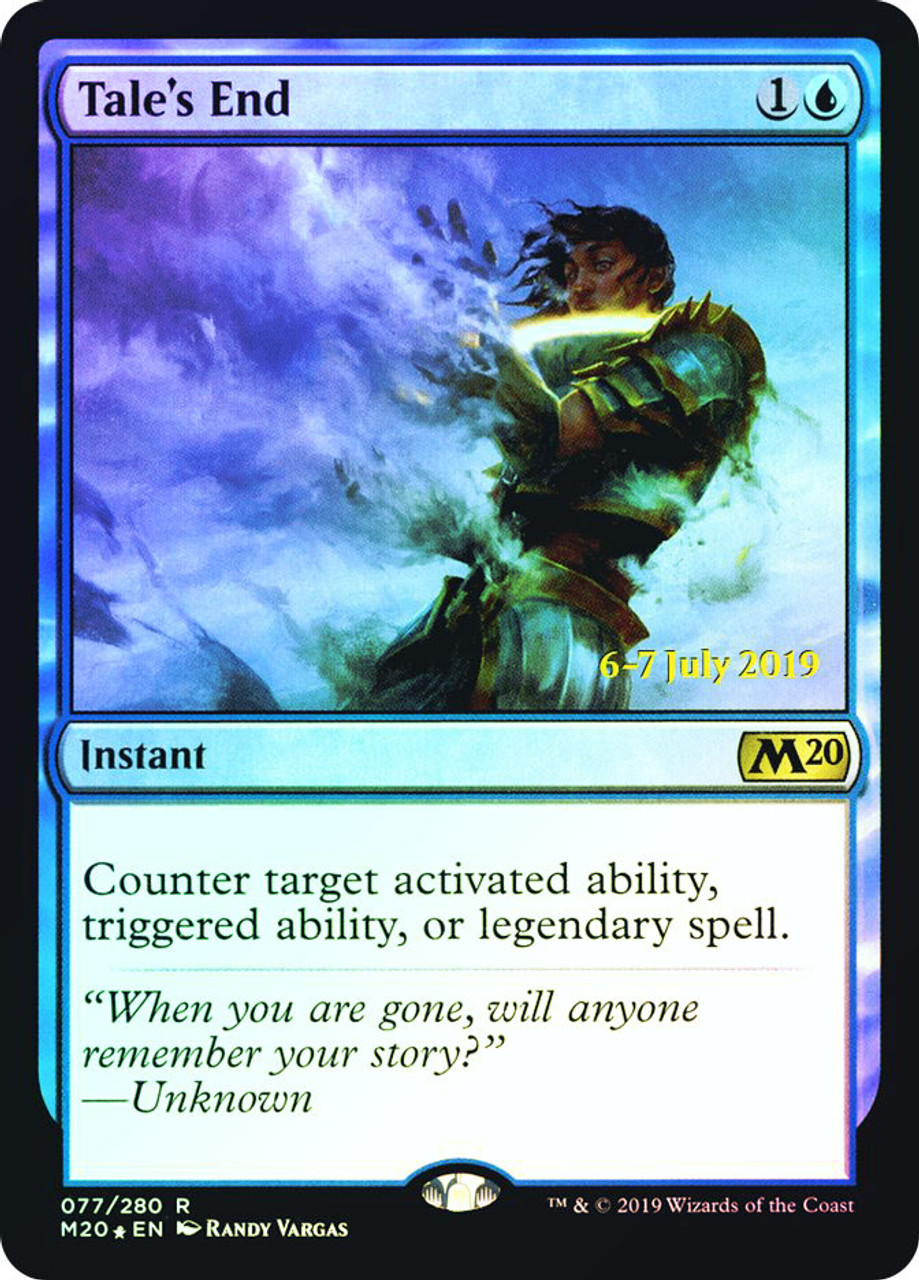
Tale’s End (1U), from Core Set 2020, counters a triggered ability or legendary spell. In Commander, it stops commander abilities (e.g., Korvold’s sacrifice trigger) or bombs like Ugin. In Standard and Pioneer, it’s a sideboard pick in legendary-heavy metas.
Its narrow focus requires meta knowledge, but its efficiency shines in the right context. Pair with removal for versatility.
- Best In: Commander and historic Standard
- Synergy: Korvold, Ugin, commander control
- Watch For: Bomb legends, ability stacks
44. Absorb
Absorb (WUU), from Invasion (2000), counters a spell and gains 3 life. In Modern and Pioneer, it’s a staple in Azorius Control, cushioning against Burn while stopping threats. In Commander, it shines in life-focused decks like Oloro.
Its multicolored cost requires a stable mana base, but its lifegain adds longevity. Synergizes with lifegain payoffs like Felidar Sovereign.
- Best In: Modern, Pioneer, life-based Commander decks
- Synergy: Oloro, lifegain triggers, Felidar Sovereign
- Watch For: Burn, red aggro
45. Rewind
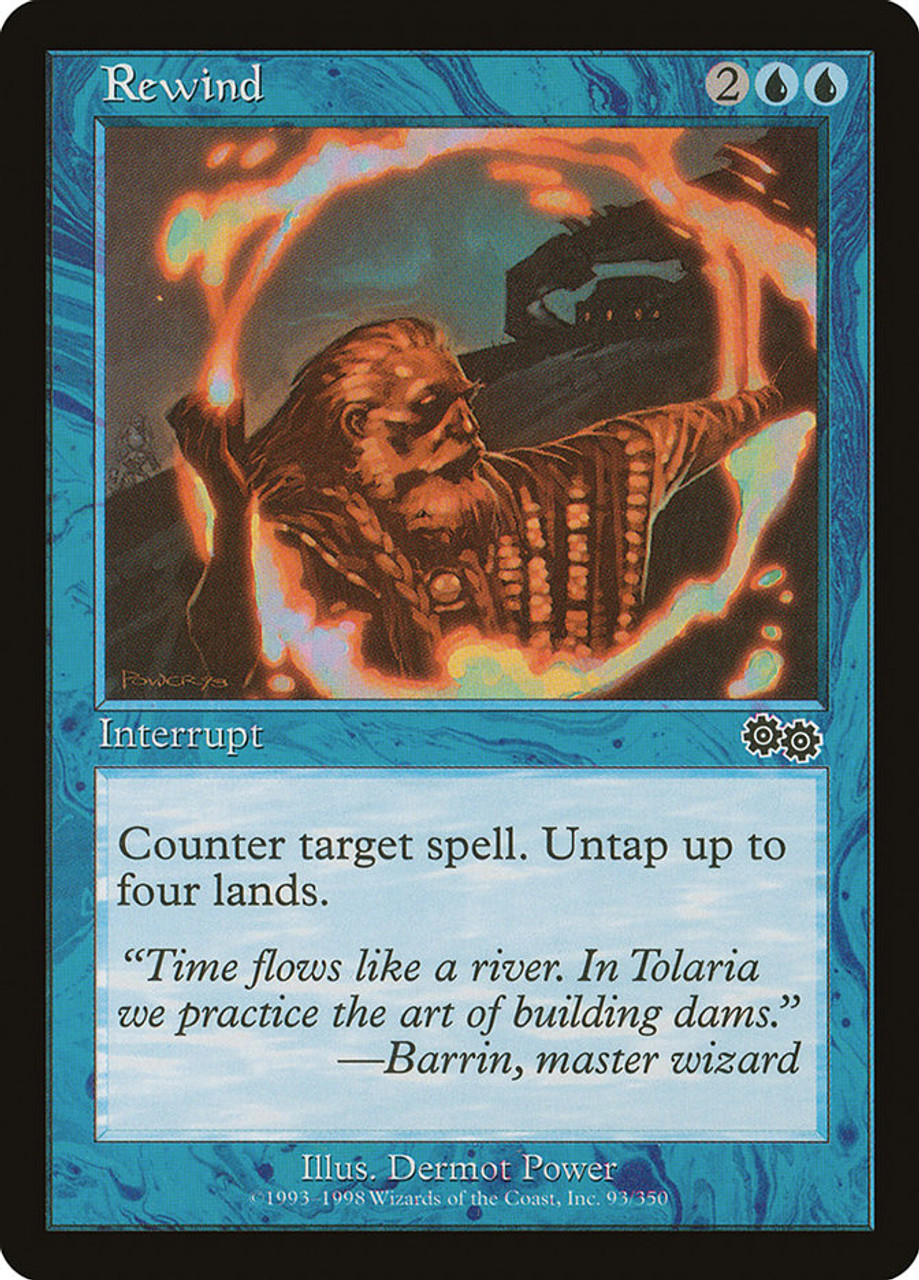
Rewind (2UU), from Urza’s Saga (1998), counters a spell and untaps four lands. In Commander, it’s a powerhouse in spell-slinging decks like Mizzix, enabling chained spells. In constructed, its high cost limits it to slow control decks like Blue Moon.
Synergizes with high-cost spells like Time Stretch for massive turns. Its mana refund makes it a unique control tool.
- Best In: Commander spell-slinger
- Synergy: Time Stretch, Mizzix, High Tide
- Watch For: Mana sinks, extra turn chains
46. Arcane Denial
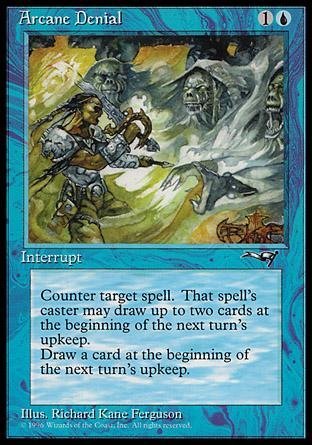
Arcane Denial (1U), from Alliances (1996), counters a spell, drawing you a card next upkeep while giving your opponent two cards. In Commander, its low cost and card draw make it a staple in spell-heavy decks like Talrand, despite the opponent’s draw.
In Legacy, it’s niche but effective in budget control builds. Its drawback requires careful use, but it synergizes with group-hug strategies or wheel effects.
- Best In: Commander, budget Legacy
- Synergy: Wheels, group hug, Talrand
- Watch For: Opponent draw, politics
47. Stubborn Denial
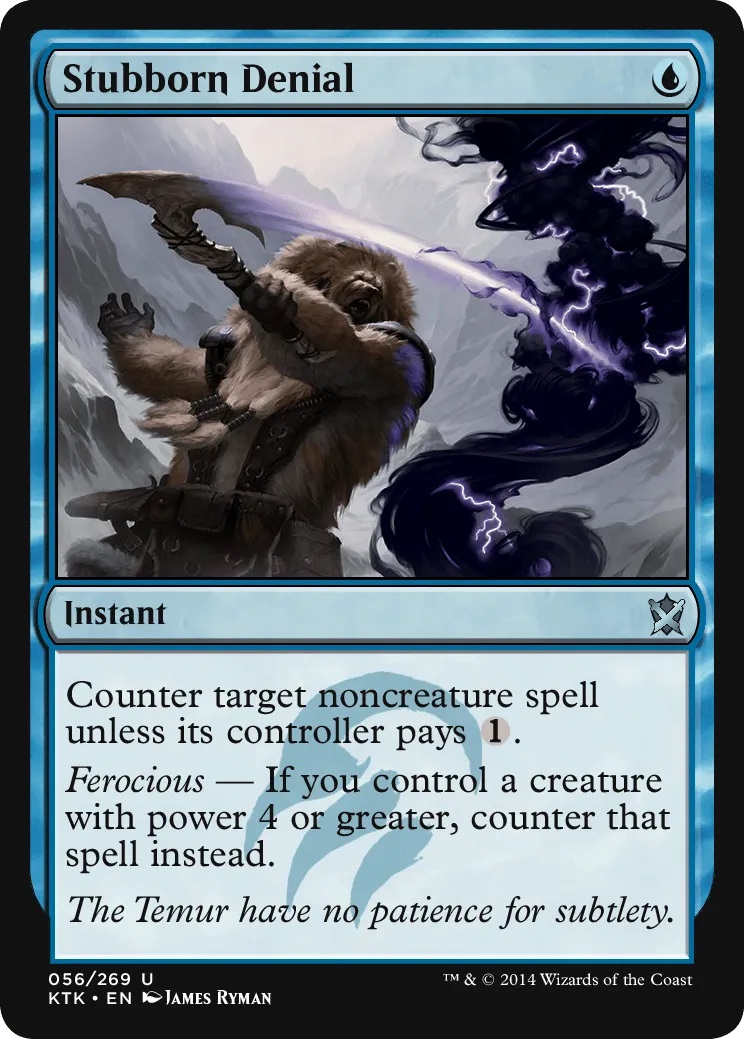
Stubborn Denial (U), from Khans of Tarkir (2014), counters a non-creature spell (or any spell with Ferocious if you control a 4+ power creature). In Modern, it’s a staple in Izzet Prowess or Simic Infect, leveraging big creatures like Murktide Regent.
In Commander, it fits aggressive blue decks like Arixmethes. Its conditionality demands creature synergy, but its one-mana cost is unmatched.
- Best In: Modern tempo, Commander aggro
- Synergy: Murktide, Arixmethes, prowess
- Watch For: Creatureless decks, combo mirrors
48. Saw It Coming
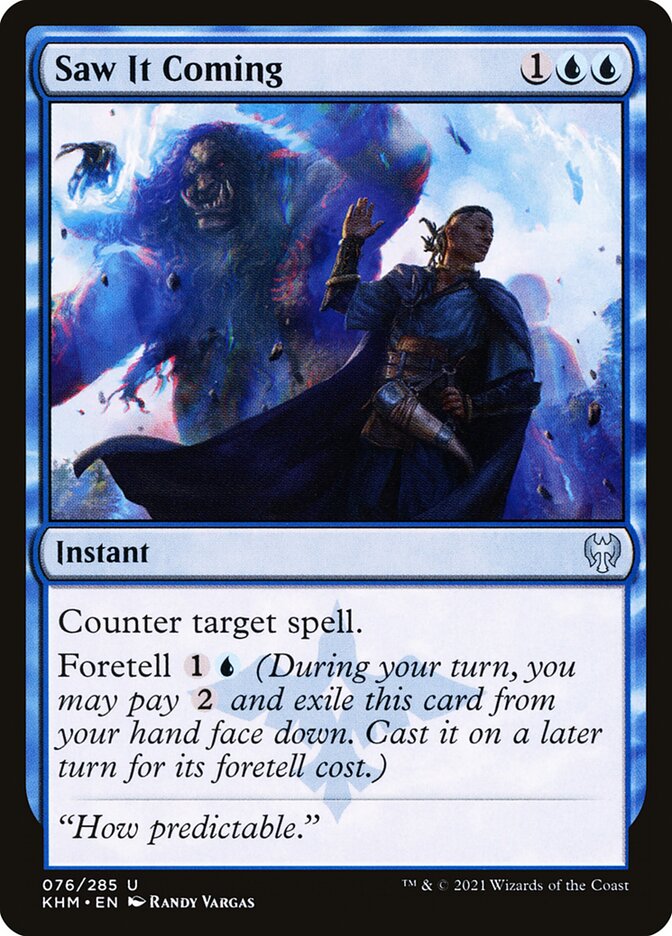
Saw It Coming (1UU), from Kaldheim (2021), counters a spell with Foretell (1U to exile, then cast for 1U). In Standard and Pioneer, its Foretell mechanic allows mana flexibility, holding up interaction without committing mana.
In Commander, it’s a solid control option in slower metas. Synergizes with Foretell cards like Behold the Multiverse for tempo and card advantage.
- Best In: Pioneer, Commander control
- Synergy: Behold the Multiverse, tempo decks
- Watch For: Mana efficiency, slow metas
49. Counterflux
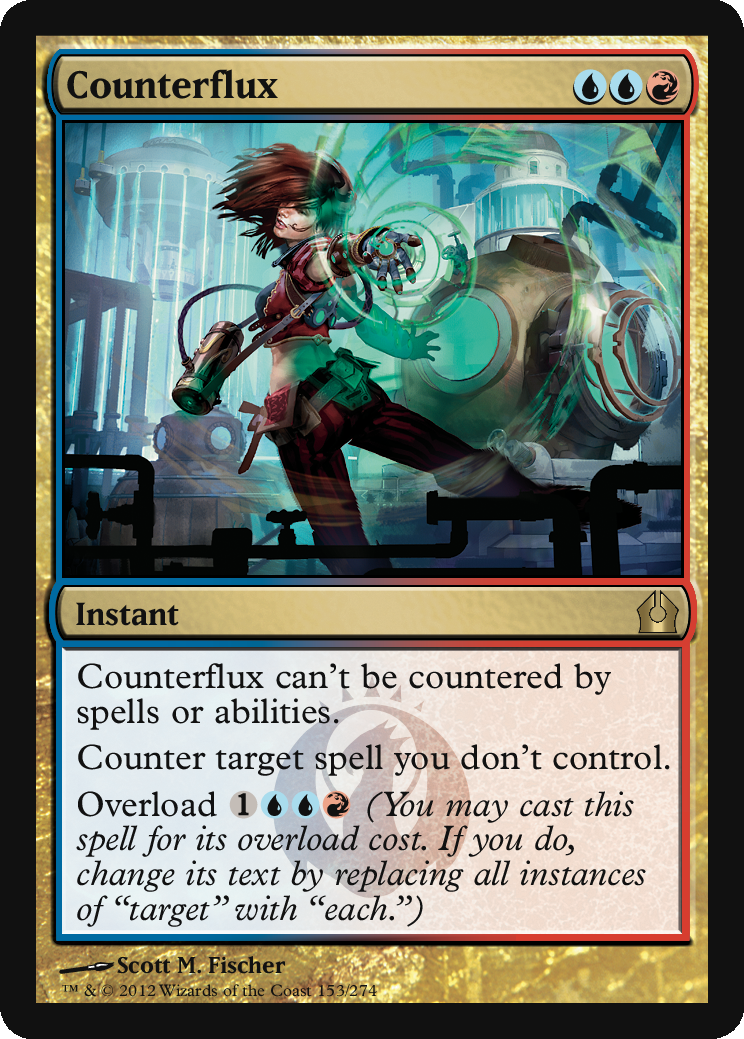
Counterflux (UUR), from Return to Ravnica (2012), counters a spell with Overload (3UUR to counter all spells on the stack). It can’t be countered, making it a Modern and Commander answer to uncounterable spells like Supreme Verdict.
In Izzet decks, its mana cost is manageable, and its Overload mode shines in stacked turns. Synergizes with spell-copy effects for maximum disruption.
- Best In: Commander, Modern sideboards
- Synergy: Twinning effects, Izzet control
- Watch For: Combo turns, cascade decks
50. Narset’s Reversal
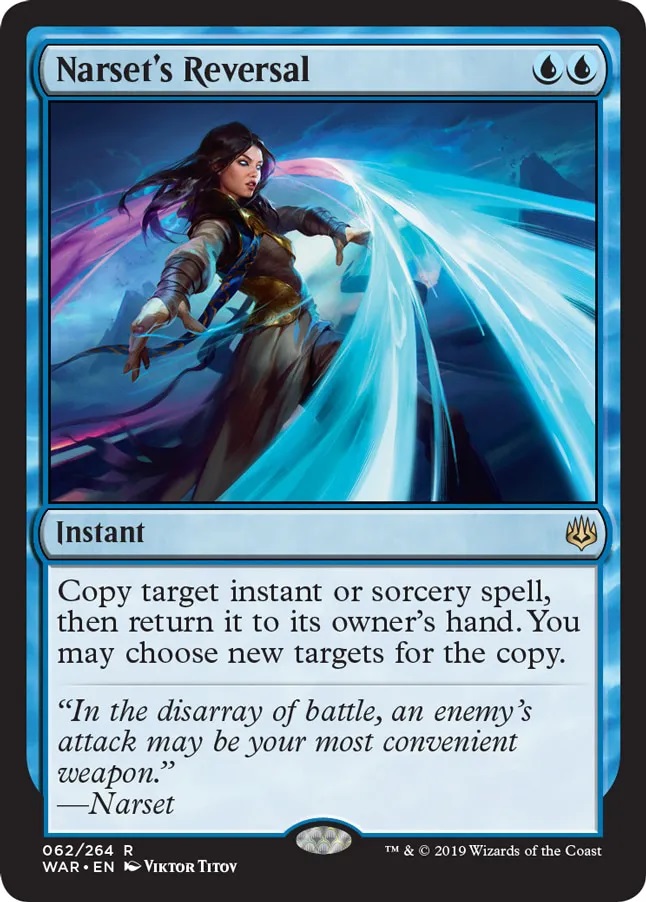
Narset’s Reversal (UU), from War of the Spark (2019), counters a spell and returns it to its owner’s hand, copying it for you to cast. In Commander, it’s a swingy play in spell-slinging decks like Niv-Mizzet, stealing bombs like Expropriate.
In Modern, it’s niche but effective against high-value spells. Synergizes with spell-copy cards like Twinning Staff or double-casting effects like Ral, Storm Conduit.
- Best In: Commander spell-slinger
- Synergy: Niv-Mizzet, Twinning Staff, Ral
- Watch For: Expropriate, Time Warp, game-winning sorceries
When And How To Use Your Counterspells
Effective counterspell usage transcends merely having the cards; it demands precise timing, astute threat assessment, and masterful mana management.
Prioritizing Threats: What Deserves A "No"?
One common mistake is misidentifying threats. Not every spell warrants a counter. Before deploying your precious countermagic, ask yourself these crucial questions:
- Is this spell lethal or game-ending?(e.g., a combo piece, a powerful finisher, a wrath effect that clears your board).
- Does this spell significantly advance my opponent's board state or strategy?(e.g., a key synergy enabler, a powerful planeswalker, a persistent threat).
- Can I deal with this threat later through other means?(e.g., creature removal, bounce spells, or simply racing them).
- What are my opponent's likely follow-up plays if I let this resolve?Sometimes, letting a lesser threat resolve to save a counterspell for a more dangerous one is the optimal line.
Patience is paramount. Each counterspell is a valuable resource; its expenditure must be justified by its impact.
The Mana Game: Holding Up Vs. Tapping Out
A crucial decision point for blue mages is whether to tap out for your own spells or keep mana open for interaction.
- Tapping out typically means committing to your game plan and developing your board. This is usually done when you have a clear path to victory, a dominant board state, or if your opponent is also tapped out and unable to react.
- Holding up mana for counterspells signifies a defensive, reactive stance. This is ideal when you're behind, need to protect your key permanents, or want to disrupt your opponent's critical, game-winning turns.
The best blue players seamlessly transition between these two modes, adapting to the ebb and flow of the game and their opponents' actions.
The Art Of The Bluff: Psychological Warfare With Open Mana
Simply having open mana can be a remarkably powerful bluff. Your opponent, fearing a decisive counterspell, might play cautiously, casting less impactful spells or delaying critical plays. This hesitation buys you precious time, even if you don't actually hold the counterspell in hand.
Conversely, if you dohave the counterspell, this tactic increases the likelihood they'll walk right into it. Observing your opponent's hesitation, mana choices, and past behavior can provide crucial "tells" to inform your decisions.
Building A Deck With Counterspells: Numbers And Synergy
Integrating counterspells effectively requires more than just picking the strongest ones. It's about building a cohesive strategy that is both supported by and supports your chosen countermagic.
Finding The Right Balance: How Many Counterspells?
There's no single magic number; the ideal count depends on your deck's archetype, the format you're playing, and your playgroup's specific metagame.
- Dedicated Control Decks:These decks often run a substantial suite of 8-12+ counterspells, forming the very core of their interaction package. In Commander, aiming for 10-15 pieces of interaction (a balanced mix of counterspells and removal) is a strong starting point for a robust control shell.
- Tempo/Midrange Decks:These decks might include 4-8 counterspells, focusing on efficiently disrupting key threats while simultaneously developing their own board presence and advancing their game plan.
- Combo Decks:Some combo decks strategically incorporate 2-4 counterspells specifically to protect their critical combo pieces from disruption, ensuring their game-winning strategy resolves successfully.
The balance is delicate: too few, and you risk being overwhelmed by opposing threats; too many, and you might find yourself with a hand full of reactive spells but no clear path to victory.
Maximizing Value: Key Synergies And Payoffs
Counterspells are excellent at preventing your opponent from winning, but they don't inherently win the game themselves. This is precisely where synergistic cards become vital to your strategy.
- Card Draw & Selection: To ensure you consistently have a counterspell when needed, and to efficiently refill your hand after expending resources, reliable card draw is paramount. Cards like Opt, Serum Visions, and Brainstorm are essential for finding your answers.
- Cost Reducers & Trigger Payoffs:Creatures like Baral, Chief of Compliance make your instants and sorceries cheaper, allowing for even more efficient use of your mana and often enabling more plays per turn. Cards that trigger off casting instants or sorceries, such as Talrand, Sky Summoner or Archmage Emeritus, transform your defensive counterspells into offensive threats (e.g., creating tokens) or powerful draw engines.
- "Draw-Go" Enablers:The classic "draw-go" strategy involves passing the turn with mana open, daring your opponent to play a spell into your interaction. This works exceptionally well with instant-speed card draw or powerful flash creatures like Hullbreaker Horror. Your opponents are left guessing whether your untapped Islands represent a Counterspell, a draw spell, or a game-ending threat, forcing them to play cautiously and often suboptimally.
- Removal: While counterspells masterfully stop spells on the stack, they don't directly deal with permanents already on the battlefield. Pairing blue with colors like black (Fatal Push), white (Swords to Plowshares), or red (Lightning Bolt) provides crucial answers to resolved threats, creating a complete interaction suite.
Addressing Counterspell Challenges: Drawbacks And Uncounterable Spells
While undeniably powerful, counterspells are not without their inherent weaknesses. Recognizing and strategically mitigating these drawbacks is key to sustained success and optimal gameplay.
Mana Inefficiency And Tempo Loss
Consistently holding up mana without casting a spell is often termed "wasting mana." If you frequently leave mana open for a counterspell that never materializes, you risk falling behind on board development.
This highlights why flexible interaction, such as Archmage's Charm (which can counter, draw, or steal a small permanent), is so highly valued-it provides options even if a counterspell isn't needed.
Card Disadvantage
Many counterspells are straightforward 1-for-1 trades (your counterspell for their spell). If your opponent consistently plays spells that generate card advantage (e.g., [Divination], creatures with powerful "enters the battlefield" triggers), you can quickly fall behind in card count. This emphasizes the critical need for your own robust card advantage engines to keep pace and maintain resource parity.
Uncounterable Spells
Some powerful threats are simply designed to be "uncounterable" (e.g., [Carnage Tyrant] or spells with explicit "cannot be countered" clauses). For these formidable threats, your deck must have alternative answers, typically through efficient removal, bounce effects, or mass exiling spells.
However, certain unique counterspells like Mindbreak Trap can bypass "uncounterable" clauses by exiling the spell from the stack instead of technically "countering" it, offering a powerful, albeit narrow, last resort.
People Also Ask
What Are The Most Essential Blue Counterspells Every Player Should Know?
The absolute essentials that form the backbone of blue control include Counterspell, Mana Leak, and Negate. For competitive play and high-power Commander, Force of Will, Force of Negation, and Fierce Guardianship are top-tier choices due to their ability to provide crucial free interaction, even when tapped out.
How Many Counterspells Should A Blue Deck Have?
For a dedicated control deck, especially in Commander, aiming for 10-15 pieces of interaction (a balanced mix of counterspells and removal) is a strong starting point.
For tempo or midrange decks, 4-8 counterspells are usually sufficient to disrupt key plays while developing your own board. The exact number ultimately depends heavily on your deck's specific strategy, the format you're playing, and your local metagame.
Are There Any Non-blue Counterspells In MTG?
While blue is the predominant color for counterspells, other colors do possess a very limited number of effects that can counter spells.
Notable examples include Red Elemental Blast and Pyroblast (red, which specifically counter blue spells or permanents), Mana Tithe (white, a rare single-mana soft counter), Avoid Fate (green, which counters spells that target permanents you control), and some colorless options like Mindbreak Trap. These are often highly situational but can be crucial in specific matchups.
When Is The Best Time To Use A Counterspell?
The best time to use a counterspell is when your opponent casts a spell that poses a critical, game-ending threat, would significantly advance their core strategy, or is a key piece of a powerful combo.
Prioritize countering spells you cannot otherwise easily answer, or those that provide immediate, overwhelming value. Avoid using them on minor threats unless you have an abundance of answers and are specifically aiming to disrupt their early curve and tempo.
What Defines A “blue Player” In MTG?
A player who values control, card draw, and reactive play-disrupting opponents while building a slow, inevitable win.
Conclusion
Mastering Magic the Gathering blue counterspells is an ongoing journey that profoundly tests a player's strategic depth and adaptability. It transcends mere card efficiency, encompassing a profound understanding of the metagame, real-time threat assessment, and a subtle psychological battle waged with your opponent.
The ability to decisively say "no" to a game-ending threat or a crucial combo piece is precisely what makes blue control decks so potent and enduringly popular, whether you're battling in a highly competitive Modern tournament or engaging in a more casual game of Commander.
By internalizing the nuances of threat assessment, managing your mana effectively, and expertly leveraging the power of a well-placed bluff, you can elevate your blue gameplay from simply playing cards to truly dictating the very flow of the game.
Embrace the subtle, powerful art of the counterspell, and watch as your opponents' grand plans unravel before your eyes.
See Also: Merge Mansion Wiki
Jump to
Master The Art Of Saying "No": Magic The Gathering Blue Counterspells
What Are Blue Counterspells In MTG?
Best Magic The Gathering Blue Counterspells List
When And How To Use Your Counterspells
Building A Deck With Counterspells: Numbers And Synergy
Addressing Counterspell Challenges: Drawbacks And Uncounterable Spells
People Also Ask
Conclusion
Latest Articles
Popular Articles