Metal Wire Disentanglement Puzzles Solutions For Beginners
Meta Description: Learn simple techniques and tips to solve basic metal wire disentanglement puzzles with ease and build your puzzle-solving confidence.
Mar 24, 202520.2K Shares326.6K Views
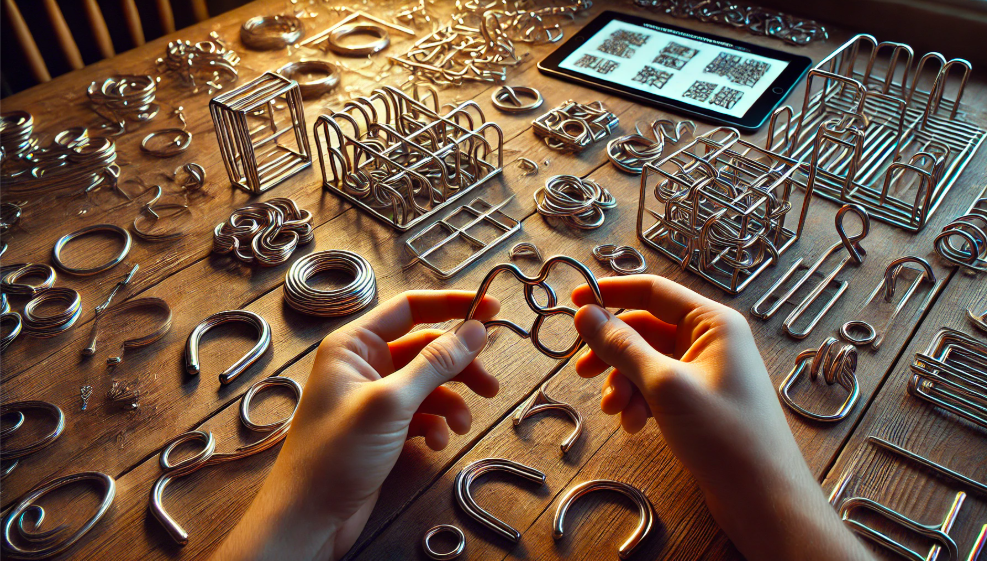
Metal wire disentanglement puzzles are a type of mechanical brain-teaser made of interlocked metal pieces that you must separate without bending or breaking them. People enjoy metal wire puzzles not only for the entertainment but also for the mental exercise they provide. Solving these puzzles is a satisfying process that tests your problem-solving and concentration.
In working through a tricky puzzle, you practice logical thinking and spatial reasoning, and you learn to stay calm and persistent. In fact, metal puzzles are known to enhance critical thinking, improve spatial awareness, and foster patience in those who play with them. This is an example of exploring different puzzle materials, as metal presents a unique challenge compared to other puzzle types.
These puzzles have entertained and challenged people for centuries and were even nicknamed “patience puzzles” because solving them demands a great deal of patience. They remain popular today as fun handheld challenges found in many toy and hobby shops.
The appeal lies in their apparent simplicity: at first glance, the parts seem hopelessly stuck together, yet there is always a clever solution that untangles them. The challenge of figuring them out – and the “aha!” moment when the pieces finally come apart – is what makes these puzzles so engaging for a broad range of ages. Exploring different puzzle materials, like metal, adds variety and excitement to the puzzle-solving experience, providing new ways to engage the mind.
How These Puzzles Work: The Basic Concept
Two bent nails interlocked form a classic wire puzzle. Despite the simple design, they will only come apart with the correct twist and alignment, illustrating the basic concept of disentanglement puzzles.
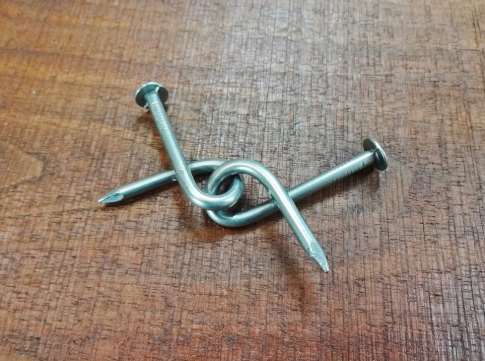
Metal wire puzzles usually consist of two or more pieces of rigid metal (wires, rods, or similar) that are ingeniously intertwined. Common forms include loops, rings, hooks, or bent nails that appear permanently stuck together. The goal is to disentangle these pieces by manipulating them through the openings and around curves in just the right way. For example, a simple puzzle might use two U-shaped nails hooked together; the gap where each nail crosses itself is narrower than the nail’s thickness, yet with the right rotation and positioning, one nail can pass through the other without any force. In all cases, the trick is to find a sequence of moves that frees the parts withoutbending, forcing, or otherwise altering the metal. Even if the pieces have only small gaps or odd shapes, there is a solution path that lets them slide apart cleanly. This basic concept – moving one piece through or around another in a specific way – underpins every metal wire disentanglement puzzle.
Types Of Metal Wire Disentanglement Puzzles
Metal wire puzzles come in a variety of types, each with a unique structure and challenge. Here are a few of the main categories and what they involve:
- Loop-and-Ring Puzzles:These puzzles feature one or more solid loops of wire and a ring that is trapped on them. The classic objective is to remove the ring from the loop. The ring might have to be threaded through a series of turns in the wire. For instance, a simple loop-and-ring puzzle might have a ring that must be navigated off a figure-eight shaped loop. The challenge is to find the one pathway that lets the ring slip free while all other moves seem blocked.
- Horseshoe Puzzles:A horseshoe puzzle is a traditional design in which two metal U-shapes (resembling horseshoes) are joined by a short chain, with a ring trapped between them. At first, the ring looks impossible to remove from the linked horseshoes. However, by angling and crossing the horseshoes just so, the ring can be cleverly worked off. This type was popular in old taverns as a trick puzzle and remains a favorite example – once you know the secret, you can remove and replace the ring at will, amazing onlookers.
- Twisted Wire Puzzles:These involve two or more metal pieces that are twisted or bent into shapes that interlock. A famous example is the bent nails puzzle, which uses two identical bent nails hooked together. Although the nails are plain metal pieces, they are curved in such a way that they won’t separate unless one nail is rotated and aligned exactly through the gap of the other. Many twisted wire puzzles use abstract shapes (like two S-shaped or heart-shaped pieces) that must be turned and flipped in a precise sequence to come apart. The pieces often look like they shouldn’t be able to separate at all, making this type especially perplexing.
Each type of puzzle provides a slightly different kind of challenge, but all of them require patience and a bit of insight to solve. Whether you’re freeing a ring, unlinking horseshoes, or untwisting nails, the key is understanding how the pieces can move relative to each other despite being intertwined.
Beginner-Level Puzzle Solutions And Tips
For beginners, it helps to learn a few core techniques that apply to many metal disentanglement puzzles. Unlike puzzles that rely on luck, these require deliberate movements. Here are some fundamental tips for solving basic wire puzzles:
- Twisting or Rotating:Gently turn one piece around the other to find an angle that allows them to separate. Often you will need to rotate a loop or hook through a gap. For example, the solution to a simple two-piece puzzle might involve rotating one piece 360 degrees in just the right way, which suddenly lets it slip free. Explore different angles and orientations; a small twist can line up the pieces perfectly for the next move.
- Sliding Movements:Many puzzles require you to slide a ring or loop along a bar or another loop until it reaches an opening where it can be released. Instead of pulling straight apart, think about shifting the pieces. You might have to slidea ring around a bend or along a spiral. In one basic puzzle solution, after a couple of rotations the next step is to simply slide a piece through a gap. This illustrates that a straightforward sliding motion, done at the correct stage, can free the trapped piece.
Remember, never use forceon a metal wire puzzle – pieces should move freely when you have the right idea. If something is stuck, back up a step and try a different approach. In general, start by examining how the pieces are connected and identify any obvious openings. Then, use gentle twists, turns, and slides to maneuver one piece through another. With practice, you’ll start recognizing common moves and will solve beginner puzzles more quickly.
Solving Intermediate Wire Puzzles: What To Try
Mid-level disentanglement puzzles often have more complex entanglements or additional parts, and it’s common to get stuck at certain points. Here are strategies to tackle intermediate wire puzzles when they become frustrating:
- Break It Down – One Piece at a Time:Intermediate puzzles might involve multiple rings or loops. A good strategy is to focus on freeing just one part first instead of trying to solve everything at once. By concentrating on a single loop or section, you simplify the problem. For example, if there are two rings tangled on a wire frame, work on releasing one ring completely before dealing with the second. Solving puzzles step-by-step like this makes it easier to see progress and prevents the pieces from all moving at once in confusing ways.
- Look for Patterns or Symmetry:Take a close look at the puzzle’s design. Many puzzles are symmetrical or have repeating elements, and recognizing that can be a big clue. If the puzzle looks the same on the left and right, the solution might involve doing the same moves on each side or bringing two identical pieces into the same position. Observing the shapes and how they relate (for instance, two rings attached in a similar way) can reveal a pattern in the moves needed. A symmetrical puzzle often “undoes” symmetrically as well – meaning once you figure out how to free one side, you apply the same method to the other.
When you get stuck, it also helps to gently retrace your steps and try a different path. Intermediate puzzles sometimes have a particular sequence of moves; missing one of them can leave you at a dead end. Stay patient and methodical: adjust one piece at a time, and watch how it affects the rest. With a bit of experimentation, you’ll uncover the correct sequence. Every puzzle has a logical solution, so keep testing different small moves and observing the result – eventually the tangle will begin to loosen.
Advanced Puzzle Solutions: Think Outside The Box
Difficult metal wire puzzles can be fiendishly complex and may require truly creative thinking to solve. With advanced puzzles, the usual approaches might not work, and you often have to find an unexpectedmove or sequence. In fact, solving these brain-teasers often pushes you to think “outside the box,” looking for non-obvious maneuvers or hidden interactions between pieces. For example, an expert-level puzzle might require you to thread a piece through a very tight spot or to make a counter-intuitive move that seems to make the tangle worse before it gets better.
One important thing to remember with advanced puzzles is that a wrong move can easily get you even more stuck. In complex designs with many intertwined parts, if you move something incorrectly you might entangle the pieces further or lock another part in place. Therefore, proceed slowly and deliberately. It can help to mentally or physically note each successful step so you can backtrack if needed. Patience is crucial– difficult puzzles might involve dozens of precise steps, and trial-and-error is often part of the process. Don’t be discouraged if it takes many attempts. With practice, you’ll start to spot the subtle tricks these puzzles use, and over time you’ll build the skill to solve them. Each failure teaches you a bit more about how the pieces move. By staying persistent and open-minded in your approach, even the most complex wire puzzle can eventually be unraveled. (And for an extra challenge, remember that once it’s apart, you can try to put it back together – reassembling a tough puzzle can be just as demanding as taking it apart.
Common Mistakes When Solving Wire Puzzles
When tackling wire disentanglement puzzles, beginners and even experienced solvers can fall into some common traps. Being aware of these mistakes can save you time and frustration:
- Using Force Instead of Finesse:A frequent mistake is trying to forcethe pieces apart by pulling or bending them. Not only can brute force damage the puzzle, it also defeats the purpose of the challenge. These puzzles are designed to be solved without strength – if you find yourself yanking on the pieces, take a step back. Forcing it might make the metal bend or warp, which can create sharp edges or make the puzzle unsolvable. Always use gentle movements; if the pieces don’t slide with moderate effort, the move is likely not correct.
- Skipping Key Moves (Rushing the Solution):Solving disentanglement puzzles is a step-by-step process. Another mistake is jumping ahead or skipping a step because you thinkyou’re close to the end. For instance, you might try to pull the final piece free before fully untangling the others. Skipping moves usually leads to a situation where nothing moves at all. Every puzzle has a specific sequence of actions needed, and ignoring one can leave you stuck or force you to start over. The remedy is to be methodical – ensure each loop or ring is completely free in the correct order. Don’t rush to the finish without setting up the pieces properly first.
- Overthinking the Problem:It’s possible to go in the opposite direction and over-complicate your approach. Some puzzlers get stuck because they assume the solution must be extremely complex, when sometimes it’s actually quite straightforward. Remember that appearances can be deceiving– a puzzle that looks impossible might have a very elegant, simple solution. Overthinking can cause you to miss the obvious. If you find yourself devising very elaborate maneuvers, take a moment to re-examine the basics. Often, trying a simple, direct move you haven’t attempted yet is the key. In short, don’t let an intimidating look trick you into overly convoluted solutions; try the simple ideas too.
Avoiding these mistakes comes down to patience and keeping a clear head. Solve puzzles gently and step by step. When you feel frustration building (the urge to squeeze or pull things hard), it’s often best to take a short break and return with fresh eyes. With a calm, careful approach, you’ll sidestep these common errors and enjoy the solving process much more.
Safety Tips While Handling Metal Puzzles
Metal wire puzzles are generally safe to handle, but it’s important to use them properly to avoid injury or damage. Keep these safety tips in mind:
- Watch for Sharp Edges:Before you start, quickly check the puzzle for any sharp ends or points. Quality metal puzzles usually have smooth or rounded edges for safety. If a wire end is rough or becomes bent out of shape, it could scratch or cut you. In such cases, handle that area carefully (or gently sand it down if you’re able). Always hold the puzzle by its sturdy parts, not by any thin, sharp tips.
- Don’t Force or Bend the Pieces:As mentioned, you should never apply excessive force to these puzzles. Apart from spoiling the fun, forcing pieces can cause the metal to snap or fling apart suddenly. A broken piece might have a sharp edge that can cut your fingers. You also don’t want bits of metal flying toward your face or eyes. Solve the puzzle with a light touch – if it isn’t coming apart easily, assume there’s a safer, intended method rather than pushing harder.
- Keep Puzzles Away from Young Children (unless supervised):Many metal disentanglement puzzles contain small parts or rings that could be a choking hazard. They are generally labeled for ages 6 or 7 and up. If you have a complicated or tiny puzzle, it’s best to keep it out of reach of toddlers and young kids. Even for older children, make sure an adult is around to guide them. Kids might be tempted to force the puzzle or put pieces in their mouth, so supervision is important. By following the age recommendations and supervising play, you ensure that everyone enjoys the puzzle safely.
Benefits Of Solving Disentanglement Puzzles
Working on metal wire puzzles isn’t just an entertaining pastime – it also comes with several cognitive and even physical benefits. Here are some of the advantages you can gain from solving these puzzles:
- Improved Focus and Concentration:Solving a puzzle requires you to concentrate on the task at hand, which can train your mind to focus better. Many enthusiasts find that while they are maneuvering the pieces, they enter a state of deep concentration and tune out distractions. This puzzle-induced focus is almost like a form of meditation, helping you practice sustained attention on a problem. Over time, this can carry over to improving your focus in other activities as well.
- Stress Relief:Tackling a disentanglement puzzle can be a great stress reliever. As you engage with the physical pieces and channel your mental energy into solving the puzzle, everyday worries tend to recede. Research or anecdotal evidence suggests that concentrating on such brain-teasers allows one to take a break from stressors and enjoy a relaxing challenge. There is a satisfying sense of accomplishment and relief once you finally solve the puzzle, which can boost your mood. In short, puzzles offer a fun escape and can reduce anxiety while you play.
- Better Problem-Solving Skills:These puzzles are essentially practical problems you solve with logic and creativity. Each new wire puzzle you attempt encourages you to think analytically – you’ll analyze how the pieces could possibly come apart, test hypotheses, and learn from each attempt. This kind of logical reasoning and “trial and error” learning strengthens your general problem-solving abilities. You may find that after tackling many puzzles, you become more adept at approaching complex problems methodically. Disentanglement puzzles also sometimes require a bit of creative thinking or an unconventional approach, which can improve your ability to think outside the box when faced with puzzles or problems in everyday life.
- Enhanced Hand-Eye Coordination and Dexterity:Manipulating small metal pieces helps refine your motor skills. You need a steady hand and careful coordination between what you see and how you move the pieces to solve these puzzles. For instance, threading a ring through a loop at just the right angle exercises fine motor control. Over time, playing with wire puzzles can improve your hand-eye coordination and finger dexterity. Some puzzles even strengthen the fingers – one product based on an ancient design notes that it “strengthens finger muscles” as you work through it. This makes disentanglement puzzles a gentle and enjoyable way to keep your hands and brain nimble.
- Patience and Perseverance:Perhaps one of the greatest benefits of disentanglement puzzles is how they cultivate patience. It’s common to spend many minutes (or even hours for very hard puzzles) trying different solutions before finding the right one. This process teaches you to stay calm and persistent even when a solution isn’t immediately obvious. You learn not to give up easily and to approach challenges with a level head. The patience developed while working slowly through a tough puzzle can carry over into other aspects of life – you might find yourself less frustrated by difficult tasks because you’re used to methodically chipping away at problems. Sticking with a puzzle until the end also builds perseverance and confidence, reinforcing the idea that steady effort can eventually solve most problems
❓ FAQs (Only Questions – No Answers)
What Are The Easiest Metal Disentanglement Puzzles To Start With?
The easiest metal disentanglement puzzles for beginners are usually the Bent Nails Puzzleand the Horseshoe and Ring Puzzle. These puzzles use simple shapes and only require a few basic moves like twisting and sliding. The Bent Nails Puzzle has two identical curved nails that can be separated with the right rotation. The Horseshoe Puzzle involves removing a ring from between two U-shaped pieces connected by a chain. Both are great for learning how wire puzzles work and help build problem-solving skills without being too frustrating.
Why Can’t I Solve A Metal Wire Puzzle Even With Instructions?
Sometimes a metal wire puzzle is still hard to solve even with instructions because the solution often depends on precise angles and hand movements. If the pieces are not aligned exactly right, the puzzle won’t come apart. Also, small details in the instructions can be misunderstood or skipped, especially if the puzzle has a tight fit or hidden step. Some puzzles also look simple but need careful handling and patience to perform the correct moves smoothly. Even a small mistake in position can block the entire solution.
Are There Any Tools To Help Solve Metal Wire Puzzles?
Yes, there are helpful tools for solving metal wire puzzles, but they are mostly visual guidesrather than physical tools. The most useful ones are solution videos on platforms like YouTube, where each step is shown clearly. Some puzzles come with printed diagrams or instruction booklets. Puzzle forums also help, as users often share hints and photos. Physical tools like pliers are not recommended, as puzzles are designed to be solved by hand without force. The best “tool” is a clear view, steady hands, and patience.
How Long Does It Take To Solve A Wire Disentanglement Puzzle?
The time it takes to solve a wire disentanglement puzzle depends on the puzzle’s difficulty and the solver’s experience. Easy puzzles can take a few minutes, while harder ones might need 30 minutes or more. Some advanced puzzles may even take hours if the correct moves are hard to find. New players usually take longer because they are still learning how to handle the pieces and spot key movements. With practice, solving time becomes shorter. Puzzle makers like Hanayama and Brainwright also rate their puzzles by difficulty to help match time expectations.
Jump to
How These Puzzles Work: The Basic Concept
Types Of Metal Wire Disentanglement Puzzles
Beginner-Level Puzzle Solutions And Tips
Solving Intermediate Wire Puzzles: What To Try
Advanced Puzzle Solutions: Think Outside The Box
Common Mistakes When Solving Wire Puzzles
Safety Tips While Handling Metal Puzzles
Benefits Of Solving Disentanglement Puzzles
❓ FAQs (Only Questions – No Answers)
Latest Articles
Popular Articles