17 Powerful Sudoku Techniques For Beginners And Experts
Master sudoku techniques with step-by-step strategies for beginners and advanced players. Solve puzzles faster with proven logic tips.
Mar 04, 202610 Shares9.9K Views
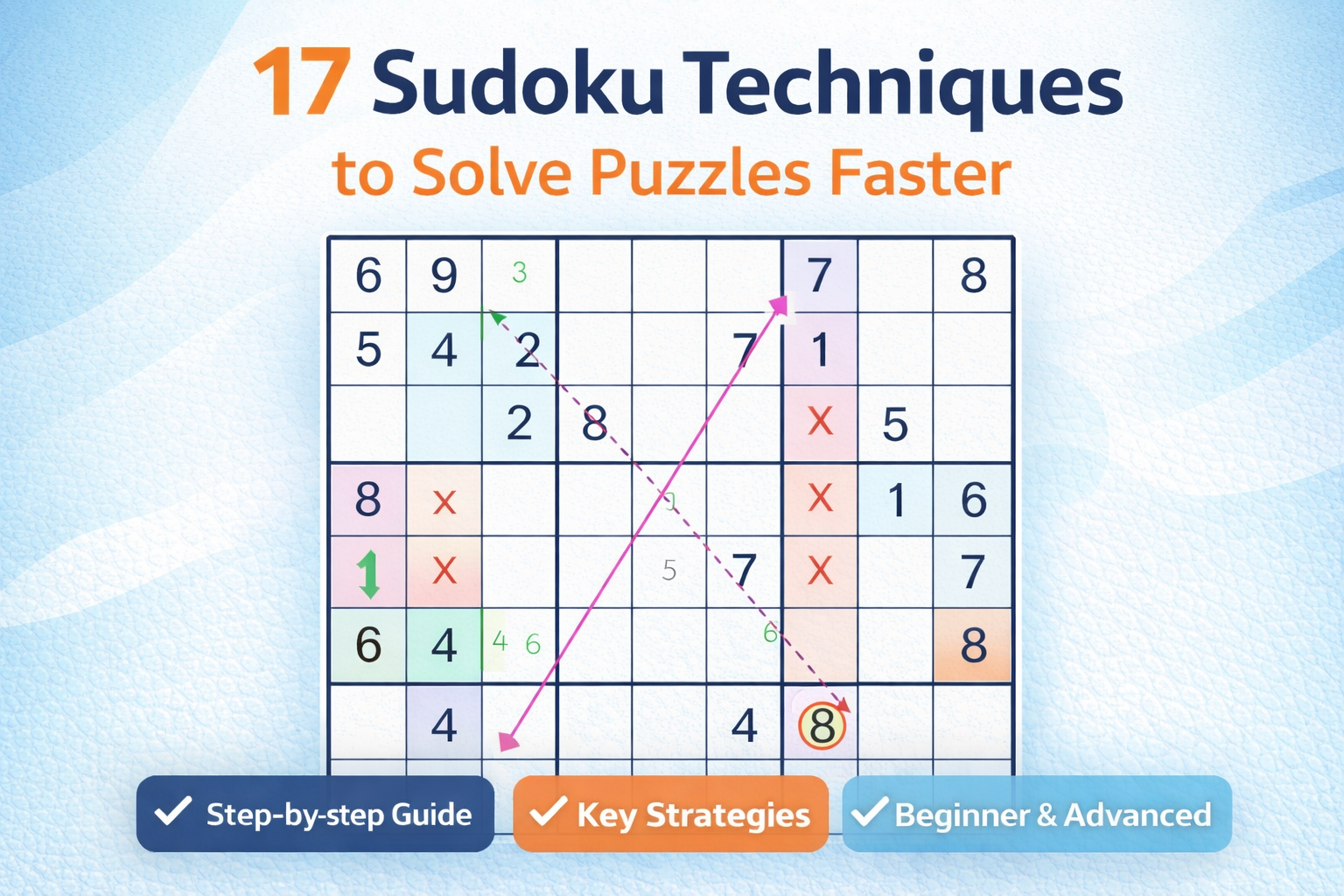
Here's What You'll Learn
- A blank Sudoku gridmay look simple at first just nine rows, nine columns, and a few starting numbers.
- Many players begin by guessing numbers, but puzzles quickly become harder.
Skilled solvers rely on a logical process instead of guessing:
- Scan the grid
- Identify candidates
- Spot patterns
- Eliminate impossible numbers
Master the Logic Behind Sudoku
Sudoku becomes far more enjoyable once you understand the logic behind it. Instead of relying on guesswork, the right techniques help you read the grid, spot patterns, and eliminate possibilities until the correct numbers naturally reveal themselves.
Sudoku Basics: The 9×9 Rules That Power Every Technique
A standard Sudoku puzzle is a 9×9 grid split into nine 3×3 boxes.
Your job is to place digits 1 through 9 so that:
- Each row contains 1–9 exactly once
- Each column contains 1–9 exactly once
- Each 3×3 box contains 1–9 exactly once
Every technique below is just a smarter way to apply these constraints.
Quick terminology (worth learning once)
- Unit: any row, column, or box
- Candidate: a number that could legally go in a cell
- Pencil marks: notes showing candidates (on paper or in “candidate mode”)
The 7-Step Solving Routine
If you want Sudoku tips for beginners that actually work, use this loop.
Step 1:Scan for obvious placements (Singles and Full Houses)
Step 2:Crosshatch boxes for quick wins
Step 3:Add pencil marks only where you’re stuck
Step 4:Run intersection logic (Locked Candidates: pointing and claiming)
Step 5:Apply subsets (pairs, then triples)
Step 6:Apply grid patterns (X-Wing, then Swordfish)
Step 7:If still stuck, use “expert tools” (Y-Wing, Skyscraper, Unique Rectangle, simple coloring)
These routine matters because it prevents two common problems:
- Over-noting too early (candidate clutter)
- Skipping high-frequency techniques and jumping to rare patterns too soon
A "What Should I Try Next?” Table
Use this table mid-puzzle whenever you feel stuck. It’s designed to be more practical than generic technique lists.
| Puzzle situation you see | Best technique to try next (and why) |
| A unit (row/col/box) has one empty cell | Full House - fastest guaranteed placement |
| A cell has only one candidate left | Naked Single - place it immediately |
| A digit can go in only one cell within a unit | Hidden Single - “only spot” logic |
| A box restricts a digit to one row/column | Locked Candidates (Pointing) - eliminate outside the box |
| A row/column restricts a digit to one box | Locked Candidates (Claiming) - eliminate inside that box |
| Two cells share the same two candidates | Naked Pair - remove those candidates elsewhere in the unit |
| Two candidates only appear in two cells | Hidden Pair - clean those two cells down to the pair |
| A candidate forms a 2x2 rectangle across 2 units | X-Wing - eliminate that candidate in shared rows/cols |
| Same idea across 3 rows/cols | Swordfish - the X-Wing “size 3” upgrade |
| X-Wing almost works but columns don’t match | Skyscraper - similar logic when alignment fails |
Important Sudoku Terms
| Term | Meaning |
| Candidate | Possible number for a cell |
| Unit | Row, column, or box |
| House | Another word for unit |
| Subgrid | The 3×3 box |
| Elimination | Removing a candidate |
Sudoku Techniques Summary
Beginner techniques(solve most easy and many medium puzzles)
- Scanning and cross-hatching
- Full House
- Naked Singles and Hidden Singles
- Light pencil marks in stubborn areas
Intermediate techniques(where “real” logic starts)
- Locked Candidates (pointing and claiming)
- Naked Pairs and Hidden Pairs
- Naked/Hidden Triples
Advanced techniques (hard puzzles)
- X-Wing
- Swordfish
- Y-Wing (XY-Wing) as a common next step
Expert tools (when the grid fights back)
- Skyscraper
- Unique Rectangle
- Simple Coloring / Chains
- Forcing chains (powerful, but easy to overuse)
See also: The Role Of Mathematical Puzzle Theory
Beginner Sudoku Techniques
1. The Full House
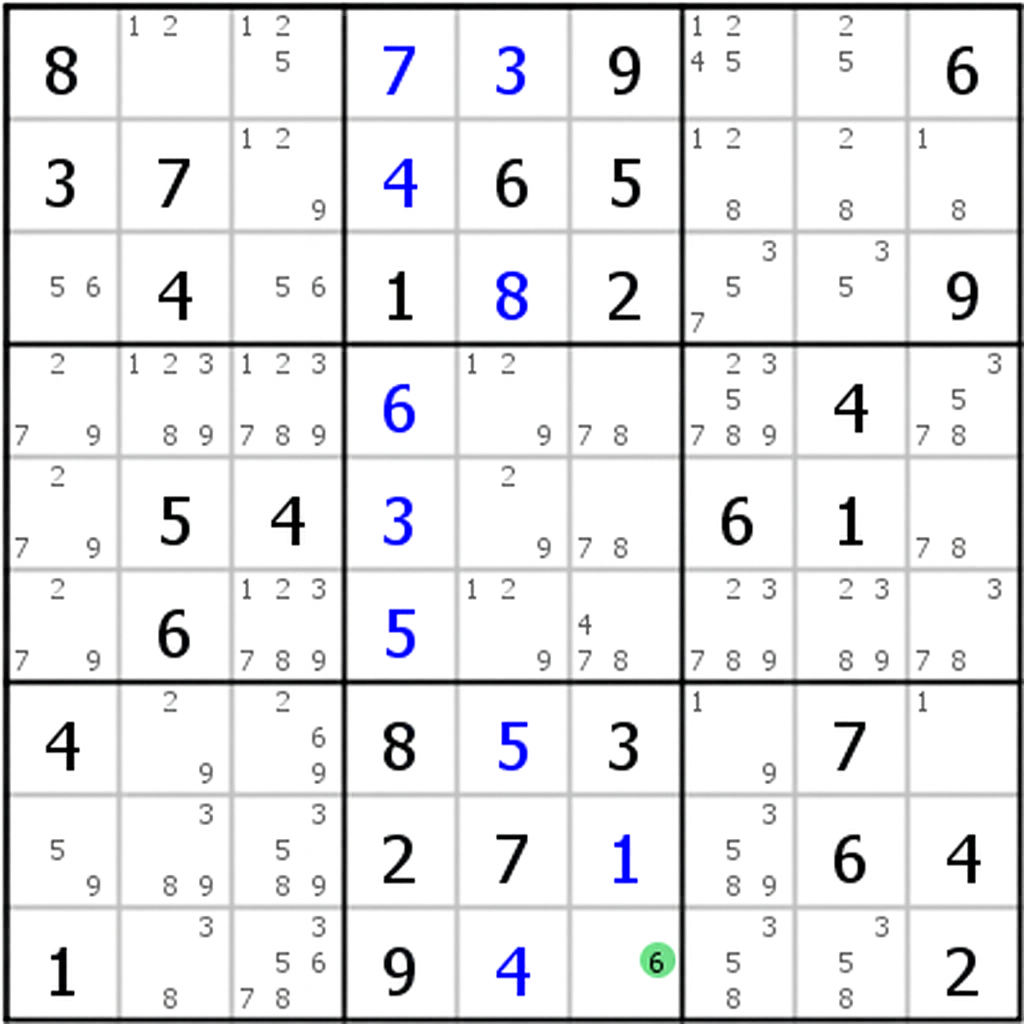
A Full House is when a row, column, or box has exactly one empty cell.
How to spot it
- Count filled digits in a unit
- If you see 8 digits placed, the missing digit is forced
Why it’s powerful
- It’s quick
- It triggers cascades (one placement often creates more singles)
Many technique hubs explicitly include Full House as a core beginner move because it’s so frequent.
2. Scanning
Scanning means checking a unit for missing digits and immediately narrowing possibilities by the intersecting column/row/box.
A strong scanning habit looks like this:
- Scan a row for missing digits
- For each empty cell, check the column and box to eliminate
- Place any forced digit immediately
- Repeat, because every placement changes the board
Mini-example logic (no guessing)
Row contains 1, 2, 4, 6, 7, 9
Missing digits are 3, 5, 8
If a target cell’s column already has 3 and 5 possible elsewhere but blocks 3 and 5 in that cell, then 8 is forced.
Scanning stays relevant at every difficulty level because it’s the engine that finds singles after you make eliminations.
Beginner's Guide to Sudoku: Learn & play today!
3. Cross-Hatching
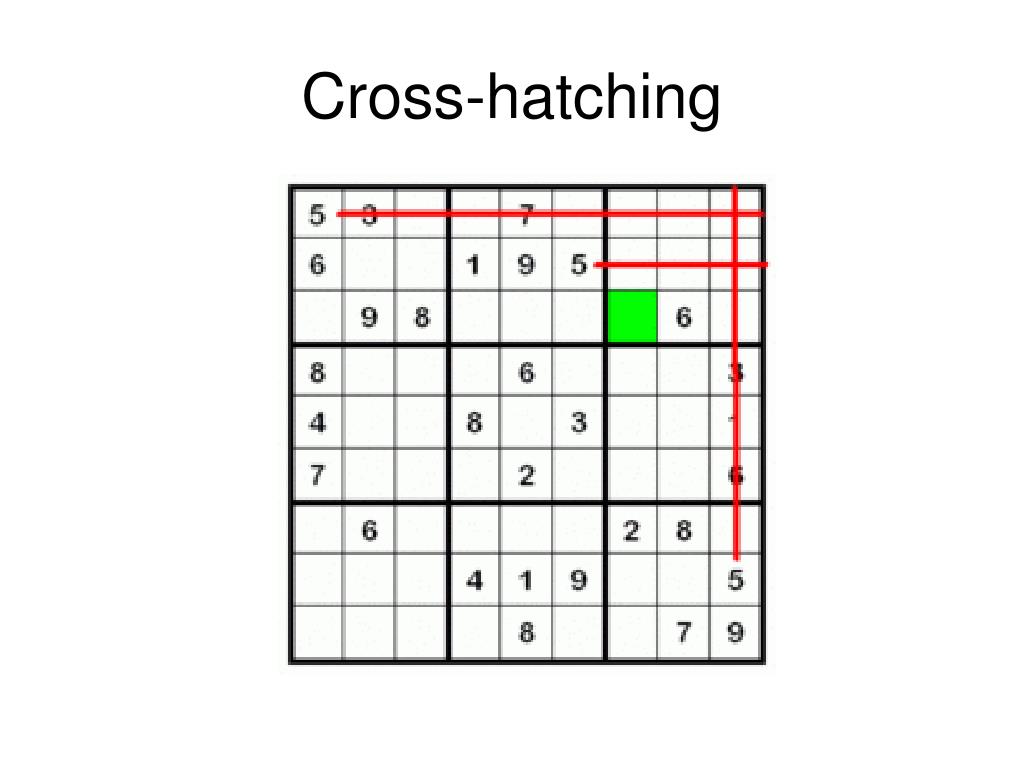
Cross-hatching is scanning from the perspective of a 3×3 box.
How it works
- Pick a digit (say 5)
- In a box, eliminate rows and columns that already contain 5
- The remaining open cells are the only possible placements for 5 in that box
When it shines
- Early stages, when many cells are empty
- When you want fast progress without heavy pencil marking
Cross-hatching is commonly paired with scanning in technique guides because it reduces the “where do I look next?” problem.
4. Pencil Marks
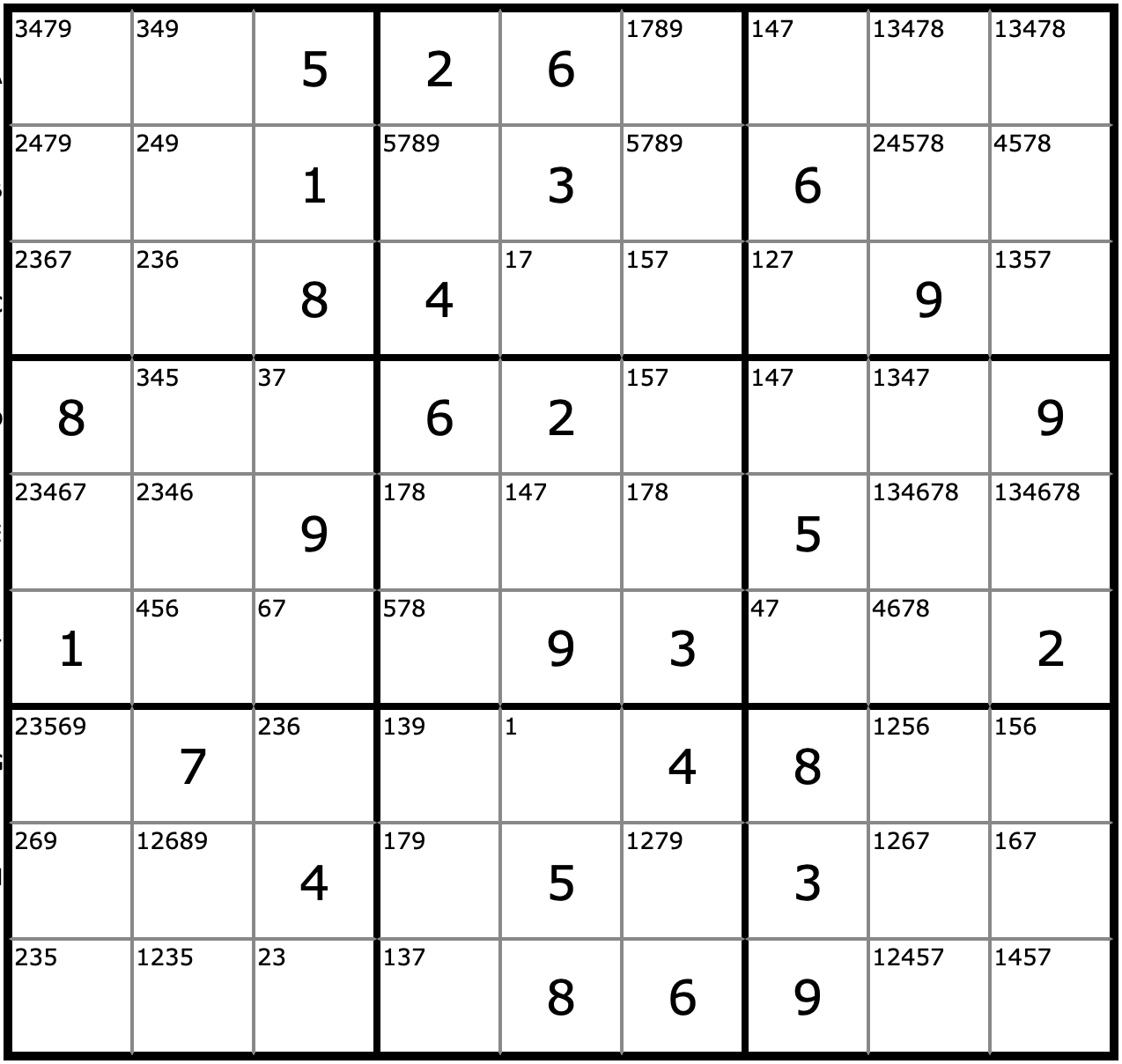
Pencil marks are essential for intermediate and advanced Sudoku, but the real skill is managing candidates cleanly. Conceptis and other technique resources emphasize that pencil marking is systematic and becomes the base for deeper analysis.
Two smart ways to use candidates
Method A:Minimal marking (faster, less clutter)
- Only note candidates in difficult areas
- Use scanning until progress stops
- Then add notes only where uncertainty is blocking you
Method B:Full marking (better for advanced patterns)
- Fill candidates across the grid
- Necessary for patterns like X-Wing and Swordfish, where you must see exact candidate counts
Candidate hygiene rules that prevent mistakes
- After every placement, re-check the row/column/box and remove impossible candidates
- If you eliminate a candidate, ask “what does that unlock?” and scan for singles
- Don’t keep stale notes. Old candidates are a common reason solver “need to guess”
5. Naked Single
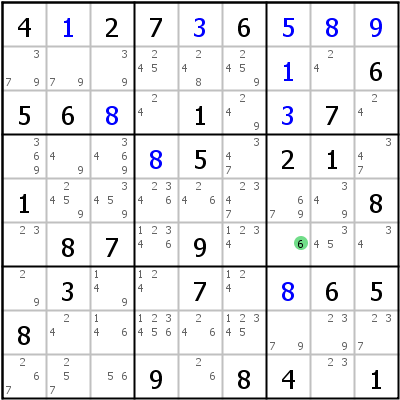
A cell is a naked single when it has only one candidate left.
Spot it
Your notes show a single number in the cell
Do it
Place the digit immediately
6. Hidden Single
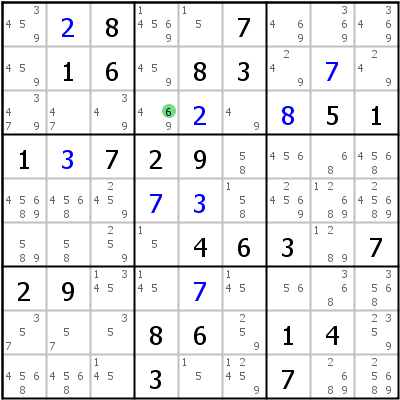
A digit is a hidden single when, within a unit, that digit can only fit in one cell (even if that cell has multiple candidates).
Spot it
- Scan a unit for a specific digit
- If only one cell can take it, it’s forced
Do it
Place the digit, then rescan nearby units
Why these matters
Singles are the “payoff” after you use elimination techniques like locked candidates, pairs, and fish. Many advanced solves are just: eliminate → singles appear → repeat.
Intermediate Sudoku Techniques
Locked Candidates: Pointing and Claiming
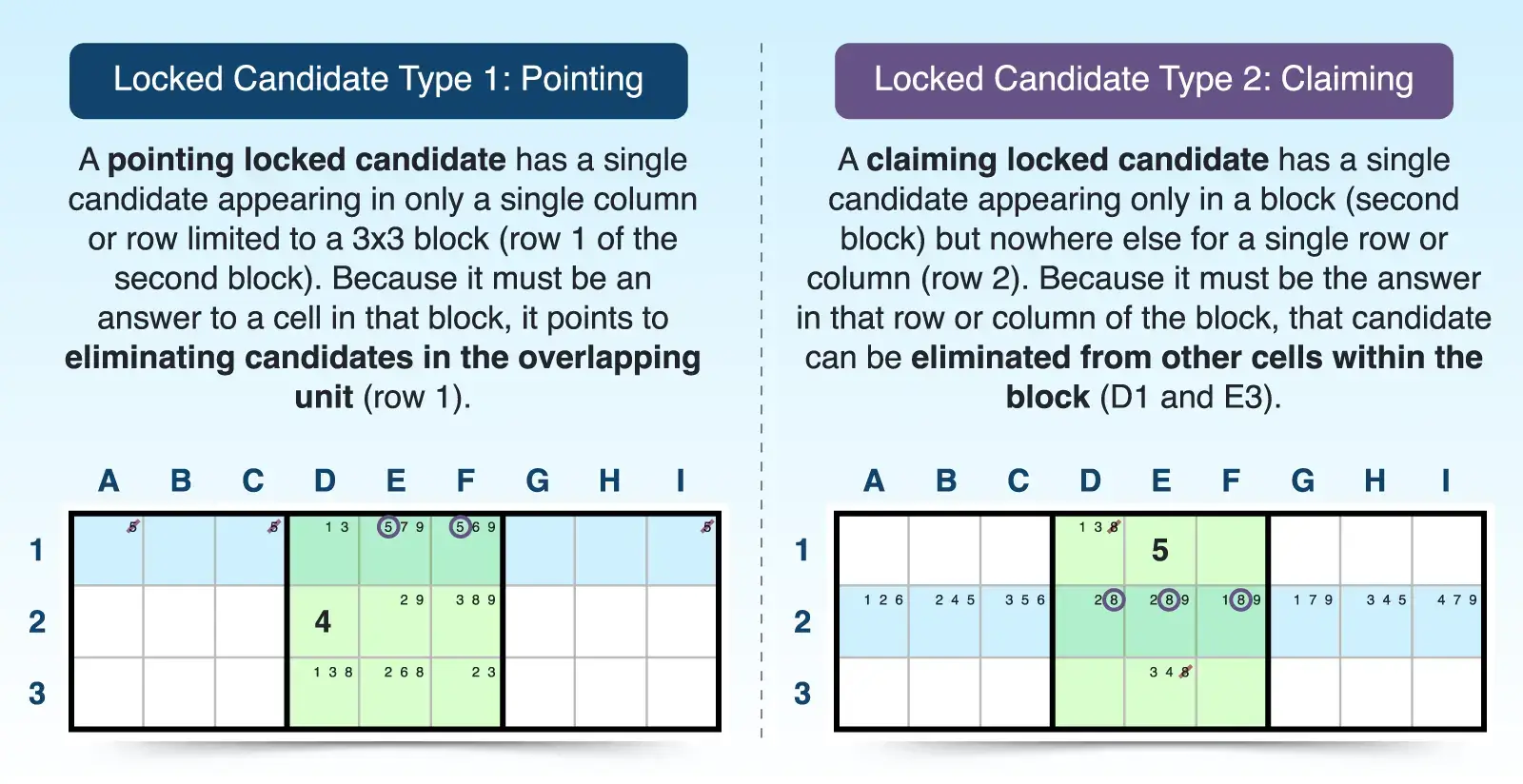
This is the bridge between “easy” and “hard.” It’s also one of the most common places beginners stall because they learn pointing but never learn claiming.
7. Locked Candidates Type 1: Pointing (Box → Line)
Definition
If, inside a box, all candidates for a digit lie in one row (or one column), then that digit cannot appear in that same row (or column) outside the box.
Spot it checklist
- Choose a digit
- In one 3×3 box, that digit’s candidates are confined to a single row or column
- That confinement “points” outward
Action
Remove that digit from the rest of the row/column outside the box
8. Locked Candidates Type 2: Claiming (Line → Box)
Definition
If, in a row (or column), all candidates for a digit fall within a single box, that digit cannot appear elsewhere inside that box.
Spot it checklist
- Choose a digit
- In a row/column, candidate positions are all inside one box
- That row/column “claims” the digit’s placement in that box
Action
Remove that digit from other cells in the box (not on that row/column)
This is where puzzles start feeling like real logic.
9. Naked Pair
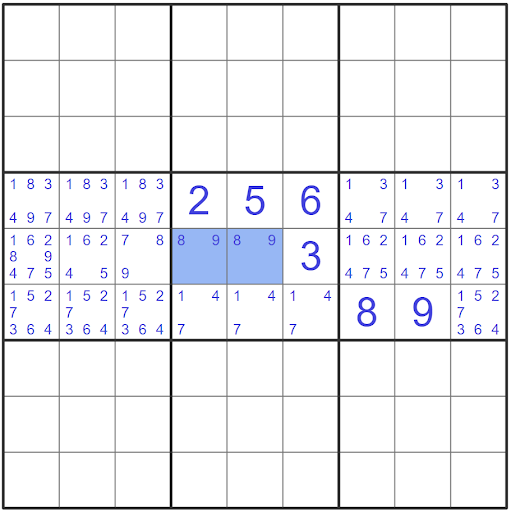
Definition
Two cells in a unit contain the exact same two candidates (and only those two). Those candidates are “locked” into those two cells, so they can be removed from every other cell in the unit.
Spot it
- Same unit
- Two cells
- Same two candidates
- No extra candidates in those two cells
Action
Remove both candidates from all other cells in that unit
10. Hidden Pair
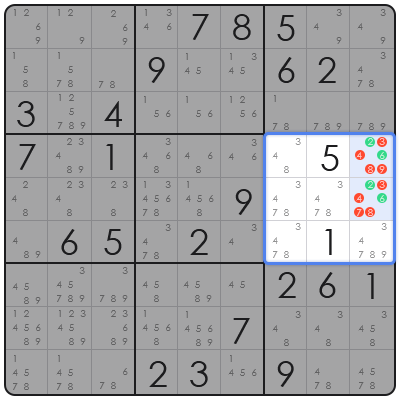
Definition
Two digits appear as candidates in exactly two cells within a unit. Even if those cells have extra candidates, the pair must occupy them, so you delete the extra candidates from those two cells.
Spot it
- Pick a unit
- Find two digits that appear only twice as candidates
- Those two cells might look “messy,” but the pair is hidden there
Action
In those two cells, erase all candidates except the pair
11. Naked Triple and Hidden Triple (short but important)
You don’t need to overcomplicate triples. Use this simple rule:
- Naked triple:Three cells in a unit collectively contain exactly three digits (in any combination like {1,3}, {1,2,3}, {2,3})
- Hidden triple:Three digits appear only in three cells (so you can delete other candidates from those cells)
Triples are common enough in hard puzzles that skipping them often pushes players into unnecessary advanced tactics
Pairs in Sudoku / Everything You NEED to Know! / Tutorial #8
Advanced Sudoku Techniques
12. X-Wing
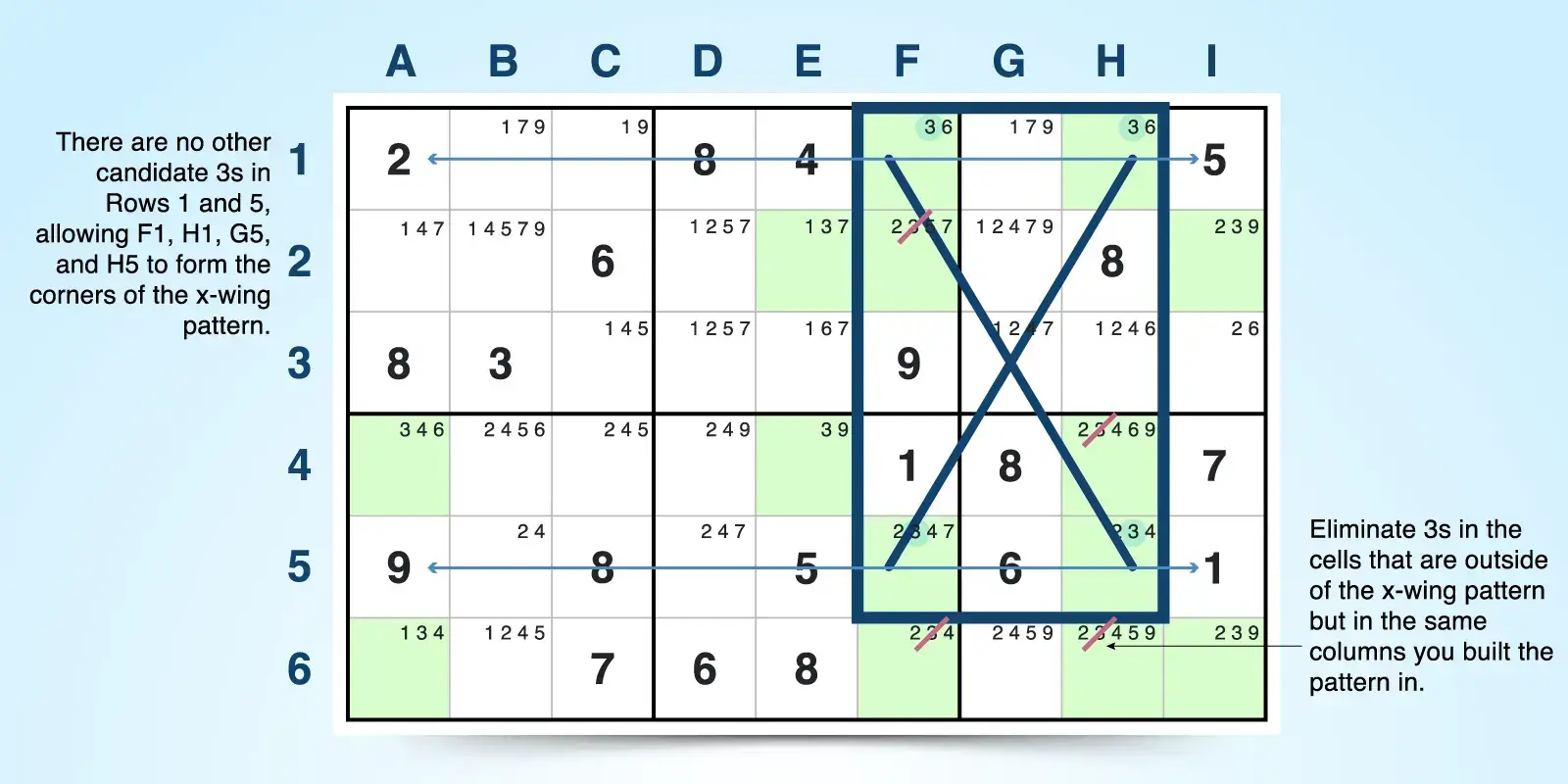
X-Wing is one of the most taught advanced Sudoku techniquesbecause the pattern is strict and the payoff is strong.
Definition
For a chosen digit, you find two rows (or two columns) where that digit appears as a candidate in exactly two positions, and those positions line up in the same two columns (or rows). This forms a rectangle. The digit must go in one of the two positions in each row, so it cannot appear elsewhere in the shared columns/rows.
How to spot it (fast scan method)
- Choose a digit (say 7)
- Scan rows: note rows where 7 appears exactly twice as candidates
- If two such rows share the same two columns, you have an X-Wing (row-based)
- Eliminate 7 from the rest of those two columns
- The same works swapped (column-based X-Wing eliminates from rows)
Common false positive
If the two rows have two candidates but they are not in the same two columns, it is not X-Wing. That “almost” case often becomes Skyscraper (expert toolbox section).
13. Swordfish
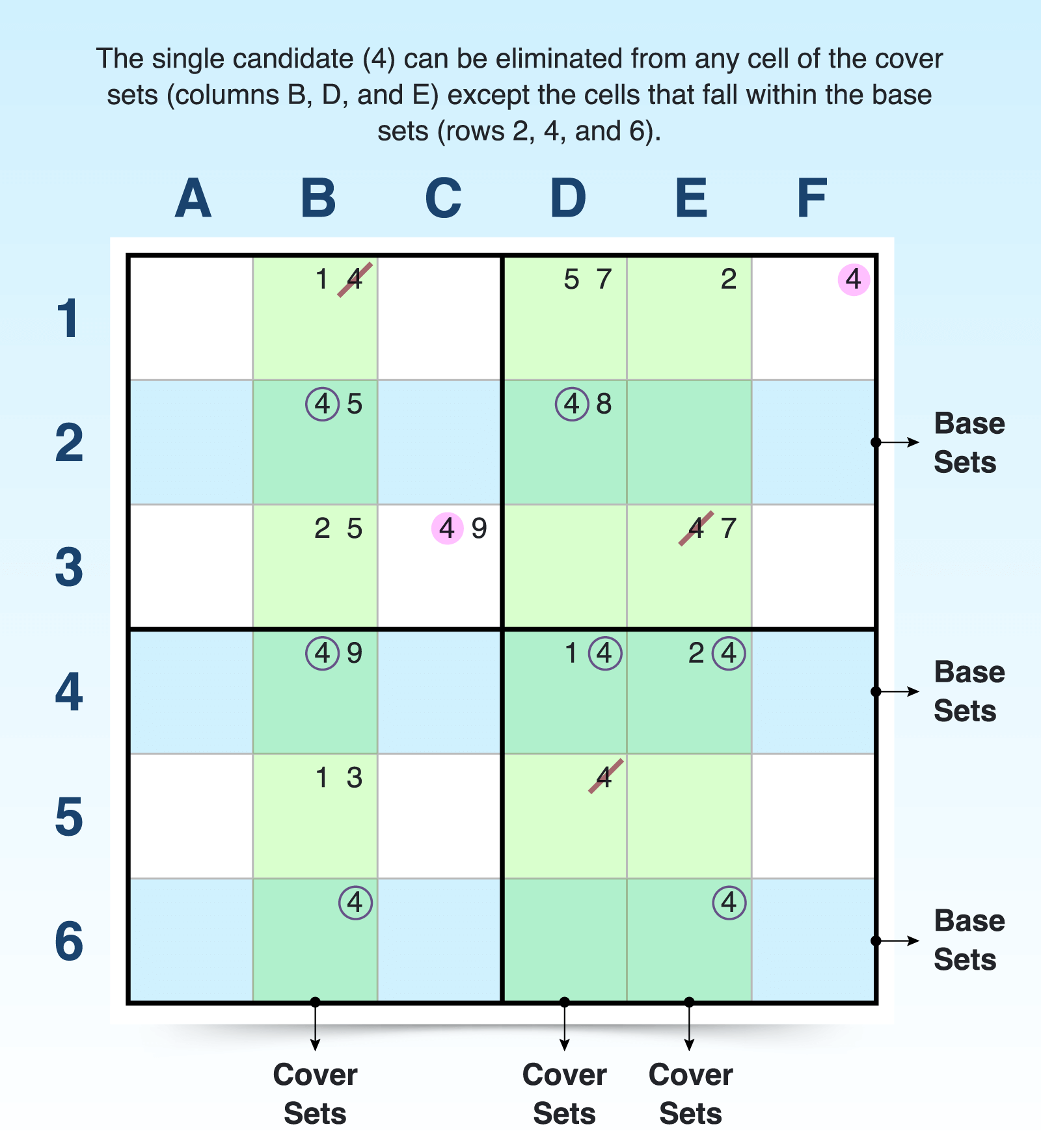
Swordfish is the same idea as X-Wing, but across three rows and three columns. Many advanced strategy guides present it as the next logical step after X-Wing and triples.
Definition
For a chosen digit, you find three rows where that digit appears as a candidate in 2 or 3 positions per row, but all those positions fall within the same three columns (or vice versa). Then you eliminate that digit from the rest of those columns (or rows).
Spot it checklist
- Choose a digit
- Find three rows (or columns) that restrict that digit to the same three columns (or rows)
- Confirm the candidate positions are contained within those three columns/rows
- Eliminate the digit elsewhere in those columns/rows
Why most people struggle with Swordfish
They try to “see it” without reliable candidates. Swordfish is dramatically easier when your pencil marks are complete and up to date.
Expert Sudoku Techniques
14. Y-Wing (XY-Wing)
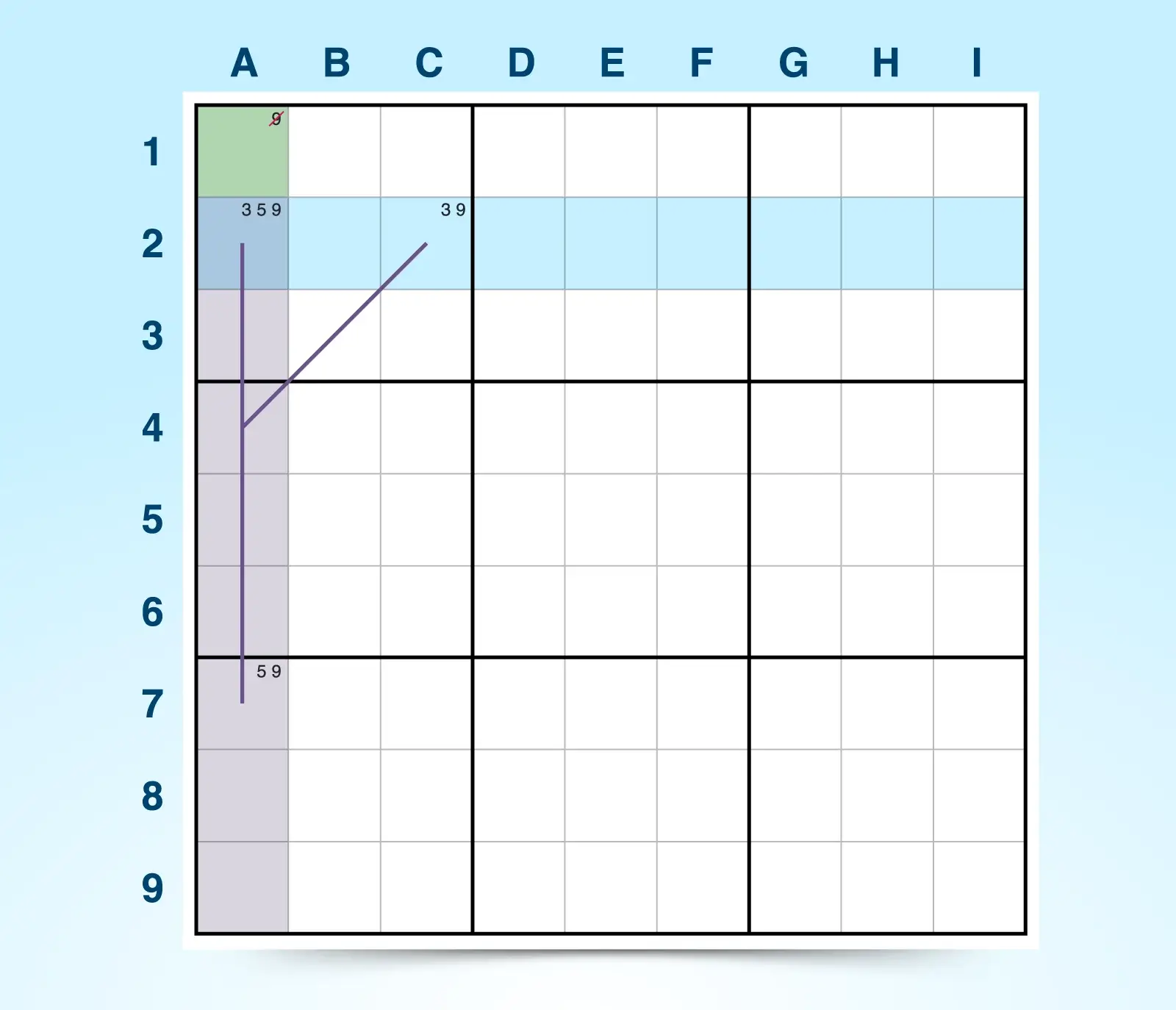
When to try it
- You have several bi-value cells (cells with exactly two candidates)
- You can form a three-cell hinge pattern that allows elimination of a shared candidate
Why it helps
- It often appears before you “need” Swordfish in many hard puzzles
- Many advanced strategy lists include it as a core next step after fish
15. Skyscraper
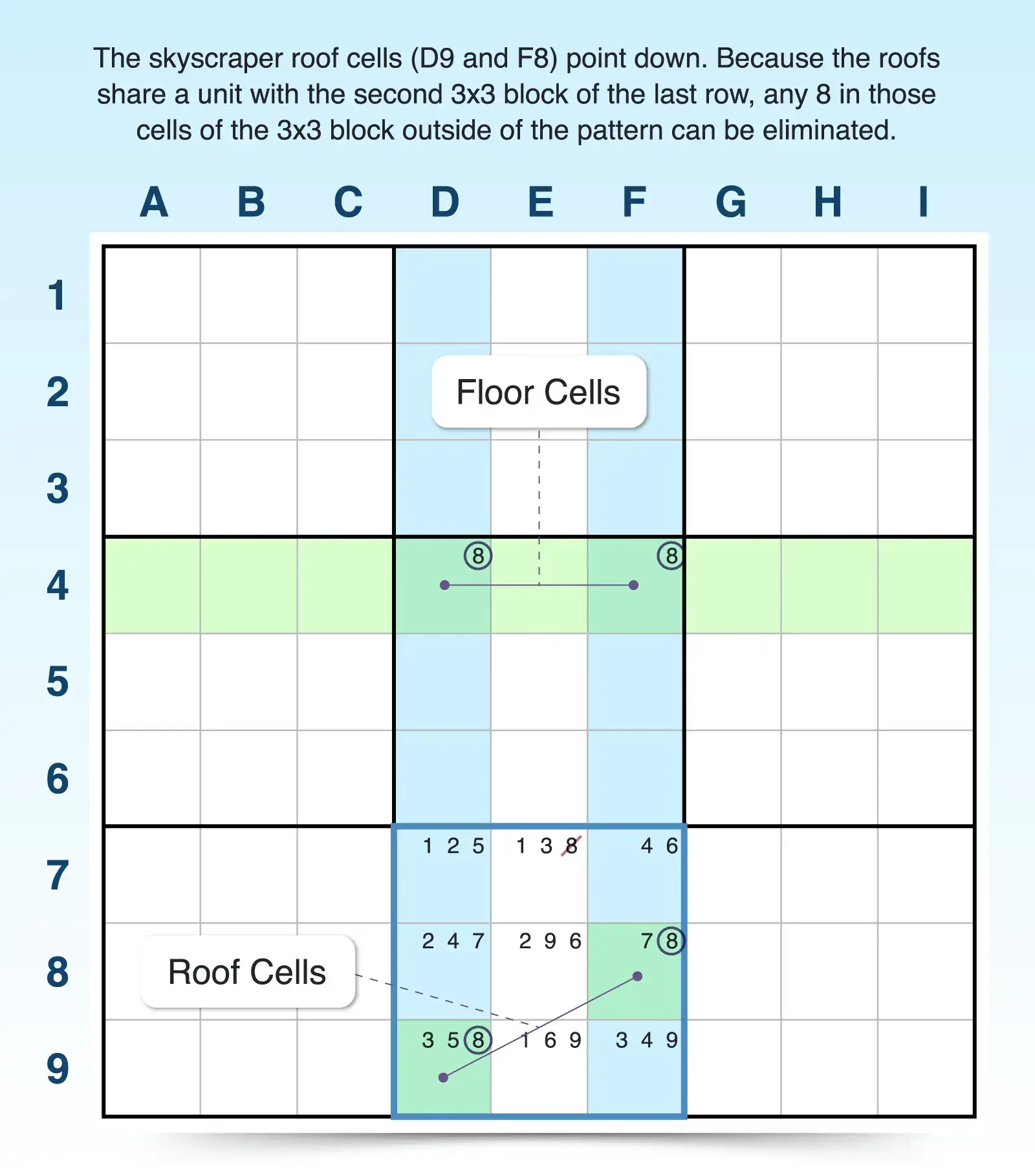
When to try it
- You almost have an X-Wing, but alignment isn’t perfect
- A digit appears twice in two rows, but columns don’t match
- The “roof” connection still enables a logical elimination
16. Unique Rectangle (UR)
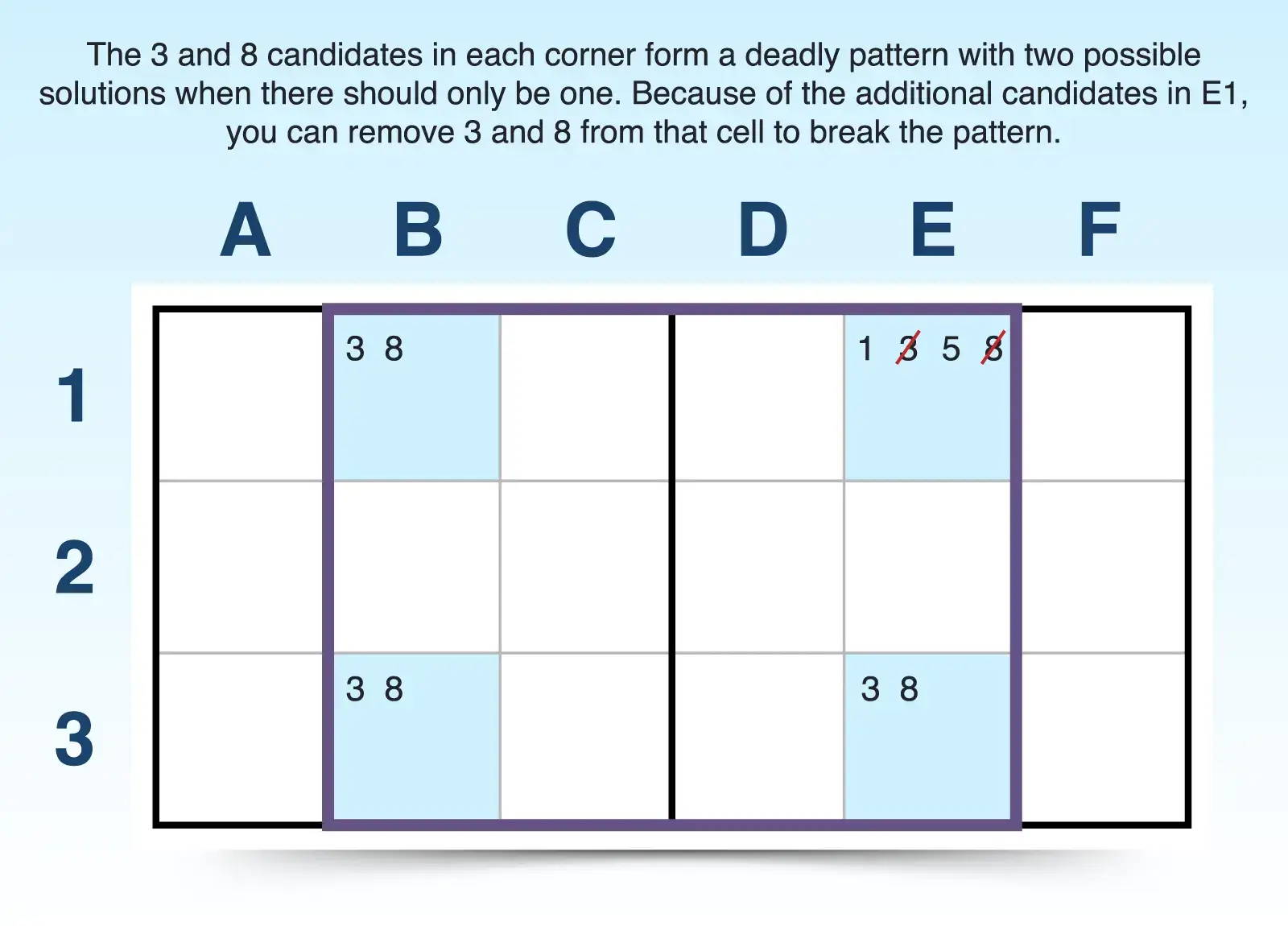
When to try it
- You see a 2×2 rectangle of two candidates that could create two solutions
- Many Sudoku puzzles assume a unique solution; UR uses that assumption to eliminate candidates
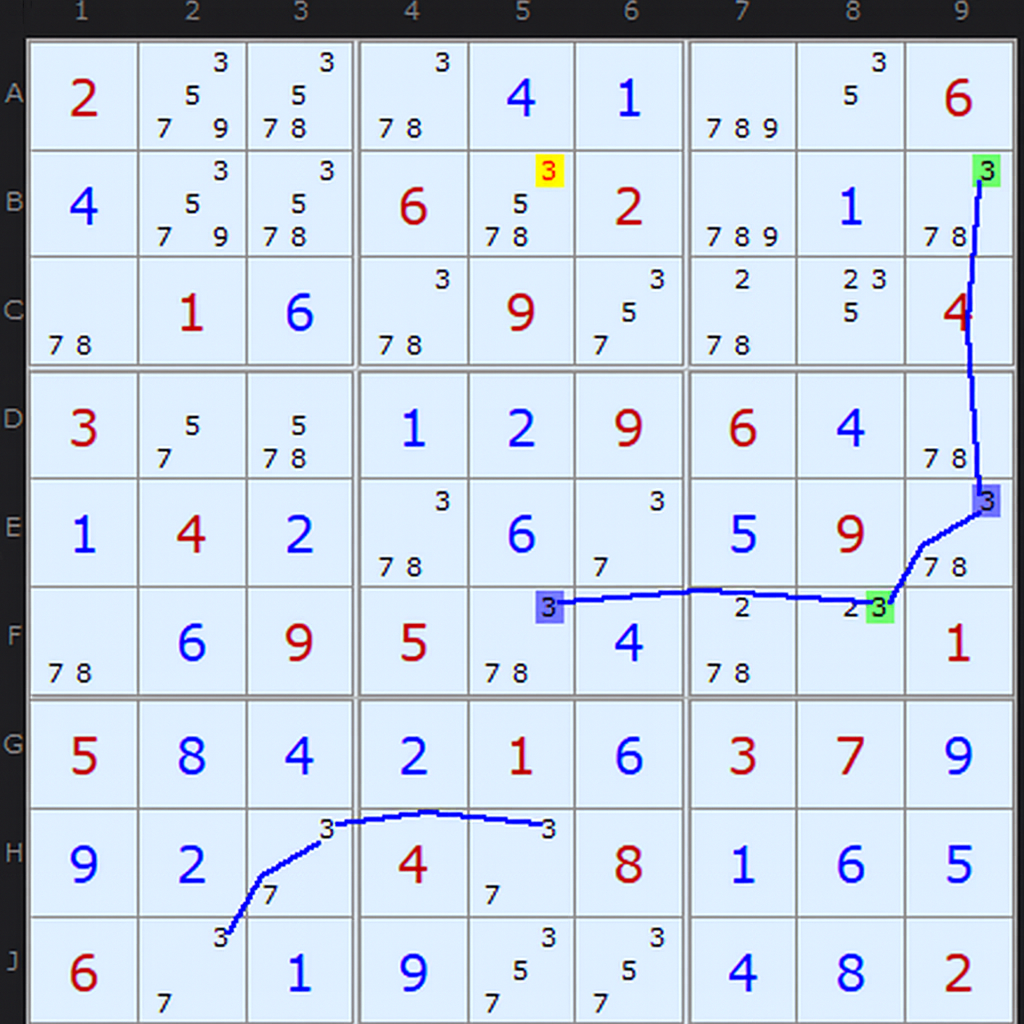
17. Simple Coloring / Chains
When to try it
- Candidates form alternating links (if A is true, B is false, etc.)
- You can color a candidate graph and spot contradictions or forced eliminations
Is Sudoku Good for Your Brain?
Sudoku is a strong mental activity because it forces attention control, working memory (holding candidates and constraints), and pattern recognition.
What research and expert reporting tends to support (carefully stated)
- Studies and reporting often find associations between doing puzzles and better cognitive test performance in older adults, but correlation does not automatically prove puzzles prevent dementia or cognitive decline.
- The practical value is real for many people: it’s a structured challenge, it’s enjoyable, and it can be part of a mentally active routine. Enjoyment matters because consistent engagement beats “perfect” training done once.
How to make Sudoku more “brain-friendly”
- Mix difficulty levels (easy for speed, hard for deeper reasoning)
- Explain your moves out loud or in writing (forces clearer logic)
- Rotate puzzle types sometimes (variety matters more than obsession with one drill)
Common Mistakes When Solving Sudoku
- Guessing too early instead of using logic
- Ignoring pencil marks
- Focusing on one area of the grid too long
- Forgetting to re-scan rows and columns
- Overlooking hidden singles
Frequently Asked Questions about Sudoku techniques
What is the trick to solve the Sudoku?
The best “trick” is a repeatable order of operations: scan for singles, use locked candidates to eliminate, apply pairs and triples, then move to X-Wing and Swordfish only when candidates are clear. This keeps you out of guesswork and makes hard puzzles feel systematic.
How to solve 9×9 Sudoku?
Solve it unit by unit. Start with scanning rows, columns, and boxes to place full houses and singles. If progress stops, add candidates, then apply locked candidates and pairs to create eliminations. Advanced patterns like X-Wing and Swordfish appear most reliably only after accurate pencil marks.
What is the hardest Sudoku technique to learn?
Strategies like Swordfish, coloring chains, and advanced pattern techniques tend to challenge new players. These methods require strong candidate tracking and logical visualization.
How to solve Sudoku easily for beginners?
Start with scanning and cross-hatching and prioritize singles and full houses before writing lots of pencil marks. When you do use notes, keep them clean and updated. Most beginner frustration comes from stale candidates and skipping the easy wins that appear after each placement.
What is the difference between beginner and advanced Sudoku techniques?
Beginner techniques are mostly direct placement (singles, scanning, cross-hatching). Advanced techniques are mostly elimination patterns (locked candidates, pairs/triples, fish, wings, rectangles, and chains) that create new singles indirectly.
Final Thoughts
Sudoku gets dramatically more enjoyable when you stop “trying numbers” and start running logic like a checklist. Each technique in this article has one job: either place a digit with certainty or eliminate candidates in a way that forces the next placement.
If you want the fastest improvement, focus on the middle layer most players miss: candidate hygiene, locked candidates (both pointing and claiming), and pairs. Once those are automatic, X-Wing and Swordfish stop feeling mystical and start feeling like just another clean elimination that leads to more singles.
Jump to
Here's What You'll Learn
Master the Logic Behind Sudoku
Sudoku Basics: The 9×9 Rules That Power Every Technique
The 7-Step Solving Routine
A "What Should I Try Next?” Table
Important Sudoku Terms
Sudoku Techniques Summary
Beginner Sudoku Techniques
Intermediate Sudoku Techniques
Advanced Sudoku Techniques
Expert Sudoku Techniques
Is Sudoku Good for Your Brain?
Common Mistakes When Solving Sudoku
Frequently Asked Questions about Sudoku techniques
Final Thoughts
Latest Articles
Popular Articles